

Telecoms, Datacoms, Wireless, IoT


Miniature GPS receiver

6 February 2013 Telecoms, Datacoms, Wireless, IoT

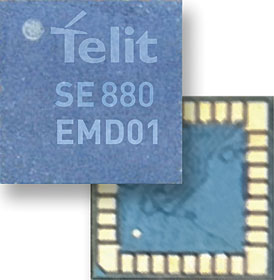
Telit Wireless Solutions recently rolled out the Jupiter SE880 GPS receiver module for applications in the commercial, industrial and consumer segments including wearable and handheld devices.

The 4,7 x 4,7 mm LGA (land grid array), SiRFstarIV-based device employs advanced 3D component embedding technology and was conceived to shorten time to market by reportedly allowing integrators to attain a working SE880-based design in as little as a week versus several months when starting from a chipset reference design.

The module includes all components necessary for a fully functioning receiver design, requiring only a 32 kHz external crystal for its time base and TCXO to complete the design, along with antenna, power and data connections adequate to the integrator’s needs.

For advanced designs incorporating the supported Satellite Based Augmentation System (SBAS), ephemeris data collected from the satellites can be stored to SPI Flash memory instead of the more common and expensive EEPROM alternative.

Responsible for delivering very high sensitivity, the Jupiter SE880’s RF front-end employs spatially calibrated waveguide-quality radio paths inside the three-dimensional space of its architecture to mitigate the parasitic impedances characteristic of traditional 2D RF designs.

Inside, a multi-filter system includes not only the traditional SAW filters typical in GPS receiver designs but also a 2,4 GHz notch filter capable of nullifying the jamming effects of high-energy radio devices such as Wi-Fi hotspots, Bluetooth systems, cordless phones and others, which greatly affect a GPS receiver’s ability to resolve timid satellite signals in the hostile radio environment where they need to operate.

Jupiter SE880 is a single-constellation GPS product enhanced for maximum sensitivity which makes it capable of achievements such as a one-satellite acquisition of UTC (typically four are required); fix acquisition with minimal sky visibility - indoors, garages, urban canyons, etc; and much lower TTFF under standard operating conditions (as much as 200 seconds quicker from cold start).

In its micro-power standby mode, the module draws 50 to 500 μA making it extremely battery friendly. It can produce a first fix in a few seconds when waking from a few hours of standby and less than 10 seconds when waking from a full day of standby, making it ideal for wearable and personal digital device applications.

Other distinguishing features of the SE880 include an extended operating temperature range wherein noise-versus-gain performance is linearly balanced throughout the range with high sensitivity stability particularly at the extremes of -40°C and +85°C – critical for applications such as sports watches and OEM automotive navigation systems.

Six-Sigma quality assurance processes employed in producing the Jupiter SE880 significantly increase manufacturing yields for the integrator’s end-product. That is due to a number of factors including the product’s higher tolerance to satellite signal variances input to its RF front end (less than 1 dB part to part variation versus a more typical tolerance range of 3 dB); and other maladies introduced by the end-manufacturing process.




Share this article:
Share via emailShare via LinkedInPrint this page

Further reading:

Sigfox SA powers smart connectivity
Editor's Choice Telecoms, Datacoms, Wireless, IoT
Sigfox South Africa is carving out a unique role, delivering low-power, wide-area network connectivity designed specifically for Internet of Things applications.

Read more...
Modern LTE connectivity for IoT
Otto Wireless Solutions Telecoms, Datacoms, Wireless, IoT
Designed to meet the evolving requirements of industrial and commercial applications, the SIMCom A7681E LTE Cat-1bis module combines simplified hardware architecture with long lifecycle support in a compact package.

Read more...
Seeing through the noise
RF Design Editor's Choice Telecoms, Datacoms, Wireless, IoT
How Adaptive Long Coherent Integration (ALCI) delivers superior measurement and positioning performance where conventional receivers fall short.

Read more...
Optical Ethernet connectivity for rugged environments
Hiconnex Telecoms, Datacoms, Wireless, IoT
The rugged Stratos T2 Series media converter maintains high data throughput and durability in mission-critical applications in security, tactical, and military communications.

Read more...
Next-gen SPE
Altron Arrow Telecoms, Datacoms, Wireless, IoT
Next-generation 100/1000BASE-T1 Single Pair Ethernet PHYs integrate MACsec security, time sensitive networking, and functional safety.

Read more...
LTE migration for legacy devices
iCorp Technologies Telecoms, Datacoms, Wireless, IoT
Quectel’s EG800Q-GL offers a low-cost upgrade path from 2G communication for legacy M2M devices and payment terminals.

Read more...
Contactless IO-Link without wear
IOT Electronics Telecoms, Datacoms, Wireless, IoT
Phoenix Contact’s IO-Link couplers transmit up to 18 W of power and IO-Link data at speeds of up to 230,4 kbps across an air gap.

Read more...
High-power RF amplifier design best practices
RFiber Solutions Telecoms, Datacoms, Wireless, IoT
By focusing on practical design considerations and planning for real-world conditions, engineers can build amplifiers that perform consistently and remain reliable over time.

Read more...
Bluetooth Classic and LE Audio module
RF Design Telecoms, Datacoms, Wireless, IoT
Refresh legacy Bluetooth designs and unlock Bluetooth Core 6.0 LE Audio in one rugged, ready to implement module.

Read more...
HackRF Pro targets advanced RF
IOT Electronics Telecoms, Datacoms, Wireless, IoT
The SDR can operate across an extensive frequency range from 100 kHz to 6 GHz, making it suitable for a broad range of applications, including wireless testing, signal analysis, and emerging communications technologies.

Read more...


While every effort has been made to ensure the accuracy of the information contained herein, the publisher and its agents cannot be held responsible for any errors contained, or any loss incurred as a result. Articles published do not necessarily reflect the views of the publishers. The editor reserves the right to alter or cut copy. Articles submitted are deemed to have been cleared for publication. Advertisements and company contact details are published as provided by the advertiser. Technews Publishing (Pty) Ltd cannot be held responsible for the accuracy or veracity of supplied material.


© Technews Publishing (Pty) Ltd | All Rights Reserved