


More and more manufacturers of electronic components and circuit boards are turning to the use of non-contact temperature measurement to meet increasing productivity demands.
Thermal behaviour can be captured and optimised through the use of modern infrared (IR) measurement devices, without influencing the measured object.
Infrared cameras are used for accurate thermal analysis at the electronic component level. This is particularly applicable, for example, in cases where not only one critical component exists or the component cannot be clearly identified. Weak points in these cases can be localised by the camera through the analysis of thermal images.
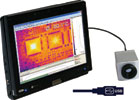
Detailed real-time analysis of the thermal behaviour of assembled circuit boards, used in the R&D field or for serial production, can be achieved with the assistance of an IR thermal imager. A standard USB2.0 interface is included in Optris imagers which allows video recording of 120 Hz. This is advantageous for spurious thermal activity which needs to be analysed in slow motion afterwards.
Analysis takes place via efficient software which allows alarms to be defined and displayed, in addition to maximum, minimum and average temperatures. Besides the recording function, the software also offers the possibility to store snapshots.
The Optris PI160 thermal imager consists of 160 x 120, or 19 200, miniature detectors in a matrix on a single chip. This uncooled microbolometer focal plane array (FPA) detector experiences a change in resistance proportional to aborbed heat radiation. A fast 14-bit analog-to-digital converter measures the resulting voltage drop, after which digital signal processing calculates the temperature for each pixel and generates a colour image in real time.
Adjustments to measurement distances and areas are achieved through the combination of the micro bolometer FPA detector and a high-performance optic. Thermal characteristics of objects as small as 50 μm are detectable thanks to the detector’s tiny pixels. The temperature of anything from a size of 0,5 mm can be measured precisely, and thermal sensitivity of 0,08 K allows the display of fine temperature details.
No camera required
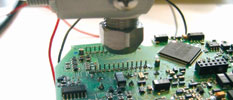
With high production volumes and a large number of test stations, the use of infrared cameras can become too expensive. Temperature monitoring with infrared thermometers is thus a good alternative for series production control of critical components within production facilities.
Critical components which are consistently placed in identical positions on printed circuit boards can be monitored via the Optris CT LT infrared temperature sensor. The measurement result is then forwarded to the test station for decision making.
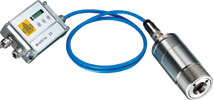
Miniaturised IR thermometer for permanent control
Modern production technology not only enables cost reductions within the manufacturing process, it also opens up multiple uses for infrared thermometers within equipment. The Optris CT LT can be used for practical applications such as the checking of assembled circuit boards.
It is one of the smallest of its kind, consisting of a miniature infrared sensing head (14 x 28 mm) and a separate control box. It measures temperature with a linear output covering the complete temperature range from -50°C to 975°C. The small size of the sensing head allows implementation in cramped surroundings and is therefore particularly suitable for test stations with very little spare space.
The sensing head comes in a stainless steel housing (IP65) which is robust and intended for use in temperatures up to 180°C without additional cooling. A high-resolution optic with a distance-to-measurement-point ratio of 22:1 provides a flexible choice regarding the installation point within the test station. An additional feature is the possibility to measure spot sizes down to 0,6 mm thanks to a small ancillary lens.
The measured temperature signal of the circuit board is made available to the operator via linear 0-20 mA, 4-20 mA, 0-10 V or thermocouple outputs.
A control panel with LCD display can be used to choose the signal processing method as well as parameter adjustment at the assembly area.
Programming can take place through a USB or RS-232 interface, supported by a PC or laptop computer. Addressable interfaces are also available, including RS-485, CAN-Bus, Profibus DP, Ethernet and alarm relays.
| Tel: | +27 10 595 1831 |
| Email: | sales@instrotech.co.za |
| www: | www.instrotech.co.za |
| Articles: | More information and articles about Instrotech |






© Technews Publishing (Pty) Ltd | All Rights Reserved
 printer friendly version