4 November 2015Manufacturing / Production Technology, Hardware & Services
Electrolube will use the pending productronica expo in Munich as a platform to showcase enhancements to two of its most successful thermal management products to provide superior properties across a greater range of applications.
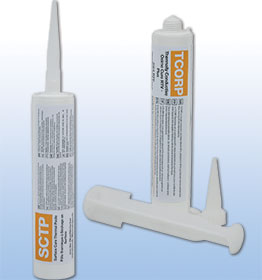
TCORP – Thermally Conductive RTV Plus TCORP is a superior version of the company’s TCOR single-component, low-odour, room temperature vulcanisation (RTV) silicone, which cures upon exposure to atmospheric moisture (oxime-cure). The thermal conductivity of the new formulation has been increased from
1,8 W/m.K (TCOR) to 2,20 W/m.K (TCORP).
TCORP is ideal for gap filling around components and power resistors to dissipate excess heat via heatsinks, and is very effective at preventing overheating and premature component failures. It is a multi-use product, as it can be used both as a sealant or gasketing compound, as well as a low bond strength thermal adhesive.
TCORP has a wide operating temperature range (-50°C to +230°C), making it a suitable contender for harsh automotive under-hood applications. It is an ideal solution when thermal conductivity is a critical requirement for an application.
SCTP – Surface-Cure Thermal Paste
SCTP is a highly effective and efficient thermal interface material, designed to fill gaps that naturally exist between two metal surfaces placed one upon the other, dramatically improving the effective range of surface area for heat transfer.
One of the key properties of SCTP is that it does not set, remaining malleable when rework of components is required. The product is specifically designed to resist pump-out of the thermal interface layer from the bond line, ensuring minimal degradation of effective heat dissipation. It is especially suited to applications that are exposed to rapid and frequent changes in temperature, as such conditions are known to exaggerate the pump-out effect of standard thermal pastes. SCTP also has excellent thermal stability, resisting up to 200°C.
While the material can be applied using conventional industrial dispensing equipment, it can also be applied via screen/stencil printing directly onto the contact surfaces. In addition, SCTP does not contain any solvents and due to its ease of application, it is possible to apply very thin films, thus minimising the effects of thermal resistance at the interface and offering much greater stability over the lifetime of the device when compared to conventional heat transfer systems.
High precision in-line conformal coating inspection system MyKay Tronics
Manufacturing / Production Technology, Hardware & Services
Conformal coating is widely used to protect electronics from moisture or other environmental hazards. It is critical to know if coatings are properly applied; covering what is meant to be covered and not covering what should be exposed.
Read more...Rugged spectrum analyser Vepac Electronics
Test & Measurement
The HAROGIC PXR Series is designed for maximum durability and performance in the most demanding environments.
Read more...Soldering day highlights
Manufacturing / Production Technology, Hardware & Services
JAPAN UNIX has published a new event report and highlight video from their UNIX SOLDERING DAY 2026 in Hungary. This event reflects on their commitment to supporting manufacturers not only through soldering automation systems, but also through technical education, live demonstrations, hands-on training, and practical engineering know-how.
Read more...Clearing the Static: Electrostatic Discharge Actum
Manufacturing / Production Technology, Hardware & Services
A cordless ESD (Electrostatic Discharge) wrist strap does not work by grounding the person in the same way as a traditional wired wrist strap. Instead, it works by reducing or balancing the static charge on your body so that you are less likely to discharge electricity into sensitive electronic components.
Read more...Engineering trust in South Africa’s SMT sector ZETECH ONE
Manufacturing / Production Technology, Hardware & Services
From a small Johannesburg start-up to a trusted SMT technology partner, Zetech One has spent four decades helping South African electronics manufacturers improve production quality, efficiency and reliability.
Read more...The new reality of PCB material supply Jemstech
Editor's Choice Manufacturing / Production Technology, Hardware & Services
How resilient manufacturing strategies are helping OEMs navigate a changing global supply chain.
Read more...Streamlining Device Programming with the AutoBee-D1 Vepac Electronics
Manufacturing / Production Technology, Hardware & Services
The AutoBee-D1 desktop automated programmer is designed to simplify the programming of devices, while delivering consistent accuracy, high throughput and reduced manual intervention.
Read more...Zero PFAS die attach paste Testerion
Manufacturing / Production Technology, Hardware & Services
With silver price volatility increasing and sustainability requirements accelerating across semiconductor assembly, MacDermid Alpha Electronics Solutions introduces ATROX CD 560-1, a zero per- and polyfluoroalkyl substance (PFAS) alternate silver filler die attach paste.
Read more...Precision jet printing for advanced PCB designs MyKay Tronics
Manufacturing / Production Technology, Hardware & Services
Mycronic’s BA 01 small dot ejector delivers unmatched precision in solder paste jet printing for advanced PCB designs.
While every effort has been made to ensure the accuracy of the information contained herein, the publisher and its agents cannot be held responsible for any errors contained, or any loss incurred as a result. Articles published do not necessarily reflect the views of the publishers. The editor reserves the right to alter or cut copy. Articles submitted are deemed to have been cleared for publication. Advertisements and company contact details are published as provided by the advertiser. Technews Publishing (Pty) Ltd cannot be held responsible for the accuracy or veracity of supplied material.









 printer friendly version