

Editor's Choice


Will OLED lighting eventually disrupt or fade away?

18 May 2016 Editor's Choice Opto-Electronics

OLED (organic light emitting diode) lighting technology has faced a difficult challenge since its very beginning, in the shape of inorganic LEDs. The challenge was that LED lighting got there first and leveraged its accumulated production experience to improve its performance and to reduce its costs. This in turn created a large gap between the two technologies that shows no signs of narrowing.

The OLED lighting industry generally had a confused commercialisation strategy, while LED incumbents viewed OLED technology as a threat and, as such, invested only to hedge their bets. Some ignored the potential uniqueness of OLED lighting, trapping themselves in the rigid (glass-based) and/or high-power corner of the markets.

Unsurprisingly, all these led to failures and disillusionment. Many simply gave up and now few committed players remain. Most notable amongst them are LG Chem and Konica Minolta. Both are from Asia and both see in OLED lighting a way into the immense prize that is the lighting market.

IDTechEx Research had anticipated these trends and developments in its market research report ‘OLED Lighting Opportunities 2015-2025: Forecasts, Technologies, Players’. It warned about the consolidation, confused commercialisation strategies and also the limited short-term market prospects of OLED lighting technology. Indeed, in 2014, IDTechEx forecast that the market would be smaller than $80 million by 2018 and still believes that this will hold true.
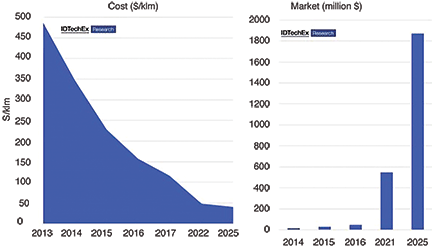
Left: IDTechEx cost projections developed in 2013. Right: Segmented IDTechEx forecast developed in 2013.

The research firm also correctly modelled and anticipated the price evolution of OLED panels, when it anticipated in 2013 that the production cost will reduce to around $200/klm by 2015. This was confirmed when LG Chem announced a very aggressive sales price of $200/klm in mid-2015. IDTechEx’s model enabled it to conclude that the panels were being sold at or below cost in order to stimulate the market.

What does the future hold for OLED lighting?

IDTechEx Research had also forecasted that the OLED lighting market will reach more than $1,8 billion in 2025 at the panel level. It still remains optimistic about the long-term prospects of this technology, because OLED lighting exhibits key characteristics of a disruptive technology: it underperforms and is overpriced when measured on the standard industry figures-of-merit such as lm/W and $/klm; but it can create new markets that value novel figures-of-merit such as large area emission, light weight and flexibility.

IDTechEx Research believes that OLED lighting can exploit these differentiators to cultivate a series of niche markets and use its accumulated industry experience to become good enough in an increasing series of established segments. This process will be helped by two fundamental characteristics of the lighting market: enormous product diversity and importance of aesthetics. This is in contrast to, for example, the photovoltaic market where there is little product diversity, therefore emerging technologies as OPVs find it exceedingly hard to create niches.

Ultimately, however, the future will depend on whether the believers will keep faith through this period of disillusionment.

For more information visit www.idtechex.com


Share this article:
Share via emailShare via LinkedInPrint this page

Further reading:

Designing with PCIe
Spectrum Concepts Editor's Choice Interconnection
PCI Express has become the backbone of modern high-performance systems with each new generation promising higher bandwidth, but that performance comes with a cost.

Read more...
Understanding two key tools for cleaner serial data
Altron Arrow Editor's Choice Analogue, Mixed Signal, LSI
Understanding how pre-emphasis and equalisation works, and when to use one over the other, is critical when designing reliable high-speed systems.

Read more...
Connected without limits: An engineering perspective on Altron Arrow’s wireless ecosystem
Altron Arrow Editor's Choice Design Automation
Wireless connectivity is no longer a supporting technology, but rather, a core design consideration that underpins modern electronic systems across industries.

Read more...
Telemetry powering South Africa’s industry
Interlynx-SA Editor's Choice
As South Africa’s economy evolves, industries are under increasing pressure to improve operational efficiency and cut costs. Telemetry is becoming a vital component of industrial strategy, allowing companies to harness real-time data to optimise processes and reduce waste.

Read more...
From the editor's desk: How electronics and AI are transforming the battlefield
Technews Publishing Editor's Choice
The current war in Iran has highlighted one critical observation: electronic engineers are shaping the future of defence and in modern warfare, superiority is no longer measured in firepower, but rather in processing power.

Read more...
Engineering in a world that cannot assume connectivity
Technews Publishing Editor's Choice News
Across industrial automation, networking, and defence systems, engineers are rediscovering the importance of resilience and autonomy in an increasingly connected world.

Read more...
Designing IoT devices for deterministic LPWAN environments
Editor's Choice Telecoms, Datacoms, Wireless, IoT
Built on Ultra Narrow Band communication technology, the Sigfox network focuses on low power, wide area M2M connectivity rather than maximising data throughput.

Read more...
Driving excellence in electronics manufacturing
Jemstech Editor's Choice Manufacturing / Production Technology, Hardware & Services
Jemstech’s reputation for disciplined execution and client-focused service has earned it strong loyalty from companies operating in demanding industries.

Read more...
In sync with the line
Testerion Editor's Choice Manufacturing / Production Technology, Hardware & Services
In modern SMT lines, stencil printing must meet two requirements at the same time: it has to ensure a reproducible solder paste volume, while adhering to the specified line cycle time.

Read more...
Resilient navigation in warfare: The role of non-GNSS
Etion Create Editor's Choice
Alternative navigation methods are essential for maintaining operational capability when satellite signals are unreliable or unavailable.

Read more...


While every effort has been made to ensure the accuracy of the information contained herein, the publisher and its agents cannot be held responsible for any errors contained, or any loss incurred as a result. Articles published do not necessarily reflect the views of the publishers. The editor reserves the right to alter or cut copy. Articles submitted are deemed to have been cleared for publication. Advertisements and company contact details are published as provided by the advertiser. Technews Publishing (Pty) Ltd cannot be held responsible for the accuracy or veracity of supplied material.


© Technews Publishing (Pty) Ltd | All Rights Reserved

