22 February 2017
Manufacturing / Production Technology, Hardware & Services
Electrolube has released two new phase change thermal management materials that offer high thermal conductivity, low phase change temperatures and low thermal resistance at the interface. Phase change materials are highly suited to the thermal management of electronic assemblies for a number of reasons. They offer efficient thermal transfer, along with enhanced performance with thermal shock cycles and greater thermal protection where temperature spikes can occur, due to their ability to store and release thermal energy (latent heat) during the phase change process.
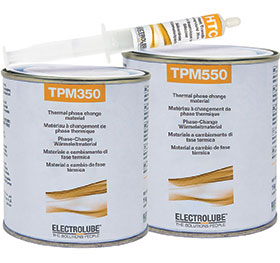
Providing an alternative to traditional thermal greases, once heated above their phase change temperature the new phase change materials become highly thixotropic liquids that perform equally as well as, but often superior to, a thermal grease. The consistency and performance of these new materials avoids possible application and migration problems that can be associated with thermal greases. Electrolube has added two new thermally conductive phase change materials to its thermal management product portfolio: TPM350 and TPM550.
TPM350 has a thermal conductivity of 3,5 W/m.K and becomes workable at approximately 50°C. At this ‘activation’ temperature it changes state to become a lower viscosity material, minimising contact thermal resistance and improving thermal conductivity. Once it cools, it reverts back to its original state. The material’s advanced formulation ensures minimal contact thermal resistance.
TPM550 has a higher thermal conductivity of 5,5 W/m.K and an activation temperature of 45°C. In common with the TPM350 product, TPM550 produces no mess due to its thixotropic characteristics which prevent flow outside of defined interfaces. Both TPM350 and TPM550 can be reworked and their low specific gravity means that more applications can be served per kilogram of the materials, reducing production costs.
The new phase change materials are silicone-free, have an operating temperature range of -40°C to +125°C and are RoHS-2 compliant. They are both screen printable and, while they do contain small amounts of solvent to improve wettability on application, this rapidly evaporates following application to leave the solid phase change material on the substrate.
Weller limited Black Edition soldering station Testerion
Manufacturing / Production Technology, Hardware & Services
Weller’s WE1010 Black Edition Soldering Station is a premium limited-edition soldering station.
Read more...High-voltage X-Ray generators for advanced imaging Vepac Electronics
Opto-Electronics
X-ray has developed a high-performance range of HV generators designed for accuracy, long-term durability, and seamless integration into OEM environments.
Read more...Quick and easy shielding Würth Electronics South Africa
Electronics Technology Manufacturing / Production Technology, Hardware & Services
Würth Elektronik expands its EMC product portfolio with nanocrystalline WE-FNCS sheets.
Read more...Smarter local buying could reboot South Africa’s manufacturing sector
Manufacturing / Production Technology, Hardware & Services
With smarter localisation, clearer procurement rules and a more deliberate industrial strategy, public spending could again become a powerful engine for rebuilding factories, expanding supply chains and restoring confidence in South Africa as a place that makes things.
Read more...Understanding EMI Filters and their applications Vepac Electronics
Passive Components
Electromagnetic Interference (EMI) Filters are essential for maintaining electromagnetic compatibility (EMC), allowing multiple devices to function together without interference.
Read more...Next-Gen Min-ITX motherboard Vepac Electronics
Computer/Embedded Technology
Adding to AAEON’s extensive industrial motherboard portfolio, the Next-Gen MIX-Q870A1 is the company’s most advanced Mini-ITX board to date.
Read more...The effect of seasonal changes on ESD performance in South Africa Actum
Editor's Choice Circuit & System Protection Manufacturing / Production Technology, Hardware & Services
Electrostatic discharge performance is influenced by several environmental factors, with relative humidity being one of the most important. This is particularly relevant in South Africa, where seasonal changes can result in significant differences in humidity levels.
Read more...High precision in-line conformal coating inspection system MyKay Tronics
Manufacturing / Production Technology, Hardware & Services
Conformal coating is widely used to protect electronics from moisture or other environmental hazards. It is critical to know if coatings are properly applied; covering what is meant to be covered and not covering what should be exposed.
Read more...Rugged spectrum analyser Vepac Electronics
Test & Measurement
The HAROGIC PXR Series is designed for maximum durability and performance in the most demanding environments.
Read more...Soldering day highlights
Manufacturing / Production Technology, Hardware & Services
JAPAN UNIX has published a new event report and highlight video from their UNIX SOLDERING DAY 2026 in Hungary. This event reflects on their commitment to supporting manufacturers not only through soldering automation systems, but also through technical education, live demonstrations, hands-on training, and practical engineering know-how.
While every effort has been made to ensure the accuracy of the information contained herein, the publisher and its agents cannot be held responsible for any errors contained, or any loss incurred as a result. Articles published do not necessarily reflect the views of the publishers. The editor reserves the right to alter or cut copy. Articles submitted are deemed to have been cleared for publication. Advertisements and company contact details are published as provided by the advertiser. Technews Publishing (Pty) Ltd cannot be held responsible for the accuracy or veracity of supplied material.









 printer friendly version