Stencil underside cleaning and manual post-cleaning
27 February 2019
Manufacturing / Production Technology, Hardware & Services
Information from kolb.
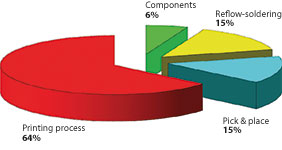
According to experts, between 60 and 70% of all defects and failures during or after the soldering process are attributable to defects in the printing process (Figure 1). In general, these are faulty solder joints, which in turn have their causes in solder paste printing mistakes. Therefore, the stencils used in the assembly process must already be cleaned during the printing process – if not, soldering errors caused by luting and bridges are inevitable.
Figure 1. Approximately 64% of process-related failures are related to deficits in the entire printing process.
Especially in the fine and ultrafine pitch range, many details are no longer visible to the naked eye (a stencil designed for wafer production can easily have more than 300 000 apertures). Microscopic carry-overs cause a noticeable loss of quality or lead to later failures or rework, which can amount to about 25% of the manufacturing costs of an assembly.
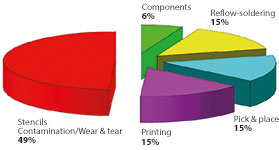
Figure 2. The stencil area alone is responsible for almost half of the total failures.
It is realistic to assume that the failure rate of 15% each during picking-and-placing and soldering would also be of a similar value for the machine printing performance, considering the use of always perfectly new and cleaned stencils. As a reverse conclusion, this means that almost 50% of process-related failures – besides wear and tear – are attributable to poor or inadequate cleaning of the relevant production tools like stencils and squeegees (Figure 2).
In order to ensure a qualified printing process in an SMD screen printer as long as possible before the stencil has to be externally machine cleaned, it is necessary to clean the underside of the stencil from flux residues already inside the screen printer.
In modern screen printers, this usually happens during the process through an automatic bottom cleaning unit, using cleaning fleeces and a suitable ready-to-use detergent. A suitable stencil cleaner for use in screen printers – such as kolb’s WipeEx SA120, which has been specially developed for this purpose – offers qualified and efficient cleaning performance due to the following factors:
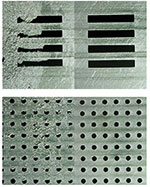
Figure 3. Stencil apertures before and after cleaning with Wipex SA 120.
• Optimal flow and wetting properties
• One-phase (aqueous, stable)
• Cleans SMD paste and SMD glue
• Cleans in contaminated state
• Fast, residue-free evaporation/ drying
• Does not change the viscosity of the adhesive
• Does not cause polymerisation (curing) of the adhesive
• No classification as a dangerous good
• Non-critical flash point (optimal >120°C)
• Biodegradable (92% after 28 days [OECD Test 301A])
• Low odour (with fresh scent)
In certain cases, manual (re)work on the stencils may be necessary; or, when it comes to cleaning squeegees by hand, to avoid carryover here too. For that kolb offers WetWipes, WipeEx’ SA120 impregnated, ready-to-use cleaning wipes with a cleaning fleece especially for stencils with fine apertures, low to no particle delivery, even soaking, and high elasticity/tear strength with high absorption of the medium or paste mixture.
Weller limited Black Edition soldering station Testerion
Manufacturing / Production Technology, Hardware & Services
Weller’s WE1010 Black Edition Soldering Station is a premium limited-edition soldering station.
Read more...Quick and easy shielding Würth Electronics South Africa
Electronics Technology Manufacturing / Production Technology, Hardware & Services
Würth Elektronik expands its EMC product portfolio with nanocrystalline WE-FNCS sheets.
Read more...Smarter local buying could reboot South Africa’s manufacturing sector
Manufacturing / Production Technology, Hardware & Services
With smarter localisation, clearer procurement rules and a more deliberate industrial strategy, public spending could again become a powerful engine for rebuilding factories, expanding supply chains and restoring confidence in South Africa as a place that makes things.
Read more...The effect of seasonal changes on ESD performance in South Africa Actum
Editor's Choice Circuit & System Protection Manufacturing / Production Technology, Hardware & Services
Electrostatic discharge performance is influenced by several environmental factors, with relative humidity being one of the most important. This is particularly relevant in South Africa, where seasonal changes can result in significant differences in humidity levels.
Read more...High precision in-line conformal coating inspection system MyKay Tronics
Manufacturing / Production Technology, Hardware & Services
Conformal coating is widely used to protect electronics from moisture or other environmental hazards. It is critical to know if coatings are properly applied; covering what is meant to be covered and not covering what should be exposed.
Read more...Soldering day highlights
Manufacturing / Production Technology, Hardware & Services
JAPAN UNIX has published a new event report and highlight video from their UNIX SOLDERING DAY 2026 in Hungary. This event reflects on their commitment to supporting manufacturers not only through soldering automation systems, but also through technical education, live demonstrations, hands-on training, and practical engineering know-how.
Read more...Clearing the Static: Electrostatic Discharge Actum
Manufacturing / Production Technology, Hardware & Services
A cordless ESD (Electrostatic Discharge) wrist strap does not work by grounding the person in the same way as a traditional wired wrist strap. Instead, it works by reducing or balancing the static charge on your body so that you are less likely to discharge electricity into sensitive electronic components.
Read more...Engineering trust in South Africa’s SMT sector ZETECH ONE
Manufacturing / Production Technology, Hardware & Services
From a small Johannesburg start-up to a trusted SMT technology partner, Zetech One has spent four decades helping South African electronics manufacturers improve production quality, efficiency and reliability.
Read more...The new reality of PCB material supply Jemstech
Editor's Choice Manufacturing / Production Technology, Hardware & Services
How resilient manufacturing strategies are helping OEMs navigate a changing global supply chain.
Read more...Streamlining Device Programming with the AutoBee-D1 Vepac Electronics
Manufacturing / Production Technology, Hardware & Services
The AutoBee-D1 desktop automated programmer is designed to simplify the programming of devices, while delivering consistent accuracy, high throughput and reduced manual intervention.
While every effort has been made to ensure the accuracy of the information contained herein, the publisher and its agents cannot be held responsible for any errors contained, or any loss incurred as a result. Articles published do not necessarily reflect the views of the publishers. The editor reserves the right to alter or cut copy. Articles submitted are deemed to have been cleared for publication. Advertisements and company contact details are published as provided by the advertiser. Technews Publishing (Pty) Ltd cannot be held responsible for the accuracy or veracity of supplied material.









 printer friendly version