


When discussing noise issues with regards to digital circuit, topics such as transmission line reflection and ground bounce are a few of the primary topics. but generally, digital circuits operate at relatively large signal levels with high noise margins. This makes these types of circuits inherently immune to low level noise pick-up. In the analog domain, where data acquisition is performed, a small amount of external noise can cause significant interference.
Finding the origin and then eliminating interfering noise in the analog domain presents a formidable challenge. Of particular interest is the 'slow' sensor system, where designers are easily tempted to ignore problematic, high frequency, noise issues. This course delves into hardware and firmware noise reduction strategies for signal conditioning paths that have sensors. Noise topics such as conducted noise, device noise and radiated noise will be explored from the analog perspective.
Data acquisition circuit using a loadcell sensor
The example circuit that will be used with this discussion is shown in Figure 1. The analog portion of this circuit consists of the loadcell sensor, a dual operational amplifier (MCP602) configured as an instrumentation amplifier, a 12 bit 100 kHz SAR A/D converter (MCP3201) and two voltage references. The A/D converter digital output is connected directly to a microcontroller SPI port.
The sensor is a 1,2 kOhm, 2 mV/V loadcell with a full-scale load range of ±32 ounces. In this 5 V system, the electrical full-scale output range of the loadcell is ±10 mV. The instrumentation amplifier, consisting of two operational amplifiers (A1 and A2) and five resistors, is configured with a gain of 153 V/V. This gain, matches the full-scale output swing of the instrumentation amplifier block to the full-scale input range of the A/D converter. The SAR A/D converter has an internal input sampling mechanism. With this function, a single sample is taken for each conversion. The microcontroller acquires the data from the SAR converter, performs some calibration and translates the data into a usable format for tasks such as displays or actuator feedback signals.
The transfer function, from sensor to the output of the A/D converter is:
DOUT = ((LCP-LCN)(Gain)
+VREF1)(212/VREF2)
with LCP = VDD (R2/(R1 + R2))
with LCN = VDD (R1/(R1 + R2))
with Gain = (1 + R3/R4 + 2R3/RG)
where LCP and LCN are the positive and negative sensor outputs.
Gain is the gain of the instrumentation amplifier circuit. The instrumentation amplifier is configured using A1 and A2. The gain is adjusted with RG.
VREF1 is a 2,5 V reference which level shifts the instrumentation amplifier output. VREF2 is the 4,096 V reference, which determines the A/D converter input range and LSB size.
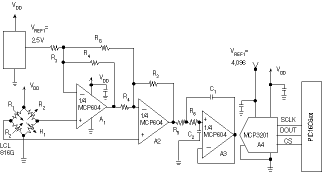
VDD is the power supply voltage and sensor excitation voltage.
DOUT is a decimal representation of the 12 bit digital output code of the A/D converter (rounded to the nearest integer).
If the design of this system is poorly implemented, it could be an excellent candidate for noise problems. The symptom of a poor implementation is an intolerable level of uncertainty with the digital output results from the A/D converter. It is easy to assume that this type of symptom indicates that the last device in the signal chain generates the noise problem. But, in fact, the root cause of poor conversion results could originate with the other active devices or passive components, the PCB layout or even extraneous sources.
For instance, in the worst of circumstances where no noise reduction precautions are taken, the 12 bit system in Figure 1 could output large distribution of code for a DC input signal. An example of this is shown in Figure 2.
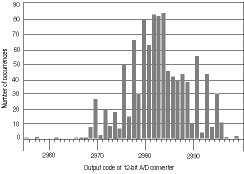
The data shown in Figure 2 is far from optimum. Forty-four bits of peak-to-peak error changes the 12 bit converter system into a noise free 6,5 bit system.
Noise problems can be divided into three sub-categories for discussion and troubleshooting purposes. These three categories are:
* Device noise: Noise that originates in the active or passive devices on the board.
* Conducted noise: Noise that appears on the PCB traces and needs to be addressed at that level. This type of noise originates in devices on the board or as a result of e-fields or b-fields.
* Radiated noise: Noise that is transmitted into the system via e-fields or b-fields.
We will discuss these types of noise in Part II of this article in a subsequent issue of Dataweek.
| Email: | willem.hijbeek@tempetech.co.za |
| www: | |
| Articles: | More information and articles about Tempe Technologies |






© Technews Publishing (Pty) Ltd | All Rights Reserved
 printer friendly version