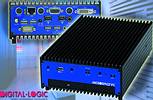
Digital-Logic has developed a 1,6 GHz personal computer without cooling fan for industrial applications. The new Microspace PC40 (MPC40) is based on the company's recently developed smartModule855 Pentium M processor and in addition to its high performance of 1,6 GHz it has a large number of interfaces.
Equipped with a 1 MB L2 cache, the power saving function of the Pentium M processor provides a dynamic CPU-clock adaptation to the application. In the slowest mode (600 MHz), the whole system only consumes a typical power of 12 W. The 'Extreme Graphic' video controller supports the Direct-X9 compatibility with a video memory of up to 64 MB. The video controller has two different video outputs. The MPC40 memory may be expanded to a maximum of 512 MB.
As mass storage a 20 GB hard disk and a DVD/CD drive are used. The hard disk is rubber-cushioned and optimally protected from vibrations.
From idea to intelligent product TRX Electronics
Computer/Embedded Technology
Mouser Electronics has announced a new eBook in collaboration with Arduino – From Blink to Think: How Arduino UNO Q Helps Designers Go from Idea to Intelligent Product.
Read more...Think Diamond Long-life COM-based SBCs Electronic Products Design
Computer/Embedded Technology
A COM-based SBC combines the flexibility of a standard computer-on-module (COM) with a baseboard offering additional I/O, expansion sockets, power supplies, and I/O connectors. The result is a highly flexible, highly expandable, feature-dense product that can be adapted to the widest range of applications, offering maximum product lifetime.
Read more...Next-Gen Min-ITX motherboard Vepac Electronics
Computer/Embedded Technology
Adding to AAEON’s extensive industrial motherboard portfolio, the Next-Gen MIX-Q870A1 is the company’s most advanced Mini-ITX board to date.
Read more...Rev 2.0 PolarFire FPGA ethernet sensor bridge Altron Arrow
Computer/Embedded Technology
Smaller, multi-camera platform enables scalable Ethernet architectures for NVIDIA Edge AI systems, while lowering power, cost and integration complexity.
Read more...Intelligent video processing Rugged Interconnect Technologies
Computer/Embedded Technology
The CHARM150AGX is based on a NVIDIA AGX Orin embedded processor, which incorporates a multicore ARM processor and powerful AI/ML accelerator.
Read more...Nordic expands nRF Cloud with firmware vulnerability scanning RF Design
Computer/Embedded Technology
nRF Cloud identifies vulnerabilities in firmware and shows exactly which deployed devices are affected, empowering device manufacturers to address EU Cyber Resilience Act requirements.
Read more...Arrival of the Epic-PTH9 Vepac Electronics
Computer/Embedded Technology
AAEON introduces the EPIC-PTH9, a compact 4-inch industrial single-board computer powered by Intel Core Ultra Series 3 (formerly Panther Lake) processors.
While every effort has been made to ensure the accuracy of the information contained herein, the publisher and its agents cannot be held responsible for any errors contained, or any loss incurred as a result. Articles published do not necessarily reflect the views of the publishers. The editor reserves the right to alter or cut copy. Articles submitted are deemed to have been cleared for publication. Advertisements and company contact details are published as provided by the advertiser. Technews Publishing (Pty) Ltd cannot be held responsible for the accuracy or veracity of supplied material.









 printer friendly version