Application: loadcell display in a hot area
8 September 2004
Telecoms, Datacoms, Wireless, IoT
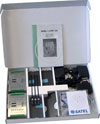
In a smelting operation, the requirement to determine whether the melting ladle that contains the molten steel is empty or not, is crucial to the safety of the plant and the employees. In the process, the ladles are weighed and calibrated to zero at the beginning of each shift, giving the crane operator a weight reading to work with.
Once the ladle has been filled with molten steel and tipped into the mould, the operator can see on the display whether the ladle is totally empty or not. The crane operator needs to know if there is any molten metal still left in the ladle. If the left-over slag is spilled by dropping or bumping the ladle, there could be a catastrophic accident.
The way the system works is as follows: a Satelline 3AS radio modem from Satel was placed on top of the crane and connected to the loadcell via RS485 communication. This radio acts as a transmitter only. The conditions on the crane are very hazardous: the temperature can exceed 200°C, and along with this, molten metal dust erodes and burns almost everything it comes into contact with. To combat these hazards, the 3AS was placed in an anti-vibration and air-cooled box. The receiver is connected to a display panel, which displays the loadcell value. There are three transmitters that transmit to one receiver, which displays each loadcell's value on its own display terminal.
The Satelline 3AS complies with the EN 300 113/EN 300 220 European land mobile standard, EN 301 489 European EMC standard, and the IEC 60950 European safety standard for IT equipment. The Satelline range of products is an ideal solution for harsh environment applications.
Further reading:
Simplifying system design
iCorp Technologies
Telecoms, Datacoms, Wireless, IoT
The FGMC63N tri-band MCU Wi-Fi 6E module from Quectel addresses offers integrated connectivity across 2,4 GHz, 5 GHz, and 6 GHz bands in a compact, highly optimised design.
Read more...
Dragino’s connectivity catalogue
Otto Wireless Solutions
Telecoms, Datacoms, Wireless, IoT
Where Wi-Fi demands frequent charging and covers tens of meters, and traditional cellular consumes too much power for battery-operated nodes, LoRaWAN threads the needle.
Read more...
RF filters explained
RFiber Solutions
Telecoms, Datacoms, Wireless, IoT
As RF environments become increasingly crowded, RF filters play a critical role in maintaining signal quality, improving system performance, and ensuring reliable operation.
Read more...
Practical design strategies for 5G
RF Design
Telecoms, Datacoms, Wireless, IoT
The Cavli CQM211 aims to provide a platform that combines strong 5G connectivity with onboard compute capability, as well as interface flexibility that suits both new designs and rapid migrations from earlier products.
Read more...
GigaDevice expands optical communication portfolio
NuVision Electronics
Telecoms, Datacoms, Wireless, IoT
GigaDevice has introduced the new GD32E512 and GD32E252 series MCUs specifically designed for optical module applications.
Read more...
An industry-first Android 16 smart module solution
RF Design
Computer/Embedded Technology Telecoms, Datacoms, Wireless, IoT
The MeiG Smart SLM580 4G Smart Module features native support for Android 16 and covers core frequency bands in major countries and regions worldwide.
Read more...
High performance RF signal conditioning
RFiber Solutions
Telecoms, Datacoms, Wireless, IoT
The AM3269 from Mercury Systems is a high-performance RF preselector module designed to improve receiver sensitivity and signal integrity in demanding electronic warfare, signals intelligence, test, and communications applications.
Read more...
RF filters explained
RFiber Solutions
Telecoms, Datacoms, Wireless, IoT
As RF environments become increasingly crowded, RF filters play a critical role in maintaining signal quality, improving system performance, and ensuring reliable operation.
Read more...
GigaDevice expands optical communication portfolio
NuVision Electronics
Telecoms, Datacoms, Wireless, IoT
GigaDevice has introduced the new GD32E512 and GD32E252 series MCUs specifically designed for optical module applications.
Read more...
Industrial connectivity without compromise
Telecoms, Datacoms, Wireless, IoT
The IR315 combines 4G LTE, Wi-Fi, Ethernet, and VPN technologies into a rugged, industrial-grade platform that enables seamless connectivity across a wide range of applications.
Read more...









 printer friendly version