


ARGUSpda is a high-performance software package for PDAs (personal digital assistants) for data acquisition, process control and monitoring applications. Compact and portable, these pocket computers frequently have small, but high-quality colour displays.
They provide high computing power and generally use wireless transmission technologies such as WLAN and Bluetooth.
A portable version of ARGUSpc, the standard PC software for data acquisition, process control and monitoring, ARGUSpda now opens up new potential applications. ARGUSpda runs on any PDA with Windows CE operating system, version CE.NET 4.2 and higher, and Pocket Windows 2003 and higher. Examples of suitable applications are: mobile wireless data acquisition; decentralised system control; system monitoring; commissioning; and embedded solutions.
Supported hardware
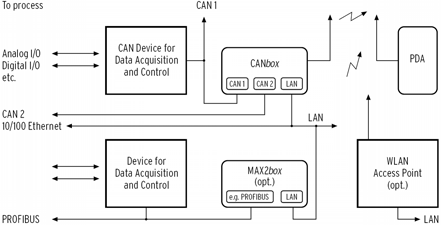
ARGUSpda sets up a connection to machinery and systems using WLAN or Bluetooth and the respective measurement and control devices. The program supports hardware from Sorcus and other manufacturers' measurement devices and systems. Almost any type of system can be 'easily connected' by software via a so-called user device interface.
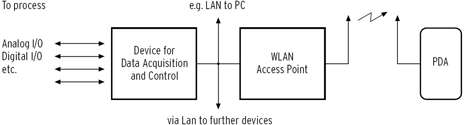
Examples of some hardware:
* Sorcus intelligent subsystems: CANbox; MAX2box; MAX3box.
* Sorcus decentralised intelligent periphery (DiP): MAX5dip; MAX8dip.
* Ipetronik: M-WiFi.
* User devices: Most other systems.
ARGUSpda is able to detect and display a variety of signals from the 'connected' devices. Fieldbus access is also simple via corresponding communication interfaces. Type of signals and fieldbuses are: analog I/O; digital I/O; counters/incremental encoders; sensors (SSI); Profibus (master/slave); CAN (high-speed/fault-tolerant); LIN; Ethernet (TCP/IP); modem; serial (RS232/422/485).
Sorcus 'Embedded PDA'
ARGUSpda runs not only on conventional handhelds, but also on the special 'Sorcus Embedded PDA', ie, MAX8dip and MAX3box. Both offer not only USB, LAN and WLAN interfaces but optionally also a PDA-compatible TFT display and six resp two free slots for MAX modules with any I/O interfaces. Visualisation and storage functionality are thus directly integrated.
Software
Although ARGUSpda is based on the ARGUSpc standard PC software, it is a separate product. However, it has retained the proven superior structures, including its simple, intuitive operation, to optimise working on a PDA's limited user interface. Special features of the CE operating system and .NET development environment were also taken into consideration. Users benefit from implementation of the ARGUSpda kernel as OCX, giving independence from both SDKs and from the user interface. Method-based communication permits greater design freedom for the user interface. It also maximises security, because measurement and control are unaffected by errors of the operator.
ARGUSpda uses standard Windows CE tools. Because of the limited user interface of a PDA, a conventional PC is used to configure all channels and sequence control. External signals are mapped onto channels and given freely definable names, eg, names, measurement rate and measurement range. The sampling rate can be set individually for each channel, ie, slow channels acquired at low sampling rates and fast channels at high rates. Channels can also be calibrated and linearised, and continuously-monitored limits can be set for each channel.
Because CANdb is the prevalent format for storing configurations in the automotive and supplier industries, ARGUSpda can also read CANdb files directly. The hardware connection to one or more CAN buses is done via the CANbox.
PDA display
The PDA graphical layout is designed directly on the PDA with no need for a PC: Using standard PDA tools, display elements can be created in only a few steps. ARGUSpda offers up to 10 different pages to give a clear display of multiple signals despite limited screen size. Users can toggle between these pages as required and each page accommodates up to two display elements, eg, y-t diagram and bar indicator. Each display element can be linked to up to four measurement channels. A clear, easy-to-follow display can be created by assigning colours and channels. ARGUSpda provides the following displays elements: y-t diagram; x-y diagram; table; bar indicator; digital instrument; message window.
Individual limit values can be monitored on all channels. In addition, all channels can be calculated online. A comprehensive library of mathematical functions is available for this. Results are delivered as channels in realtime.
All measurement tasks can be activated and deactivated manually, by external trigger or by condition. The integrated formula interpreter permits even complex trigger conditions to be configured. Pre- and post-triggers can be set as well.
Measured data is stored in the local RAM or other PDA memory, eg, SD card or Compact Flash. In addition to acquiring data, the control functions of ARGUSpda transform a PDA into a very powerful tool. At the same time control algorithms, eg, PID, can be processed. The realtime capability is achieved by rolling out the control process to the intelligent subsystems, eg, MAX8dip or MAX2box. It has acccess to the control process at any time, eg, to change parameters online. Event and action management functions can also be implemented. Here, actions are triggered by configurable events, to set outputs for example.
Analysis and documentation
Simple analysis, eg, replay function, can be performed directly on the PDA. A PC or notebook is generally preferred for larger analysis, graphic processing and data documentation tasks.
ARGUSpda features an open, modular system architecture which can be expanded and adapted. The user interface is implemented as an OCX container, enabling users to program their own customised interface or adapt the existing interface to their needs.
For more information contact Systematic Designs, +27 (0)12 667 5751.






© Technews Publishing (Pty) Ltd | All Rights Reserved
 printer friendly version