


The good old car antenna is getting on in years. Today's vehicles are equipped with a large number of antennas that can do much more than just 'listen to the radio'. Researchers at DaimlerChrysler are now working on new types of antennas that are very powerful and can be elegantly integrated into cars.
You can still see the warning signs hanging in car washes - and anyone whose car has a conventional radio antenna should heed them. If the antenna is not pushed in or unscrewed, the car owner may as well go buy another one right after the car wash.
But the age of snapped-off antennas is now coming to an end: The number of cars equipped with rod antennas is declining, and radio reception is increasingly being provided for by antennas consisting of thin metal wires that are integrated into windows and can easily withstand any car wash. Of course, the passing of the chrome-plated antenna rod cannot obscure the fact that as cars have become filled with more and more electronics, the number of antennas has grown substantially, too. If all the antennas now found in a mid-range or upper-range car were rod antennas and you placed them on the fender or roof as before, the vehicle would look a little like a porcupine.
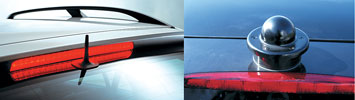
At first glance, at least, most of the up to 18 antennas are invisible (see Figure 1). "Automakers and suppliers refer to antennas as being 'invisible' when they are built underneath electromagnetically transparent materials like plastics or glass," explains Johann-Friedrich Luy, whose team is working intensively on new technologies for vehicle antennas at DaimlerChrysler's Ulm Research Center.

Examples of invisible antennas go beyond the radio antennas integrated into windows. The TeleAid emergency call system from DaimlerChrysler operates with antennas hidden in the rear bumper, for example. And parts of the antenna system in Maybach brand vehicles, and in the Mercedes-Benz CL and CLK convertible, are currently installed under the trunk lid; the system has antennas for satellite navigation and Sirius satellite radio.
Better reception through decorrelation
And it will not stop there. "Together with our colleagues from the design department, we are working on modules that contain a large number of antennas for things like analog and digital car radio, mobile phones, the navigation system, telematics services, remote controls, television, and special weather channels," explains Luy. "These complex modules should take up only small amounts of space when installed, so they have to be very compact."
Thus the Mercedes-Benz GST (Grand Sports Tourer) scheduled to come on the market in early 2005 will have a flat antenna module integrated into the vehicle roof. A similar 'antenna element' will likewise be realised in the next M-Class model series.
The advantages offered by the invisible antennas lie not only in the trouble-free car washes and the greater freedom they give designers when fashioning the body. Another future benefit for engineers, and especially for customers, will be the ability to 'decorrelate' various reception antennas: through the spatial separation of individual modules - a goal researchers and developers are working toward - the complete antenna system of a car will enable a further increase in reception quality.
However, such developments are not expected soon. "As far as research goes," says Luy, "the initial concern is making further improvements to the performance of mobile antennas." The path radio signals take from the transmitting antenna to the receiving antenna is not always direct. At buildings and trees, for example, they are reflected, scattered and attenuated. In the extreme case, this leads to a situation where a reflected signal arrives late because it took a longer route than the direct signal, and the two signals ended up cancelling each other out through interference.
To avoid problems of this kind, VHF radio receivers (FM), for example, use multiple antennas that are scanned one after the other with an electronic switch and route their signals to the tuner in that same order.
Fewer antennas through MIMO technology
In the case of a stationary antenna system, such 'antenna diversity' works quite well, but in a mobile system like a car, additional improvements can be made to achieve truly flawless reception. "Our goal," explains Luy, "is to sample all the antenna signals at once and route them into a processor that immediately analyses them and picks out the strongest signal each time. With this 'beam-forming' technique, the antenna always 'looks' in just one direction, thus ensuring optimal reception."
This is a long-term research project, however. An interim solution that will bring a noticeable improvement has already been worked out by DaimlerChrysler engineers. "It is an extension of current antenna technology, and it will be built into one of the next model series as 'phase diversity'," explains Peter Ebel from Mercedes-Benz Passenger Car Development.
The antenna revolution in cars is based on MIMO technology. The acronym stands for 'multiple input, multiple output' and refers to a system with multiple receiving antennas and multiple transmitting antennas. MIMO technology makes it possible to increase the capacity of the radio channels in mobile communications. However, because a car has mostly input antennas, MIMO-like technologies are in this case useful primarily for quality enhancement.
The improved signal recognition that results will, in turn, make it possible to simplify the antennas and reduce their number. "The vision we have," says Luy, "is to utilise the metallic parts of the body like the car roof, the trunk lid or a fender as antennas. Basically, all you would have to do then is lay a cable from these components to the processor. That would make it possible to do without antennas in the conventional sense, and then you would really have an invisible antenna."
Listening to the radio with the roll bar
A research project run by the scientists in Ulm shows that this vision has a sound footing and is not just fantasy: For the Chrysler PT Cruiser convertible, Luy and his team are working on an antenna unit that is integrated into the roll bar and can be used for various infotainment services.
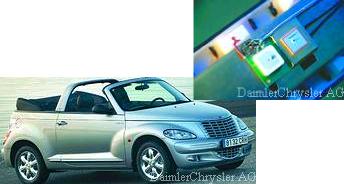
Underneath the vinyl trim of the roll bar are three matchbox-sized antennas provided by component suppliers, as well as a high-performance antenna that was designed by DaimlerChrysler researchers. The latter is only 14 mm high; comparable standard parts have a height of 70 mm and thus cannot be integrated into the roll bar.
But the really special thing about the new system is that the steel roll bar itself serves as the radio antenna - and with that the researchers were able to show that metallic body parts really can be used as antennas. "There is still a lot of research to do, however," cautions Luy. For instance, the scientists want to separate the antenna functionality of the roll bar from the rest of the body, since only then can individual parts deliberately be used as special antennas.
Radio broadcasts in the cars of tomorrow may therefore come through a fender, while satellite navigation might come from the hood, and e-mails could be transmitted via the roof.
This article was first published in HiTech Report and republished with the kind permission of DaimlerChrysler AG. All pictures copyright DaimlerChrysler AG. For more information about DaimlerChrysler see www.daimlerchrysler.com
Antennas and diversity
Antennas are metallic structures for transmitting or receiving electromagnetic waves. A high-frequency oscillating current in the transmitting antenna creates a periodic magnetic field in the surrounding area. At the same time, the high-frequency voltage in the antenna gives rise to an electric field that likewise oscillates periodically. The electromagnetic field emitted by the transmitting antenna induces in the receiving antenna a high-frequency alternating voltage and thus alternating currents, which serve as a signal for the receiving device. 'Multiple reception' or 'diversity reception' is the reception of one and the same message with multiple antennas, on multiple frequencies or at various times.
Antennas for everything: Whereas in the past, cars were equipped with a single rod-shaped radio antenna, today's vehicles have a large number of antennas:
Radio: Modern car radios can have as many as five different antennas just for receiving radio broadcasts in the VHF and short, medium and long-wave bands. Some of the antennas are built into the body, while others are integrated into the windows. The antennas are also used to receive digital traffic data from the radio data system (RDS) and the traffic message channel (TMC). In these cases, the radio stations broadcast inaudible VHF signals that are decoded and interpreted by the car radio.
Television: Cars in the luxury segment have antennas for receiving TV programs. The COMAND system from Mercedes-Benz, for example, receives the television images of terrestrial broadcasters using four special antennas and an analog TV tuner. Since October 2003, customers have also been able to receive digital TV programs while on the road. For that, DaimlerChrysler engineers developed a retrofittable digital receiver with four antennas and two tuners. This receiver can be connected to the existing system, and the user can switch between analog and digital reception depending on reception conditions.
Telecommunications: The car telephone needs at least one receiving and one transmitting antenna, and these are generally designed as a combined assembly. Fixed telephones installed in cars provide the technical basis for various telematics, information and mobility services. They allow short SMS text messages to be sent or received within Europe and the US. In Europe, rear-seat passengers can also surf the Internet and send or receive e-mails via WAP (wireless application protocol).
Navigation: To determine the position of the car, navigation aids like the GPS system also need antennas, which they use to receive signals from satellites. In the past, these antennas were mounted on the car roof, on or under the trunk lid, or behind the front or rear window. In the case of dynamic route guidance, the carphone antennas are used as well. With the Mercedes-Benz COMAND APS system, for instance, the car radio can act in concert with the telephone to establish contact with a service provider that will transmit digital traffic-jam warnings to the navigation system via SMS and recommend a detour if necessary.
Telematics: The TELEAID automatic emergency call system developed by DaimlerChrysler also uses a fixed-installation car telephone. After an accident, the system identifies the precise GPS position of the vehicle and automatically emits an SOS signal over the cellphone network to notify emergency medical services. In the case of the telematics service TELEDIAGNOSE, the driver uses the carphone to contact a customer assistance centre. The system also sends all necessary data to the centre, including vehicle and engine model, year of manufacture, engine temperature, battery voltage, mileage and any fault or warning messages stored in the vehicle's onboard memory.
Remote control: Modern car keys lock and unlock the doors and trunk lid at the push of a button. In the Mercedes-Benz Keyless-Go system, this even happens automatically as soon as the driver approaches the car: the electronic ignition key receives signals from antennas located in the doors, in the centre console, beneath the rear shelf, in the rear bumper and in the windows.
Distance control system: The Distronic distance cruise control system monitors traffic movements ahead of the vehicle using a radar sensor. It relies on a special system of transmitting and receiving antennas mounted behind the radiator grille.






© Technews Publishing (Pty) Ltd | All Rights Reserved
 printer friendly version