The requirements of mobile computer users, for data-intensive services like multimedia streaming and fast Internet and intranet access, are on the increase - regardless of which continent they happen to find themselves in. Additionally, the mobile computing market is characterised by short product life cycles, fierce competition, and the fact that computer and mobile technology are converging more and more as time goes on.
The Siemens Wireless Modules division offers individually tailored packages consisting of extremely compact modules, support, and the necessary expertise in GSM/GPRS and EDGE technology.
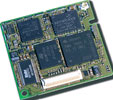
Both private individuals and the business world are becoming increasingly mobile. The ideal GSM frequency range must be made available to users globally to make it possible for them to use the data-intensive services enabled by EDGE on their own mobile computers. The MC75 from Siemens is a quad-band GSM-based wireless module allowing access to every GSM network around the globe, using them as EDGE-standard data highways.
EDGE plays a key role in the evolutionary process leading to UMTS: on the one hand, EDGE supplements the UMTS network, while on the other hand, it offers a fast alternative to network providers without an UMTS licence and regions without any UMTS coverage. For conventional applications that do not require data-intensive services, Siemens has developed the smallest dual tri-band GSM/GPRS modules currently available - the MC55/56.
Siemens Wireless Modules benefits from its synergies with the Siemens Mobile Phones and Mobile Networks divisions when developing modules for mobile devices. Additionally, Siemens' support team offers customers tailored service packages. FTA (full-type approval) in accordance with R&TTE, FCC, GCF, IC, UL and PTCRB testing standards and worldwide approval from all large network providers ensure further reduction of the total cost of ownership and help shorten the time-to-market span.
Manufacturers working in the mobile computing application field are already successfully integrating Siemens modules in a broad range of devices like pocket PCs and professional laptops.
Macom targets broadband radar with time delay MMIC RFiber Solutions
Telecoms, Datacoms, Wireless, IoT
Macom’s MADU FR1012 is a GaAs MMIC 1-bit true time delay device covering 4 GHz to 12 GHz, designed for broadband microwave systems where beam accuracy and signal integrity are critical.
Read more...Compact analogue phase shifter RF Design
Telecoms, Datacoms, Wireless, IoT
The Mini-Circuits JSPHS-150+ is a compact analogue voltage-controlled phase shifter designed for narrowband RF applications between 100 and 150 MHz.
Read more...Wireless connectivity expanded iCorp Technologies
Telecoms, Datacoms, Wireless, IoT
Espressif Systems has introduced two new members of its ESP32 wireless SoC family: the ESP32-E22, the company’s first Wi-Fi 6E connectivity chip, and the ESP32-H21, an ultra-low-power Bluetooth LE microcontroller aimed at coin-cell and battery-powered devices.
Read more...Integrated X-band radar front-end module RF Design
Telecoms, Datacoms, Wireless, IoT
Qorvo has introduced an X-band radar front-end solution that enables defence system designers to achieve higher performance without increasing size, weight or prime power.
Read more...Space saving SMD common-mode chokes Electrocomp
Passive Components
TDK Corporation presents the EP21 series of flat-wire double chokes designed for common-mode EMI filtering and available in an SMD format with dimensions of only 23,8 x 17,7 mm and heights ranging from 21,6 to 22,3 mm
Read more...Introducing Aurata CST Electronics
Telecoms, Datacoms, Wireless, IoT
Antenova has launched Aurata SR4L112: a compact, high efficiency embedded 4G/LTE antenna engineered for long, narrow PCB designs.
Read more...Multi-constellation GNSS module in a legacy-compatible footprint Altron Arrow
Telecoms, Datacoms, Wireless, IoT
Telit Cinterion has announced the SE869eK2L, a single-frequency L1 GNSS module designed to help device manufacturers upgrade legacy positioning designs with improved performance and cost efficiency, while preserving design continuity.
Read more...Quectel expands 5G portfolio iCorp Technologies
Telecoms, Datacoms, Wireless, IoT
Quectel expands 5G portfolio with new Qualcomm- and UNISOC-based modules.
Read more...Compact RTK design: More than just the receiver iCorp Technologies
Editor's Choice Telecoms, Datacoms, Wireless, IoT
In practice, engineers building compact RTK products keep discovering the same thing: the hardest component in the system is no longer the receiver. It is the antenna.
Read more...Microchip advances Space-Grade timing performance ASIC Design Services
Telecoms, Datacoms, Wireless, IoT
Microchip Technology has expanded its atomic clock portfolio with the radiation-tolerant Space CSAC-SA65, a Chip Scale Atomic Clock designed to deliver precise timing for space systems.
While every effort has been made to ensure the accuracy of the information contained herein, the publisher and its agents cannot be held responsible for any errors contained, or any loss incurred as a result. Articles published do not necessarily reflect the views of the publishers. The editor reserves the right to alter or cut copy. Articles submitted are deemed to have been cleared for publication. Advertisements and company contact details are published as provided by the advertiser. Technews Publishing (Pty) Ltd cannot be held responsible for the accuracy or veracity of supplied material.









 printer friendly version