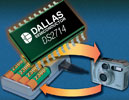
Dallas Semiconductor has introduced a loose-cell NiMH charger integrated circuit that detects and avoids charging primary alkaline cells, Lithium primary cells, and defective NiMH or NiCd cells. Designed to work with a regulated charge source, the DS2714 can charge from one to four NiMH or NiCd battery cells, including the AA or AAA sizes typically found in many consumer electronics.
The DS2714 charge cycle begins with a precharge qualification test that prevents the fast charging of deeply depleted cells or damaged cells. Deeply depleted cells are charged at a reduced rate to protect them from damage and extend the life of the battery. When each cell reaches a safe threshold, fast charging begins. During the fast-charge phase, the DS2714 tests for inappropriate or damaged cells that should not be charged. Fast charging terminates with the 'negative-delta-V' or 'flat-V' method, and is followed by a top-off phase that completely charges the cells. Finally, a maintenance phase continues indefinitely to keep the cells fully charged.
Besides testing for nonrechargeable or damaged cells, the 20-pin DS2714 has other features that ensure safe and effective charge operation. Throughout charging, the DS2714 continuously monitors cell voltages and temperature to ensure that they remain within proper ranges. Whenever the measured values are outside preset thresholds, charging is discontinued and a fault condition is issued. The DS2714 includes an adjustable timer for increased safety and secondary termination. Additionally, four LED outputs can be used to display charge status and fault conditions.
High-precision current transducer
Power Electronics / Power Management
Danisense announces its new high-precision DP12IP current transducer designed for isolated DC and AC current measurement in demanding PCB-mounted power electronics applications.
Read more...Secure holder for protected 18650 batteries
Power Electronics / Power Management
Designed for protected 18650 batteries up to 70 mm long, the holder offers secure retention for portable, industrial, and embedded applications.
Read more...More room to scale Altron Arrow
Power Electronics / Power Management
With the latest STM32H5 lines from STMicroelectronics, you can now scale within the same platform, from a compact 1 Mbyte device to higher-memory MCUs for graphics-rich and feature-heavy designs.
Read more...Space saving SMD common-mode chokes Electrocomp
Passive Components
TDK Corporation presents the EP21 series of flat-wire double chokes designed for common-mode EMI filtering and available in an SMD format with dimensions of only 23,8 x 17,7 mm and heights ranging from 21,6 to 22,3 mm
Read more...Introducing Aurata CST Electronics
Telecoms, Datacoms, Wireless, IoT
Antenova has launched Aurata SR4L112: a compact, high efficiency embedded 4G/LTE antenna engineered for long, narrow PCB designs.
Read more...Surface mount power amplifier for high-power applications RF Design
Power Electronics / Power Management
The GNA-63-5W+, from Mini-Circuits, is a GaN MMIC Power Amplifier (PA) designed for demanding RF applications requiring high efficiency, excellent linearity, and a compact footprint.
Read more...1200 V QSiC modules
Power Electronics / Power Management
SemiQ Inc has launched the QSiC Dual3, a family of 1200 V half-bridge MOSFET modules for motor drives in data centre cooling systems, grid converters in energy storage systems, and industrial drivers.
Read more...Expanded range of high-thermal-performance QSiC modules
Power Electronics / Power Management
SemiQ’s half-bridge series for data centre power converters and industrial motor drives features low RDSON SiC MOSFETs and parallel SBD diodes for best-in-class power density and conversion efficiency.
While every effort has been made to ensure the accuracy of the information contained herein, the publisher and its agents cannot be held responsible for any errors contained, or any loss incurred as a result. Articles published do not necessarily reflect the views of the publishers. The editor reserves the right to alter or cut copy. Articles submitted are deemed to have been cleared for publication. Advertisements and company contact details are published as provided by the advertiser. Technews Publishing (Pty) Ltd cannot be held responsible for the accuracy or veracity of supplied material.









 printer friendly version