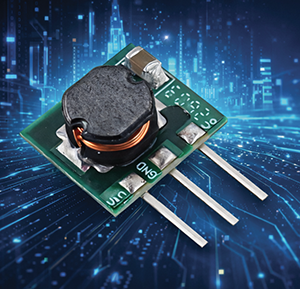
As edge devices and industrial electronics continue to shrink, power stages are expected to deliver higher efficiency in tighter spaces. AIPUPOWER’s K78XXJT-500R3 family has been developed for exactly this, offering two low-profile, non-isolated DC-DC converters aimed at IoT nodes, industrial instrumentation, and battery-powered systems.
A key strength of the series is its claimed efficiency of up to 96%. Higher efficiency lowers heat generation, which is particularly beneficial in compact enclosures with limited airflow. By reducing the need for additional cooling measures, the converters help designers produce cooler, longer-lasting products.
The family also addresses the growing importance of low standby consumption. With no-load input current specified as low as 0,2 mA, the converters suit devices that operate for long periods in sleep or idle states, such as remote sensors, handheld instruments, and distributed control modules. Low quiescent drain directly supports longer battery life and reduced maintenance requirements.
Two package formats are available. The K78XXJT-500R3 offers an ultra-thin 12,5 x 13,5 mm footprint with a height of 3,50 mm, while the K78XXJT-500R3-LB provides a compact 12 x 12 mm option at 4,50 mm high. This allows engineers to prioritise either minimal height or a tighter outline.
The converters operate in a temperature range of -40°C to 85°C. For modern IoT and industrial platforms that require compact, efficient, always-on power conversion, the K78XXJT-500R3 family delivers a well-balanced solution.
Batteries and ATEX: What you need to know Uniross Batteries
Power Electronics / Power Management
Choosing compliant batteries not only helps mitigate risk in hazardous areas, but it can also help developers decrease the certification phase and time-to-market.
Read more...40 W and 75 W railway DC/DC converter Brabek
Power Electronics / Power Management
RECOM has announced two new cost-efficient DC/DC converters for the rail market with an ultra-wide 11:1 input range to cover all nominal input voltages from 24 to 110 V DC.
Read more...High-precision current transducer
Power Electronics / Power Management
Danisense announces its new high-precision DP12IP current transducer designed for isolated DC and AC current measurement in demanding PCB-mounted power electronics applications.
Read more...Secure holder for protected 18650 batteries
Power Electronics / Power Management
Designed for protected 18650 batteries up to 70 mm long, the holder offers secure retention for portable, industrial, and embedded applications.
Read more...More room to scale Altron Arrow
Power Electronics / Power Management
With the latest STM32H5 lines from STMicroelectronics, you can now scale within the same platform, from a compact 1 Mbyte device to higher-memory MCUs for graphics-rich and feature-heavy designs.
Read more...Wireless connectivity expanded iCorp Technologies
Telecoms, Datacoms, Wireless, IoT
Espressif Systems has introduced two new members of its ESP32 wireless SoC family: the ESP32-E22, the company’s first Wi-Fi 6E connectivity chip, and the ESP32-H21, an ultra-low-power Bluetooth LE microcontroller aimed at coin-cell and battery-powered devices.
Read more...Quectel expands 5G portfolio iCorp Technologies
Telecoms, Datacoms, Wireless, IoT
Quectel expands 5G portfolio with new Qualcomm- and UNISOC-based modules.
Read more...Surface mount power amplifier for high-power applications RF Design
Power Electronics / Power Management
The GNA-63-5W+, from Mini-Circuits, is a GaN MMIC Power Amplifier (PA) designed for demanding RF applications requiring high efficiency, excellent linearity, and a compact footprint.
Read more...1200 V QSiC modules
Power Electronics / Power Management
SemiQ Inc has launched the QSiC Dual3, a family of 1200 V half-bridge MOSFET modules for motor drives in data centre cooling systems, grid converters in energy storage systems, and industrial drivers.
Read more...Compact RTK design: More than just the receiver iCorp Technologies
Editor's Choice Telecoms, Datacoms, Wireless, IoT
In practice, engineers building compact RTK products keep discovering the same thing: the hardest component in the system is no longer the receiver. It is the antenna.
While every effort has been made to ensure the accuracy of the information contained herein, the publisher and its agents cannot be held responsible for any errors contained, or any loss incurred as a result. Articles published do not necessarily reflect the views of the publishers. The editor reserves the right to alter or cut copy. Articles submitted are deemed to have been cleared for publication. Advertisements and company contact details are published as provided by the advertiser. Technews Publishing (Pty) Ltd cannot be held responsible for the accuracy or veracity of supplied material.









 printer friendly version