


As the Internet of Things continues to expand into homes, cities, farms, and industrial sites, one design decision remains critical: power. Behind every smart meter, tracker, or sensor lies a battery that must deliver reliable energy for years, often in harsh or inaccessible environments. Choosing the right battery is therefore not simply a technical detail, but a defining factor in the longevity and cost-effectiveness of any IoT deployment.
Why lithium is the default choice for IoT
Wireless, connected devices place unique demands on power sources. They are typically small and compact, and expected to operate unattended for long periods. Lithium batteries have emerged as the preferred solution because they combine several essential characteristics in a single technology:
• They are lightweight and compact, and perfect for use in small smart devices.
• Thanks to a strong charge retention, they deliver reliable performance over an extended life expectancy.
• Lithium cells are robust and able to maintain performance over a wide range of temperatures making them ideal for use in both indoor and outdoor environments.
• The use of lithium for the anode provides a high voltage output – delivering an amount of energy per volume up to ten times more than zinc-oxide batteries.
There is no one-size-fits-all solution
Despite their advantages, not all lithium batteries are the same. Selecting the right option requires a clear understanding of the device itself. Key considerations include:
• Current requirements.
• Pulse loads.
• Operating temperature.
• Expected lifetime.
• Maintenance access.
• Can the application tolerate single-use or does it require rechargeability.
By matching these parameters to the right battery chemistry and construction, designers can optimise performance, reliability, and total cost of ownership.
Exploring Saft’s lithium battery portfolio for IoT
Saft has developed a broad range of lithium batteries specifically with IoT use cases in mind. Its portfolio spans primary (single-use) and rechargeable solutions, designed to address everything from low-power sensing to high-pulse industrial applications.
LS/LSH/LSP Cylindrical primary lithium cells (3,6 V)
This family of batteries is based on lithium-thionyl chloride (Li-SOCl2) chemistry, which offers the highest nominal voltage among primary lithium technologies at 3,6 V. These cells also provide the highest energy density, with potential lifetimes of up to 20 years, and are highly resistant to high temperatures and mechanical stress.
Two construction types are available. LS and LSP cells use a bobbin construction, while LSH cells use a spiral construction, allowing the range to cover very different power profiles.
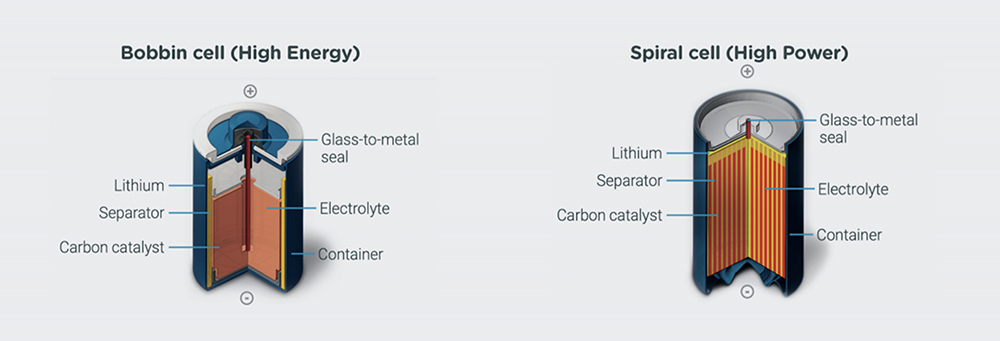
LS cells are particularly well suited to applications with very low continuous current or moderate pulsed demands, such as utility metering or parking sensors. The bobbin construction maximises the volume of active material, delivering maximum energy. These cells can also withstand extreme pressure, vibration, and temperature swings from -60°C to 150°C, making them ideal for remote trackers and other harsh environments.
LSH cells feature a spiral construction that supports very high current pulses, typically between 50 mA and 2 A. Certain models are designed to operate at the elevated temperatures found in demanding sectors such as oil and gas, where power resilience is critical.
The LSP range takes a hybrid approach, combining a bobbin primary lithium cell with a lithium-ion capacitor connected in parallel. This design delivers both high energy and high pulse power: what Saft describes as the best of both worlds.
These cells are optimised for performance stability, wide temperature operation, and long lifetimes exceeding 10 years, with very low self-discharge and equivalent series resistance.
LM/M Cylindrical primary lithium cells (3,0 V)
LM and M cells are based on lithium-manganese dioxide (Li-MnO2) chemistry and use a spiral internal construction similar to the LSH range. With a nominal voltage of 3,0 V, they represent a strong economic option for devices with a cut-off voltage below 2,5 V.
Offering a good balance between energy and power, these cells are well suited to applications such as smart metering, parking sensors, and smart agriculture. Their high surface-area electrodes enable strong pulse performance, while their electrolyte formulation supports reliable operation between -40°C and 85°C.
Rechargeable MP and small VL cells (3,6-3,75 V)
For applications where battery replacement is impractical or where devices are used frequently, Saft offers rechargeable lithium-ion solutions in medium prismatic (MP) and cylindrical Small VL formats.
These cells can be recharged up to 2800 times with only around 30% capacity loss, making them long-life, low-maintenance solutions with a reduced cost per cycle. Optional state-of-charge and state-of-health indicators allow real-time monitoring of battery condition, helping to improve maintenance planning.
Safety is also a key focus, with features such as electronic protection circuits, built-in circuit breakers, shutdown separators, and safety vents integrated into the design. Combined with strong performance in unregulated outdoor conditions and extreme temperatures, these rechargeable cells are well suited to industrial and mission-critical IoT deployments.
Power as a strategic design choice
As IoT systems scale, battery selection becomes a strategic decision rather than a simple component choice. By carefully aligning device requirements with the right lithium technology, designers can extend operational life, improve reliability, and reduce maintenance costs.
With a portfolio ranging from ultra-long-life primary cells to robust rechargeable solutions, Saft’s lithium batteries offer designers the flexibility to power connected devices confidently, even in the most demanding environments.
| Tel: | +27 11 466 1156 |
| Email: | info@uniross.co.za |
| www: | www.uniross.co.za |
| Articles: | More information and articles about Uniross Batteries |






© Technews Publishing (Pty) Ltd | All Rights Reserved
 printer friendly version