Siemens offers customers an EDGE
28 November 2007
Telecoms, Datacoms, Wireless, IoT
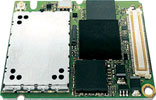
Siemens' MC75 allows users to take advantage of the EDGE Class 12 transmission standard in facilitating functions such as multimedia downloads and data streaming in their products.
EDGE - which stands for 'enhanced data rates for GSM evolution' - is both a supplement and an alternative to UMTS. The cost of rolling out a UMTS network is high and as a result, 3G and HSDPA coverage is only available in major city centres and urban areas. EDGE on the other hand is based on GSM and so the implementation costs are much lower, with the result that it has far wider coverage in South Africa. By employing this standard, products are able to download data at speeds of up to 236,8 Kbps, even in regions where UMTS is not available.
In addition, due to the Quad-Band technology, the module can be used in every GSM network worldwide. The MC75 includes an RIL driver, which makes it particularly attractive for Microsoft Windows Mobile-based devices like smartphones and PDAs. The integrated USB port also allows the use of the MC75 in applications like GSM/GPRS modems.
The MC75 allows mobile e-mail and Internet access - features that can now be available in vehicles when embedded into fleet management products. Even multimedia streaming is possible. This degree of flexibility enables a host of possibilities for notebooks, PDAs, and other computing and industrial applications.
In order to get customers' products to market quickly and easily, the MC75 comes with full type approval. It has also been approved by major network carriers around the world, including US and European operators.
Further reading:
Simplifying system design
iCorp Technologies
Telecoms, Datacoms, Wireless, IoT
The FGMC63N tri-band MCU Wi-Fi 6E module from Quectel addresses offers integrated connectivity across 2,4 GHz, 5 GHz, and 6 GHz bands in a compact, highly optimised design.
Read more...
Dragino’s connectivity catalogue
Otto Wireless Solutions
Telecoms, Datacoms, Wireless, IoT
Where Wi-Fi demands frequent charging and covers tens of meters, and traditional cellular consumes too much power for battery-operated nodes, LoRaWAN threads the needle.
Read more...
RF filters explained
RFiber Solutions
Telecoms, Datacoms, Wireless, IoT
As RF environments become increasingly crowded, RF filters play a critical role in maintaining signal quality, improving system performance, and ensuring reliable operation.
Read more...
Practical design strategies for 5G
RF Design
Telecoms, Datacoms, Wireless, IoT
The Cavli CQM211 aims to provide a platform that combines strong 5G connectivity with onboard compute capability, as well as interface flexibility that suits both new designs and rapid migrations from earlier products.
Read more...
GigaDevice expands optical communication portfolio
NuVision Electronics
Telecoms, Datacoms, Wireless, IoT
GigaDevice has introduced the new GD32E512 and GD32E252 series MCUs specifically designed for optical module applications.
Read more...
An industry-first Android 16 smart module solution
RF Design
Computer/Embedded Technology Telecoms, Datacoms, Wireless, IoT
The MeiG Smart SLM580 4G Smart Module features native support for Android 16 and covers core frequency bands in major countries and regions worldwide.
Read more...
High performance RF signal conditioning
RFiber Solutions
Telecoms, Datacoms, Wireless, IoT
The AM3269 from Mercury Systems is a high-performance RF preselector module designed to improve receiver sensitivity and signal integrity in demanding electronic warfare, signals intelligence, test, and communications applications.
Read more...
RF filters explained
RFiber Solutions
Telecoms, Datacoms, Wireless, IoT
As RF environments become increasingly crowded, RF filters play a critical role in maintaining signal quality, improving system performance, and ensuring reliable operation.
Read more...
GigaDevice expands optical communication portfolio
NuVision Electronics
Telecoms, Datacoms, Wireless, IoT
GigaDevice has introduced the new GD32E512 and GD32E252 series MCUs specifically designed for optical module applications.
Read more...
Industrial connectivity without compromise
Telecoms, Datacoms, Wireless, IoT
The IR315 combines 4G LTE, Wi-Fi, Ethernet, and VPN technologies into a rugged, industrial-grade platform that enables seamless connectivity across a wide range of applications.
Read more...









 printer friendly version