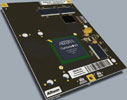
Altium has announced a new daughterboard for its desktop NanoBoard reconfigurable hardware development platform.
This latest plug-in daughterboard targets Altera’s low-cost Cyclone III EP3C40 FPGA in a 780 BGA package. The daughterboard includes a range of onboard memories for application use and a 1-wire memory device used to store board identification and related information.
The Altera Cyclone III FPGA plug-in daughterboard offers an opportunity for electronics engineers to experiment with different programmable devices, particularly in mainstream electronics design. This means that designers do not need to commit to their final device too early in the design cycle. For example, they have the option of creating their design using one FPGA, and choosing another device for their final product. Designers can also observe the performance of an actual design running on the NanoBoard, and compare it with other devices simply by swapping daughter boards and rebooting in seconds.
When the desktop NanoBoard is combined with Altium’s unified electronics design solution, Altium Designer, designers have an ‘innovation station’ that lets them create prototypes rapidly, optimise product performance and overall cost in their designs, and create a competitive advantage embedded within the design.
Altium Designer’s unified design environment also lets designers lay out custom printed circuit boards once the design is final. It manages all the design documentation required to take the design through the complete design process – early concept development; multiple prototype creation on the desktop NanoBoard; custom 3D PCB design, including dynamic clearance checking between the PCB and its casing; and final output files for manufacturing. Every designer on a project accesses a single design data model, can see the changes in the design as they happen, and can update versions and associated documentation with a single command.
AMD Vivado Design Suite 2026.1
Design Automation
AMD Vivado Design Suite 2026.1 is here and features a new tiered licensing model for greater flexibility, new device support, major NoC and QoR improvements, and ease-of-use enhancements for designing with AMD Versal adaptive SoCs.
Read more...Advanced STM32 debugging in VS Code
Design Automation
Once an STM32 project is running in VS Code, the IAR C-SPY Debug extension adds a professional-grade analysis layer that scales with project complexity.
Read more...Introducing STM32CubeMX2 Altron Arrow
Design Automation
STMicroelectronics has launched STM32CubeMX2, a new evolution of its popular configuration and code generation tool for STM32 microcontrollers.
Read more...AI assistant for STM32 developers
Design Automation
The STMicroelectronics STM32 Sidekick is an AI-driven assistant fully integrated into the STM32 ecosystem designed to streamline embedded development using STM32 microcontrollers.
Read more...Next-gen robotic systems initiative EBV Electrolink
Design Automation
EBV Elektronik recently introduced MOVE – Driving Robotics Forward, a new initiative designed by EBV Elektronik‘s Embedded Solutions team to support the development of next-generation robotic systems.
Read more...Reference design for NB-IoT plus GNSS Altron Arrow
Design Automation
ST Microelectronics’ STDES-ST87M01IGN is a reference design for the ST87M01 NB-IoT + GNSS module, implemented on a 2-layer FR4 PCB (90 x 60 x 1,6 mm).
Read more...ST welcomes STM32Cube AI Studio
Design Automation
STMicroelectronics has introduced STM32Cube AI Studio, a new desktop software environment designed to simplify the deployment of artificial intelligence on STM32 microcontrollers.
Read more...NeoCortec introduces new NeoGW software
Design Automation
This is a powerful multiplatform open-source solution designed to streamline integration between the NeoMesh network and upper-level systems, whether deployed in the cloud or on-premise environments.
While every effort has been made to ensure the accuracy of the information contained herein, the publisher and its agents cannot be held responsible for any errors contained, or any loss incurred as a result. Articles published do not necessarily reflect the views of the publishers. The editor reserves the right to alter or cut copy. Articles submitted are deemed to have been cleared for publication. Advertisements and company contact details are published as provided by the advertiser. Technews Publishing (Pty) Ltd cannot be held responsible for the accuracy or veracity of supplied material.









 printer friendly version