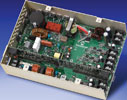
Microchip has released an AC-DC reference design based on the new dsPIC33F 'GS' series of digital power digital signal controllers (DSCs). This reference design demonstrates how digital power techniques are applied to reduce component count, lower product cost, eliminate oversized components and incorporate topology flexibility to develop the best solution for the application.
The reference design unit works from a universal input voltage range and produces three output voltages, with a continuous power output rating of 300 W. The front-end power factor correction (PFC) boost circuit converts universal AC input voltages to a 420 V d.c. bus voltage. A full-bridge transformer isolated buck converter, incorporating a phase-shift zero voltage transition (ZVT) circuit, produces 12 V d.c. at 30 A from the 420 V bus. The phase-shift ZVT converter also provides output voltage isolation from the AC mains input. A multiphase synchronous buck converter then produces 3,3 V d.c. at 69 A from the 12 V d.c. bus, and a single-phase buck converter produces 5 V d.c. at 23 A from the same bus.
The reference design is powered by one of Microchip’s new dsPIC33F 'GS' series of DSCs, which controls the PFC boost circuit and the primary-side ZVT full-bridge circuit. A second 'GS' series dsPIC33F monitors the 12 V bus voltage and controls the four buck converters.
AMD Vivado Design Suite 2026.1
Design Automation
AMD Vivado Design Suite 2026.1 is here and features a new tiered licensing model for greater flexibility, new device support, major NoC and QoR improvements, and ease-of-use enhancements for designing with AMD Versal adaptive SoCs.
Read more...Advanced STM32 debugging in VS Code
Design Automation
Once an STM32 project is running in VS Code, the IAR C-SPY Debug extension adds a professional-grade analysis layer that scales with project complexity.
Read more...Introducing STM32CubeMX2 Altron Arrow
Design Automation
STMicroelectronics has launched STM32CubeMX2, a new evolution of its popular configuration and code generation tool for STM32 microcontrollers.
Read more...AI assistant for STM32 developers
Design Automation
The STMicroelectronics STM32 Sidekick is an AI-driven assistant fully integrated into the STM32 ecosystem designed to streamline embedded development using STM32 microcontrollers.
Read more...Next-gen robotic systems initiative EBV Electrolink
Design Automation
EBV Elektronik recently introduced MOVE – Driving Robotics Forward, a new initiative designed by EBV Elektronik‘s Embedded Solutions team to support the development of next-generation robotic systems.
Read more...Reference design for NB-IoT plus GNSS Altron Arrow
Design Automation
ST Microelectronics’ STDES-ST87M01IGN is a reference design for the ST87M01 NB-IoT + GNSS module, implemented on a 2-layer FR4 PCB (90 x 60 x 1,6 mm).
Read more...ST welcomes STM32Cube AI Studio
Design Automation
STMicroelectronics has introduced STM32Cube AI Studio, a new desktop software environment designed to simplify the deployment of artificial intelligence on STM32 microcontrollers.
Read more...NeoCortec introduces new NeoGW software
Design Automation
This is a powerful multiplatform open-source solution designed to streamline integration between the NeoMesh network and upper-level systems, whether deployed in the cloud or on-premise environments.
While every effort has been made to ensure the accuracy of the information contained herein, the publisher and its agents cannot be held responsible for any errors contained, or any loss incurred as a result. Articles published do not necessarily reflect the views of the publishers. The editor reserves the right to alter or cut copy. Articles submitted are deemed to have been cleared for publication. Advertisements and company contact details are published as provided by the advertiser. Technews Publishing (Pty) Ltd cannot be held responsible for the accuracy or veracity of supplied material.









 printer friendly version