

Telecoms, Datacoms, Wireless, IoT


Wireless solution leverages 32-bit MCU power

3 February 2010 Telecoms, Datacoms, Wireless, IoT

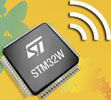
STMicroelectronics has extended its STM32 microcontroller portfolio by introducing the STM32W family, which features an integrated IEEE 802.15.4 radio to deliver a true system-on-chip platform supporting embedded wireless sensor network design.

IEEE 802.15.4 is an open standard for low-power, low-data-rate radio in the unlicensed 2,4 GHz band, and is widely used in communication and networking applications such as smart energy metering, home automation, security and monitoring equipment, and remote controls. The ZigBee Alliance has specified IEEE 802.15.4 as the radio platform for the ZigBee protocol, which is popular in applications such as sensor networking and automatic meter reading.

The new STM32W family implements the IEEE 802.15.4 physical (PHY) layer as well as the media access control (MAC) layer, giving developers the flexibility to target ZigBee-compliant specifications or to build any network wireless protocol which interfaces with the standardised IEEE802.15.4 MAC. Other well known protocols include ZigBee RF4CE for radio-frequency remote controls or 6LoWPAN for wireless embedded Internet solutions. Software support for the STM32W family includes libraries for the latest ZigBee PRO specification, as well as ZigBee RF4CE, and the IEEE 802.15.4 MAC.

The new devices combine the benefits of a radio platform with the added performance, flexibility and scalability of the STM32 microcontroller architecture. The STM32 portfolio features the advanced 32-bit ARM Cortex-M3 processor, and features characteristics such as high processing performance, advanced power management and high integration, as well as realtime behaviour.

The STM32W devices can transmit up to 7 dBm output power and support up to 107 dB link budget, achieve up to –100 dBm receiver sensitivity, and allow co-existence with nearby Wi-Fi and Bluetooth networks, which also operate in the 2,4 GHz frequency band. Performance highlights include low power consumption, drawing as little as 27 mA in receive mode and 31 mA in transmit mode, and implementing a 1 μA deep-sleep mode to aid power management.

Special features supporting wireless applications include 8 KB SRAM, 128 KB Flash for code storage, and embedded AES encryption with hardware acceleration. General-purpose resources include a flexible ADC, an SPI/UART/TWI serial interface, multiple timers, and 24 GPIOs with Schmitt-trigger inputs. Single-voltage operation from 2,1 V to 3,6 V simplifies design, while high integration also saves external components. Only a single 24 MHz crystal is required, or an optional 32,768 kHz crystal for increased timer accuracy. There is also support for an external power amplifier.

For more information contact Steve Santamarina, Arrow Altech Distribution, +27 (0)11 923 9600, ssantamarina@arrow.altech.co.za, www.arrow.altech.co.za, Avnet Kopp, +27 (0)11 809 6100, sales@avnet.co.za, www.avnet.co.za


Credit(s)


Share this article:
Share via emailShare via LinkedInPrint this page

Further reading:

Module provides 4G LTE Cat 1 bis connectivity
Dizzy Enterprises Telecoms, Datacoms, Wireless, IoT
Mikroe adds 4G LTE Cat 1 bis connectivity where reliable data transmission and low power consumption are critical with the GC02S1-EU2 module.

Read more...
Enabling next-generation FPGA and SDR innovation
RFiber Solutions Telecoms, Datacoms, Wireless, IoT
Puzhi Electronic Technology has established itself as a dynamic provider of advanced ARM and FPGA-based solutions, delivering a comprehensive ecosystem of products designed for modern embedded and high-performance computing applications.

Read more...
Magnetic mount antenna takes the hassle out of 4G installations
iCorp Technologies Telecoms, Datacoms, Wireless, IoT
Designed for fast, tool-free installation, the YECN022CA 4G magnetic mount whip monopole antenna gives wireless devices a dependable cellular link in the field, where installation time and signal reliability both matters.

Read more...
Engineering for failure: why resilient telemetry matters more than perfect connectivity
Editor's Choice Telecoms, Datacoms, Wireless, IoT
One of the biggest assumptions in modern tracking systems is that connectivity will always be available. From an engineering perspective, this creates an interesting problem.

Read more...
Wi-Fi and Bluetooth smart module series integrates intelligence
iCorp Technologies Telecoms, Datacoms, Wireless, IoT
Quectel Wireless Solutions has expanded its smart module portfolio with the SH503FM, a new-generation series of Wi-Fi and Bluetooth smart modules.

Read more...
Generating negative voltages from a positive supply
Altron Arrow Editor's Choice Passive Components
It is common for IoT devices, industrial sensors, meters, and medical equipment to require both a positive and negative voltage, and this article explains the options available to produce a negative rail from a positive rail supply.

Read more...
Addressing latency and signal integrity challenges
Altron Arrow DSP, Micros & Memory
Strengthening Microchip Technology’s data centre solutions portfolio, its XpressConnect retimers support high-bandwidth architectures, while helping reduce integration complexity.

Read more...
Powering smart sensor networks
CST Electronics Telecoms, Datacoms, Wireless, IoT
NeoCortec’s NeoMesh wireless mesh networking protocol and software stack is ideally suited for powering smart sensor networks where each device is required to send and receive small packets of data infrequently, but with high reliability.

Read more...
Lessons in long-distance telemetry
Omniflex Remote Monitoring Specialists Telecoms, Datacoms, Wireless, IoT
Ian Loudon, international sales and marketing manager at Omniflex, reflects on some of the key engineering lessons learned from decades of deploying wireless telemetry systems in demanding industrial applications.

Read more...
PEAK’s first automotive Ethernet solution
Industrial Data Xchange (IDX) Editor's Choice Telecoms, Datacoms, Wireless, IoT
The PAE-Media Converter is a robust and compact device designed to connect Automotive Ethernet (100BASE-T1 or 1000BASE-T1) with standard Ethernet (100BASE-TX or 1000BASE-T) networks.

Read more...


While every effort has been made to ensure the accuracy of the information contained herein, the publisher and its agents cannot be held responsible for any errors contained, or any loss incurred as a result. Articles published do not necessarily reflect the views of the publishers. The editor reserves the right to alter or cut copy. Articles submitted are deemed to have been cleared for publication. Advertisements and company contact details are published as provided by the advertiser. Technews Publishing (Pty) Ltd cannot be held responsible for the accuracy or veracity of supplied material.


© Technews Publishing (Pty) Ltd | All Rights Reserved

