Wireless M-Bus module
10 November 2010
Telecoms, Datacoms, Wireless, IoT
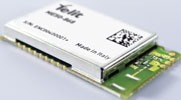
Telit Wireless Solutions is launching a new module featuring wireless M-Bus transfer technology. The ME50-868 supports uni- and bi-directional RF connections at 868 MHz between meters for gas, water, heating or electricity and concentrators. This exchange of data forms the basis for the use of smart meters which increase the accuracy and transparency of bills, offer better customer service and help improve energy efficiency.
The device’s 122 dB budget link provides a range of up to 2000 m. The modules with LGA (land grid array) mounting technology operate with ultra-low power (<1 μA in standby), resulting in long battery life and low maintenance requirements. Equipped with an RS232 interface and digital as well as analog inputs and outputs, the modules can be integrated into a variety of systems. The ME50-868 is pin-to-pin compatible with the Telit modules in the ZE (ZigBee 2007 and PRO stack), NE (mesh low power) and LE (basic point-to-point, broadcast stack) families. It is also compliant with EN 13757 part 4 and part 5.
M-Bus is a standardised transfer technology for the remote reading of meters inside buildings. When the transfer is made by radio, the technology is referred to as wireless M-bus. The frequency range used, from 868 MHz to 870 MHz, offers the widest range inside buildings. The data from the individual meters is transferred to a concentrator on site, which collates and transfers it via the Internet or a telephone network to the supply companies. Telit also provides a gateway solution (GG863-SR) that integrates short range and GSM/GPRS capabilities.
Smart metering is already being successfully used in Italy, Scandinavia, the Netherlands, North America and Australia. In Germany, from 2010 onwards, new buildings are required to be equipped with smart meters, and from 2018 this will apply to all buildings. The aim is to encourage consumers to be more energy-conscious by giving them detailed and real-time information about their energy usage.
For more information contact Pieter Lentz, Telit Wireless Solutions, +27 (0)11 367 0607, [email protected], www.telit.com
Further reading:
Simplifying system design
iCorp Technologies
Telecoms, Datacoms, Wireless, IoT
The FGMC63N tri-band MCU Wi-Fi 6E module from Quectel addresses offers integrated connectivity across 2,4 GHz, 5 GHz, and 6 GHz bands in a compact, highly optimised design.
Read more...
Dragino’s connectivity catalogue
Otto Wireless Solutions
Telecoms, Datacoms, Wireless, IoT
Where Wi-Fi demands frequent charging and covers tens of meters, and traditional cellular consumes too much power for battery-operated nodes, LoRaWAN threads the needle.
Read more...
RF filters explained
RFiber Solutions
Telecoms, Datacoms, Wireless, IoT
As RF environments become increasingly crowded, RF filters play a critical role in maintaining signal quality, improving system performance, and ensuring reliable operation.
Read more...
Practical design strategies for 5G
RF Design
Telecoms, Datacoms, Wireless, IoT
The Cavli CQM211 aims to provide a platform that combines strong 5G connectivity with onboard compute capability, as well as interface flexibility that suits both new designs and rapid migrations from earlier products.
Read more...
GigaDevice expands optical communication portfolio
NuVision Electronics
Telecoms, Datacoms, Wireless, IoT
GigaDevice has introduced the new GD32E512 and GD32E252 series MCUs specifically designed for optical module applications.
Read more...
An industry-first Android 16 smart module solution
RF Design
Computer/Embedded Technology Telecoms, Datacoms, Wireless, IoT
The MeiG Smart SLM580 4G Smart Module features native support for Android 16 and covers core frequency bands in major countries and regions worldwide.
Read more...
High performance RF signal conditioning
RFiber Solutions
Telecoms, Datacoms, Wireless, IoT
The AM3269 from Mercury Systems is a high-performance RF preselector module designed to improve receiver sensitivity and signal integrity in demanding electronic warfare, signals intelligence, test, and communications applications.
Read more...
RF filters explained
RFiber Solutions
Telecoms, Datacoms, Wireless, IoT
As RF environments become increasingly crowded, RF filters play a critical role in maintaining signal quality, improving system performance, and ensuring reliable operation.
Read more...
GigaDevice expands optical communication portfolio
NuVision Electronics
Telecoms, Datacoms, Wireless, IoT
GigaDevice has introduced the new GD32E512 and GD32E252 series MCUs specifically designed for optical module applications.
Read more...
Industrial connectivity without compromise
Telecoms, Datacoms, Wireless, IoT
The IR315 combines 4G LTE, Wi-Fi, Ethernet, and VPN technologies into a rugged, industrial-grade platform that enables seamless connectivity across a wide range of applications.
Read more...









 printer friendly version