Microchip announces its simplified line of C compilers that provide the best execution speed and code size for all ~900 PIC microcontrollers (MCUs) and dsPIC digital signal controllers (DSCs).
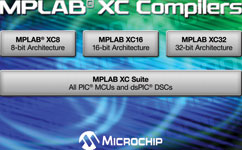
The MPLAB XC8, XC16 and XC32 compilers offer reduced complexity for 8-, 16- and 32-bit designers, with three cost-effective optimisation levels: Free, Standard and Pro. In addition, MPLAB XC provides support for the Linux, Mac OS and Windows operating systems, enabling designers to use their platform of choice for embedded development.
Another important consideration for today’s designers is the ability to re-use their code and easily migrate to the level of microcontroller performance and features that best suits the needs of each project. These have always been strengths for Microchip, and MPLAB XC continues that tradition by making it easy to move code from any of Microchip’s existing compilers.
Additionally, MPLAB XC completes Microchip’s tool-chain of compatible compilers and debugger/programmers that operate seamlessly within the universal, cross-platform and open-source MPLAB X integrated development environment, to reduce both learning curves and tool investments. MPLAB XC compilers are also compatible with the legacy MPLAB IDE.
Many designers need a free C compiler: the 8-, 16- and 32-bit Free editions of Microchip’s MPLAB XC compilers offer many optimisations, are fully functional and have no license restrictions for commercial use. For those who want to test their code with the Pro optimisation levels, which are approximately
50% better than the Free editions, Microchip also offers 60-day evaluation editions with Pro optimisation which revert to the Free compilers after the evaluation period. Like the Free editions, the evaluation editions are fully functional and have no license restrictions for commercial use.
Microchip is now offering the ability to purchase both single-user licenses and organisations with multiple engineers can purchase a floating network license, where the compiler is hosted on that company’s intranet for easy access by all of its designers.
AMD Vivado Design Suite 2026.1
Design Automation
AMD Vivado Design Suite 2026.1 is here and features a new tiered licensing model for greater flexibility, new device support, major NoC and QoR improvements, and ease-of-use enhancements for designing with AMD Versal adaptive SoCs.
Read more...Advanced STM32 debugging in VS Code
Design Automation
Once an STM32 project is running in VS Code, the IAR C-SPY Debug extension adds a professional-grade analysis layer that scales with project complexity.
Read more...Introducing STM32CubeMX2 Altron Arrow
Design Automation
STMicroelectronics has launched STM32CubeMX2, a new evolution of its popular configuration and code generation tool for STM32 microcontrollers.
Read more...AI assistant for STM32 developers
Design Automation
The STMicroelectronics STM32 Sidekick is an AI-driven assistant fully integrated into the STM32 ecosystem designed to streamline embedded development using STM32 microcontrollers.
Read more...Next-gen robotic systems initiative EBV Electrolink
Design Automation
EBV Elektronik recently introduced MOVE – Driving Robotics Forward, a new initiative designed by EBV Elektronik‘s Embedded Solutions team to support the development of next-generation robotic systems.
Read more...Reference design for NB-IoT plus GNSS Altron Arrow
Design Automation
ST Microelectronics’ STDES-ST87M01IGN is a reference design for the ST87M01 NB-IoT + GNSS module, implemented on a 2-layer FR4 PCB (90 x 60 x 1,6 mm).
Read more...ST welcomes STM32Cube AI Studio
Design Automation
STMicroelectronics has introduced STM32Cube AI Studio, a new desktop software environment designed to simplify the deployment of artificial intelligence on STM32 microcontrollers.
Read more...NeoCortec introduces new NeoGW software
Design Automation
This is a powerful multiplatform open-source solution designed to streamline integration between the NeoMesh network and upper-level systems, whether deployed in the cloud or on-premise environments.
While every effort has been made to ensure the accuracy of the information contained herein, the publisher and its agents cannot be held responsible for any errors contained, or any loss incurred as a result. Articles published do not necessarily reflect the views of the publishers. The editor reserves the right to alter or cut copy. Articles submitted are deemed to have been cleared for publication. Advertisements and company contact details are published as provided by the advertiser. Technews Publishing (Pty) Ltd cannot be held responsible for the accuracy or veracity of supplied material.









 printer friendly version