


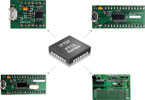
Future Technology Devices International (FTDI) has revealed the FT12 series of high-performance USB controller ICs. Operating at 12 Mbps and designed to the USB 2.0 specification, the new controllers support direct memory access (DMA) operation, while providing system interfaces for 8-bit parallel bus and SPI slave.
The FT12 series is configurable as a standard device class, and as such there is no need to add USB drivers. It was designed specifically so that engineers can quickly
understand the device functionality and architecture, as well as taking advantage of application software and standard class drivers currently available and installed within the market.
Composed of three members, and inspired by the industry standard D12, the FT12 series offers features like battery charging detection, numerous interface options and optimised device footprints – allowing the designer to choose the best-fit chip.
A serial interface engine (SIE) built into each IC handles the USB protocol as well as carrying out packet recognition, checking and sequencing. Multiple USB transfer modes are supported, enabling bulk and isochronous data transfer activity, as well as supporting interrupt protocol.
For the FT120 and FT122 ICs, microcontroller/FPGA connection takes the form of an 8-bit generic parallel interface, while the FT121 supports SPI slave mode. The FT120 has 3 USB endpoints, with 320 Bytes of configurable endpoint buffer integrated into the controller.
The FT121 and FT122 offerings have greater capacity, with up to eight bidirectional endpoints available and 2 KBytes of endpoint buffer capacity. Both the FT121 and FT122 also have USB battery charger detection functionality, allowing extra power from a dedicated charging port (DCP) to be utilised, so that up to 1,8 A of current, rather than the usual 500 mA, can be drawn, without the need to add multiple external components into the circuit.
Input voltages of 5 V or 3,3 V are supported for all devices. The FT121 and FT122 handle all clock generation internally and require no crystal, thus freeing valuable PCB area and lowering system cost. A dedicated clock output pin with programmable clock frequency (from 4 MHz to 24 MHz) is also included.
The FT120 and FT122 are both supplied in TSSOP-28 and QFN-28 packages, while the FT121 is offered in TSSOP-16 and QFN-16 package options. All have an operating temperature range of -40°C to 85°C.
Development tool support is provided through four evaluation modules – the UMFT12XEV, UMFT120DC, UMFT121DC and UMFT122DC – that can be used to implement and demonstrate USB functionality. The ‘DC’ denotes daughter-card functionality which enables the USB connection through a micro-B port and can be used in conjunction with the UMFT12XEV board or another microcontroller development system.
The feature-rich UMFT12XEV board includes the LPC1114 microcontroller (preloaded with CDC class driver support), prototyping area, numerous connectors (SPI, JTAG, GPIO), LEDs for signal status and battery charging detection.
For more information contact Electrocomp, +27 (0)11 458 9000, [email protected], www.electrocomp.co.za
| Tel: | +27 11 458 9000 |
| Email: | [email protected] |
| www: | www.electrocomp.co.za |
| Articles: | More information and articles about Electrocomp |






© Technews Publishing (Pty) Ltd | All Rights Reserved
 printer friendly version