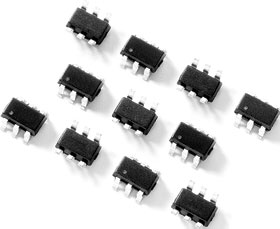
Littelfuse has introduced an ultra-low-capacitance protection thyristor in the SOT23-6 package. The SDP Series SIDACtor provides robust over-voltage protection for broadband/xDSL telecommunications equipment with minimal effects on connection speed and reach.
Patent-pending silicon crowbar technology allows for a claimed 45% lower capacitance than clamping devices like transient voltage suppressor (TVS) diodes, as well as providing faster response to surges, ensuring lower overshoot voltages and improved electrostatic discharge (ESD), lightning and power fault protection.
The device is designed for the tertiary or line driver side protection position in VDSL2, ADSL2, ADSL2+ telecommunications applications and general I/O protection functions. Its small-footprint package is well-suited for high-density card designs.
Crowbar devices operate as shunt devices in response to a surge that exceeds the breakover voltage. After switching on, they offer a very low impedance path that diverts transient energy away from the load. In contrast, clamping devices limit the transient voltage to a set value. When the applied voltage reaches the device’s breakdown value, it switches to a much lower resistance value to minimise the transient energy the circuit will experience.
The SDP Series provides a crowbar response to surge events with a maximum threshold of 29 V at 250 V/μs, and offers robust surge protection performance up to 30 A while maintaining low off-state capacitance for better AC protection. It responds quickly to surges, preventing damage caused by the coupling of transient events across the small signal transformer.
Accelerate development of physical AI deployments Altron Arrow
DSP, Micros & Memory
With Avocado OS now available on the HummingBoard RZ-V2N-
AIoT and SolidSense AIoT V2N from SolidRun, teams can move from prototype to deployed fleet in weeks.
Read more...Universal NFC device Altron Arrow
DSP, Micros & Memory
Delivering high-end performance in a compact 4 x 4 mm package, the multipurpose NFC reader from ST Microelectronics, enables the convenience of contactless interaction and features for various end applications.
Read more...Compact direct Time-of-Flight 3D LiDAR module Altron Arrow
AI & ML DSP, Micros & Memory
The VL53L9 from STMicroelectronics is the first direct Time-of-Flight (dToF) 3D LiDAR all-in-one module in ST’s portfolio, offering a resolution of 2,3K zones, wide field of view, on-chip processing, 100 frames per second, and sensing range from 5 centimeters to 9 meters.
Read more...SoC brings scalable edge AI to life Altron Arrow
AI & ML
The NXP i.MX 937 applications processor is optimised for performance without excessive power draw and bridges the gap between entry-level chips and high-end processors.
Read more...Compact direct Time-of-Flight 3D LiDAR module Altron Arrow
Opto-Electronics Electronics Technology AI & ML
The VL53L9 from STMicroelectronics is the first direct Time-of-Flight (dToF) 3D LiDAR all-in-one module in ST’s portfolio, offering a resolution of 2,3K zones, wide field of view, on-chip processing, 100 frames per second, and sensing range from 5 centimeters to 9 meters.
Read more...Generating negative voltages from a positive supply Altron Arrow
Editor's Choice Passive Components
It is common for IoT devices, industrial sensors, meters, and medical equipment to require both a positive and negative voltage, and this article explains the options available to produce a negative rail from a positive rail supply.
Read more...Addressing latency and signal integrity challenges Altron Arrow
DSP, Micros & Memory
Strengthening Microchip Technology’s data centre solutions portfolio, its XpressConnect retimers support high-bandwidth architectures, while helping reduce integration complexity.
Read more...Precision timing in compact package Altron Arrow
Telecoms, Datacoms, Wireless, IoT
Designed for use in harsh environments, the EX-423 incorporates a four-point mounted quartz crystal structure that improves shock resistance and reduces g-sensitivity.
Read more...EMC limits and levels Altron Arrow
Editor's Choice Circuit & System Protection
As soon as electronics and electrical systems started interfering with each other, the world had to come to some consensus. Considering physics is universal and does not care about what country electrical/electronic products are used in, it should be the same everywhere, right? It is nearly there, but not quite.
While every effort has been made to ensure the accuracy of the information contained herein, the publisher and its agents cannot be held responsible for any errors contained, or any loss incurred as a result. Articles published do not necessarily reflect the views of the publishers. The editor reserves the right to alter or cut copy. Articles submitted are deemed to have been cleared for publication. Advertisements and company contact details are published as provided by the advertiser. Technews Publishing (Pty) Ltd cannot be held responsible for the accuracy or veracity of supplied material.









 printer friendly version