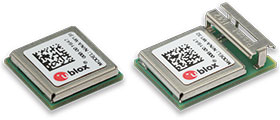
Recently débuted by u-blox are two new Wi-Fi modules for industrial markets. NINA W131 and NINA W132 are ultra low power Wi-Fi modules supporting 802.11 b/g/n in the 2,4 GHz ISM band, and are the first two variants of the new NINA W1 module series. Developed with security and quick time to market in mind, the standalone modules simplify integration and their secure design makes them ideal for applications including telematics, low power sensors, connected buildings (appliances, surveillance etc.), point of sales, and health devices.
"A major challenge in today’s IoT applications is security," noted Pelle Svensson, market development manager, product centre short range radio at u-blox. "With NINA W131 and NINA W132, we are giving product developers ready-to-use modules with extra security focus, antenna options, pre-Flashed connectivity software and a range of country certifications; all to efficiently integrate Wi-Fi connectivity into IoT devices."
The NINA W1 modules provide top-grade security, thanks to secure boot, which ensures the module only boots up with original u-blox software. In addition, they will provide end-to-end security on the wireless link with the latest 802.11i (WPA2) standard and enterprise security to provide a secure connection to the infrastructure.
Device design is simplified as developers can choose to either use an external antenna (NINA W131) or take advantage of the internal antenna (NINA W132). Furthermore, the modules are pin compatible with the NINA B1 Bluetooth low energy modules, thus offering maximum flexibility for devices that are to offer multiple radio technologies. As with all u-blox short range radio modules, the NINA W1 modules will be globally certified.
u-blox says the NINA W1 series will be expanded to include variants with Open CPU, Bluetooth connectivity, and additional hardware interfaces (RMII, CAN, SDIO, etc.).
Wireless connectivity expanded iCorp Technologies
Telecoms, Datacoms, Wireless, IoT
Espressif Systems has introduced two new members of its ESP32 wireless SoC family: the ESP32-E22, the company’s first Wi-Fi 6E connectivity chip, and the ESP32-H21, an ultra-low-power Bluetooth LE microcontroller aimed at coin-cell and battery-powered devices.
Read more...Integrated X-band radar front-end module RF Design
Telecoms, Datacoms, Wireless, IoT
Qorvo has introduced an X-band radar front-end solution that enables defence system designers to achieve higher performance without increasing size, weight or prime power.
Read more...Introducing Aurata CST Electronics
Telecoms, Datacoms, Wireless, IoT
Antenova has launched Aurata SR4L112: a compact, high efficiency embedded 4G/LTE antenna engineered for long, narrow PCB designs.
Read more...Multi-constellation GNSS module in a legacy-compatible footprint Altron Arrow
Telecoms, Datacoms, Wireless, IoT
Telit Cinterion has announced the SE869eK2L, a single-frequency L1 GNSS module designed to help device manufacturers upgrade legacy positioning designs with improved performance and cost efficiency, while preserving design continuity.
Read more...Quectel expands 5G portfolio iCorp Technologies
Telecoms, Datacoms, Wireless, IoT
Quectel expands 5G portfolio with new Qualcomm- and UNISOC-based modules.
Read more...Surface mount power amplifier for high-power applications RF Design
Power Electronics / Power Management
The GNA-63-5W+, from Mini-Circuits, is a GaN MMIC Power Amplifier (PA) designed for demanding RF applications requiring high efficiency, excellent linearity, and a compact footprint.
Read more...Compact RTK design: More than just the receiver iCorp Technologies
Editor's Choice Telecoms, Datacoms, Wireless, IoT
In practice, engineers building compact RTK products keep discovering the same thing: the hardest component in the system is no longer the receiver. It is the antenna.
Read more...Microchip advances Space-Grade timing performance ASIC Design Services
Telecoms, Datacoms, Wireless, IoT
Microchip Technology has expanded its atomic clock portfolio with the radiation-tolerant Space CSAC-SA65, a Chip Scale Atomic Clock designed to deliver precise timing for space systems.
Read more...Channel emulator for 6 G and Wi-Fi 7/8 Concilium Technologies
Telecoms, Datacoms, Wireless, IoT
With 400 MHz instantaneous bandwidth and support for carrier frequencies up to 23,6 GHz, Vertex 6.0 is the industry’s first channel emulator designed for next generation 6 G and Wi-Fi 7/8 testing.
Read more...Secure, low-power Bluetooth LE SoC NuVision Electronics
Telecoms, Datacoms, Wireless, IoT
Silicon Labs unveils BG2B, its lowest-power Bluetooth LE SoC with industry-leading power efficiency, security, and integration.
While every effort has been made to ensure the accuracy of the information contained herein, the publisher and its agents cannot be held responsible for any errors contained, or any loss incurred as a result. Articles published do not necessarily reflect the views of the publishers. The editor reserves the right to alter or cut copy. Articles submitted are deemed to have been cleared for publication. Advertisements and company contact details are published as provided by the advertiser. Technews Publishing (Pty) Ltd cannot be held responsible for the accuracy or veracity of supplied material.









 printer friendly version