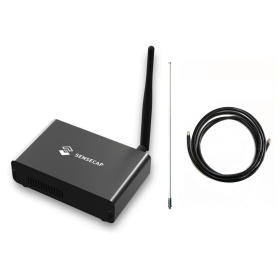
The Sensecap M1 LoRa gateway adopts a crowdfunded networking approach, with the addition of Helium crypto-mining taking place in the background.
Worldwide deployment stands at roughly 600 000 Helium mining gateways, with the vast majority being in Europe and the USA, making Africa, and in particular South Africa, prime growth territory. For this reason, says local distributor, Otto Wireless Solutions, the uptake of the Sensecap M1 gateway has been unprecedented, as they are affordable, with proof of coverage being the only current requirement to start earning crypto currency. Very simply, the user can plug the indoor gateway into an Internet connection, register via the app, and start earning.
What makes this solution attractive is its ability matched with Otto Wireless Solutions’ high-gain 11 dB omnidirectional ‘cryptenna’ branded antenna to create a sensitive LoRa hotspot able to accommodate future nodes, thereby boosting crypto revenue for gateway owners. With this combination, a household is able to plug the Sensecap M1 gateway into its existing fibre or LTE router and run a cable to an externally mounted antenna, resulting in generation of Helium crypto income with minimal time and effort.
At the heart of this approach by Helium is its drive to be the number 1 supplier of LoRa in the world, through this innovative crowdfunded approach. Ultimately, it hopes to fuel and enable the Internet of Things via the Helium network. Hot on the heels of Helium is the MXC token crypto miner from MatchX, taking much the same crowdfunded strategy.
Both these LoRa service provider models are enabling more rapid network deployment worldwide, compared to the establishment of a local entity in each country along with the identification of sites and overhead expenses for Internet connectivity.
Incorporating household participation, coupled with the monetary reward of crypto-currency mining, is increasingly being seen as the future of network development, and this divergence from traditional norms makes the concept highly attractive to many individuals.
Macom targets broadband radar with time delay MMIC RFiber Solutions
Telecoms, Datacoms, Wireless, IoT
Macom’s MADU FR1012 is a GaAs MMIC 1-bit true time delay device covering 4 GHz to 12 GHz, designed for broadband microwave systems where beam accuracy and signal integrity are critical.
Read more...Compact analogue phase shifter RF Design
Telecoms, Datacoms, Wireless, IoT
The Mini-Circuits JSPHS-150+ is a compact analogue voltage-controlled phase shifter designed for narrowband RF applications between 100 and 150 MHz.
Read more...Wireless connectivity expanded iCorp Technologies
Telecoms, Datacoms, Wireless, IoT
Espressif Systems has introduced two new members of its ESP32 wireless SoC family: the ESP32-E22, the company’s first Wi-Fi 6E connectivity chip, and the ESP32-H21, an ultra-low-power Bluetooth LE microcontroller aimed at coin-cell and battery-powered devices.
Read more...Integrated X-band radar front-end module RF Design
Telecoms, Datacoms, Wireless, IoT
Qorvo has introduced an X-band radar front-end solution that enables defence system designers to achieve higher performance without increasing size, weight or prime power.
Read more...Introducing Aurata CST Electronics
Telecoms, Datacoms, Wireless, IoT
Antenova has launched Aurata SR4L112: a compact, high efficiency embedded 4G/LTE antenna engineered for long, narrow PCB designs.
Read more...Multi-constellation GNSS module in a legacy-compatible footprint Altron Arrow
Telecoms, Datacoms, Wireless, IoT
Telit Cinterion has announced the SE869eK2L, a single-frequency L1 GNSS module designed to help device manufacturers upgrade legacy positioning designs with improved performance and cost efficiency, while preserving design continuity.
Read more...Quectel expands 5G portfolio iCorp Technologies
Telecoms, Datacoms, Wireless, IoT
Quectel expands 5G portfolio with new Qualcomm- and UNISOC-based modules.
Read more...Compact RTK design: More than just the receiver iCorp Technologies
Editor's Choice Telecoms, Datacoms, Wireless, IoT
In practice, engineers building compact RTK products keep discovering the same thing: the hardest component in the system is no longer the receiver. It is the antenna.
Read more...Microchip advances Space-Grade timing performance ASIC Design Services
Telecoms, Datacoms, Wireless, IoT
Microchip Technology has expanded its atomic clock portfolio with the radiation-tolerant Space CSAC-SA65, a Chip Scale Atomic Clock designed to deliver precise timing for space systems.
Read more...Channel emulator for 6 G and Wi-Fi 7/8 Concilium Technologies
Telecoms, Datacoms, Wireless, IoT
With 400 MHz instantaneous bandwidth and support for carrier frequencies up to 23,6 GHz, Vertex 6.0 is the industry’s first channel emulator designed for next generation 6 G and Wi-Fi 7/8 testing.
While every effort has been made to ensure the accuracy of the information contained herein, the publisher and its agents cannot be held responsible for any errors contained, or any loss incurred as a result. Articles published do not necessarily reflect the views of the publishers. The editor reserves the right to alter or cut copy. Articles submitted are deemed to have been cleared for publication. Advertisements and company contact details are published as provided by the advertiser. Technews Publishing (Pty) Ltd cannot be held responsible for the accuracy or veracity of supplied material.









 printer friendly version