



5G is currently the newest cellular standard that, depending on requirements, promises enormous bandwidth in the gigabit range, real-time capability, and high numbers of participants, while offering high-level reliability and security at the same time.
In contrast to previous cellular generations such as 3G and 4G, 5G for the first time, also satisfies the industrial sector’s demands, meaning that intelligent wireless communication between machines and applications can be guaranteed. With Industrial 5G, private networks that satisfy all the prerequisites for flexible, sustainable network connections in mobile or highly flexible applications can also be established.
Industrial 5G is ideal for use in Industry 4.0 applications. With its high level of flexibility, versatility, usability, and efficiency, 5G will make Industry 4.0, smart factories, and the Industrial Internet of Things (IIoT) possible.
5G features and characteristics
Industrial 5G offers users a level of performance that is many times higher when compared to previous cellular standards. Alongside characteristics such as low latency times (ultra-reliable low-latency communication, URLLC), high connection density (massive machine type communication, mMTC), and bandwidth (enhanced mobile broadband, eMBB), the technology features properties such as comprehensive IIoT connectivity and a higher level of flexibility.
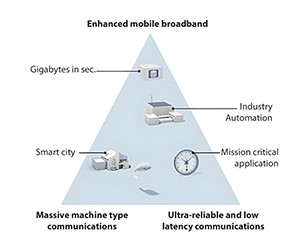
Industrial 5G does not, however, provide all these superlatives at once. Instead, it enables these properties to be assigned to the respective fields of application, and individual resources to be attributed in a private 5G network. It thus offers a triangle of functions that can be used depending on the application.
As the manufacturing sector moves toward Industry 4.0, the demand for high-speed, low-latency, and highly reliable data exchange has never been greater. The IIoT serves as the backbone of this transition, but its true potential is unlocked by the massive bandwidth and real-time capabilities of Industrial 5G.
At the edge of the network sits the industrial router that serves as the critical bridge between local hardware and global networks:
• Performance: These routers support both public and private 5G networks, offering gigabit-range speeds and 4x4 MIMO antenna technology for maximum throughput.
• Flexibility: Designed for the harsh conditions of a control cabinet, they operate in temperatures ranging from -40°C to 70°C and offer fallbacks to 4G (LTE) and 3G (HSPA+), ensuring your connection never drops.
• Security: With integrated firewalls and support for up to 10 VPN tunnels (IPsec/OpenVPN), they ensure that industrial data remains secure, while traveling across the cellular network.
While 5G provides the ‘pipeline,’ a system like PLCnext Technology can provide the smarts. It is an open ecosystem that bridges the gap between IT and OT (Operational Technology). It features:
• Open programming: Engineers can combine classic PLC languages with high-level languages like C++, C#, and Python.
• Future-proofing: The open Linux core allows for the native integration of 5G, OPC UA, and Time-Sensitive Networking (TSN), allowing for modular expansion as system requirements evolve.
By combining Industrial 5G for connectivity with an open control system, industrial operators can achieve a level of transparency and efficiency previously reserved for only large enterprises. This integrated approach reduces downtime, optimises energy consumption, and provides a secure foundation for the next generation of smart manufacturing.
For more information contact IOT Electronics,
| Tel: | +27 11 568 2736 |
| Email: | [email protected] |
| www: | www.iotelectronics.co.za |
| Articles: | More information and articles about IOT Electronics |






© Technews Publishing (Pty) Ltd | All Rights Reserved
 printer friendly version