


In recent years, the LED-lighting revolution has transformed vehicle styling, and the quality of the illumination cast onto the road. In front and behind, the change is evident in new designs, new shapes, and signature branding. Cars are more brightly lit and easily visible at all times of day or night, while brighter, whiter headlamps vividly illuminate the way forward. Inside, the revolution is seen in enhancements like customisable mood lighting that lets occupants determine their desired ambience.
The transition to LED lighting is also driving change in the manufacturing processes used to build these light engines. Large numbers of emitters can be arrayed in grids, or strips, and associated power-supply and electronic driving circuitry is also needed. Components are assembled on a PCB or flexible printed circuit (FPC) using surface-mount technology. It’s a leap forward from traditional techniques that transforms lamp-unit production into a high-precision sequence that can only be handled using specialised automation.
Yamaha Robotics SMT Section is a leading supplier of surface-mount assembly equipment chosen by both well-known brands and manufacturing services companies to build automotive LED-lighting assemblies. Working with customers in this industry directly, and through its network of sales agents and distributors throughout Europe, Yamaha has delivered complete surface-mount production lines for lighting, and general automotive electronic assemblies. These include electronic control units, power modules, sensor modules, and chargers and inverters for hybrid and electric vehicles.
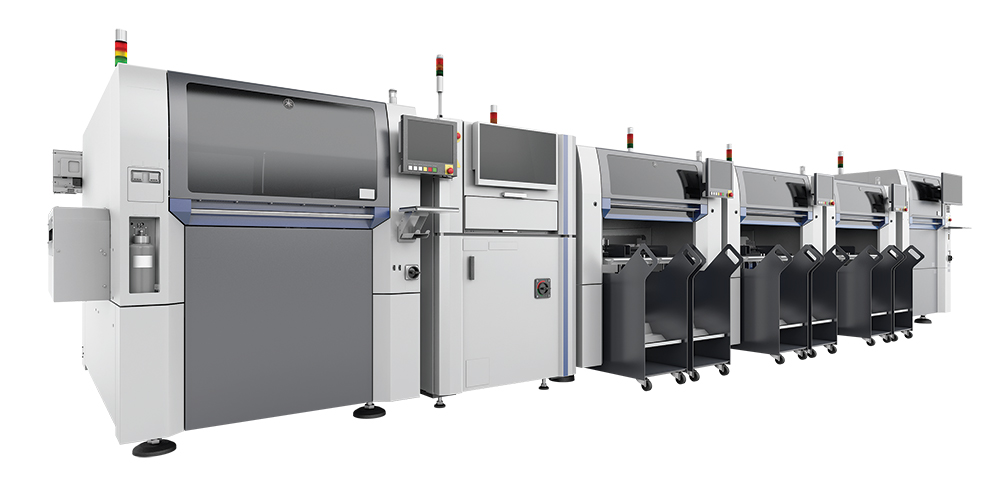 Figure 1. 1 STOP SMART SOLUTION.
The Yamaha 1 STOP SMART SOLUTION brings all these qualities together in a portfolio of screen printing, component mounting, and automatic optical inspection platforms that interconnect and communicate to maintain seamless production with rich diagnostics and reporting. This keeps operators informed continuously and in real-time of the current status and progress towards production goals. Any of these machines can be supplied individually to upgrade slower or less highly automated equipment from other manufacturers. The YRi-V 3D AOI can even be used as a standalone system with automated program-generation using Yamaha’s YSUP software to accelerate new product introduction.
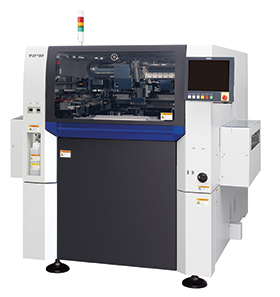
Among equipment from the 1 STOP SMART SOLUTION, the YRP10 screen printer is engineered for repeatability and ease of use. Its features include standard cycle time of just five seconds, and the 3S swing single squeegee head that automatically self-optimises as the solder-paste roll diminishes. Automated stencil loading and setup cuts the effective time between changeovers to zero, enabling the next job to begin instantly.
The YRM20 mounter can place components at up to 115 000 cph, and handles a wide range of components from 0201 (mm) with multi-purpose head options that ensure high speed, versatility, and minimal changeovers. Side-view component detection instantly senses pickup status, and the mounter automatically creates recognition data for custom or unique components.
The YRi-V AOI system combines high-performance machine vision and optics including high camera resolution, multi-angle and multi-wavelength lighting, and laser height measurement to check for correct component placement and solder-joint integrity. The YRi-V gives unerring results in a fast cycle time, which enables consistently high-quality control even when working at peak production throughput.
| Tel: | +27 31 822 8555/6 |
| Email: | [email protected] |
| www: | www.truthelectronics.co.za |
| Articles: | More information and articles about Truth Electronic Manufacturing |






© Technews Publishing (Pty) Ltd | All Rights Reserved
 printer friendly version