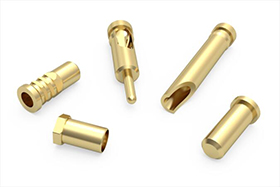
Mill-Max has announced the release of its number 36 contact, a unique contact designed to accept a wide range of lead sizes, while providing low insertion force and high current carrying capacity. The receptacles assembled with the number 36 contact are produced in a variety of termination styles to address the many interconnect requirements typically found in electronic assemblies.
The Mill-Max number 36 contact accepts lead diameters of 0,022 to 0,042-inch (0,56 to 1,07 mm), with initial insertion force averages ranging from 180 grams at the low end to 560 grams at the top of the acceptance range. The relatively low forces for these contacts make for easier mating and de-mating of multi-pin connections.
The wide acceptance range enables them to be used across applications for power and signal connections, simplifying receptacle choice, reducing the variety of components on a bill of materials, and allowing for uniform mounting hole layouts. The unique design of this four-finger contact allows it to stand out for its compliancy across the entire pin acceptance range, which means that the contact can alternate accepting the largest lead followed by the smallest lead while maintaining a reliable electrical connection.
Along with wide range and low force, these receptacles exhibit low contact resistance of 4 to 10 mΩ, and high current carrying capacity of 16 A maximum or 12,8 A de-rated, making them ideal in connector and cable assemblies, or as PCB jacks for power connections in a wide range of applications from communications equipment to pumps, fans, DC motor,s and industrial control equipment.
4 mm pitch power connectors Spectrum Concepts
Interconnection
Mill-Max has introduced a new line of high-reliability, 4 mm (.157”) pitch sockets and headers designed for power connections and rugged field applications.
Read more...56 G MezzaWave connectors and cable assemblies
Interconnection
Engineered to deliver notable signal integrity, TE Connectivity’s high-speed, high-density 56 G MezzaWave connector family is built on an open-pin-field array platform that supports data rates up to 56 Gbps PAM4 for next-generation modular system
Read more...Space SMPM and SMPM-Lock connectors Hiconnex
Interconnection
Radiall has released the Space SMPM and SMPM-Lock, miniature Space connectors for high-frequency performance and high-density applications.
Read more...Compact, high density, heavy duty, thermoplastic connectors TRX Electronics
Interconnection
Amphenol Sine Systems ATD series connectors, available from Mouser, are a compact, high density, heavy duty, thermoplastic solution with superior environmental seals and end caps for exceptional rear seal retention.
Read more...Samtec supports SGeT oHFM.c with high-performance interconnects Spectrum Concepts
Interconnection
Samtec has announced a new product portfolio designed for the SGeT oHFM.c standard. These connectors are based on Samtec’s proven AcceleRate HD and AcceleRate HP high-density, high-performance product families.
Read more...Connectivity solutions for hydrogen technologies Hiconnex
Interconnection
As the production distribution and utilisation of hydrogen continue to scale, connectivity becomes a key enabler for efficient energy transmission, data communication, and system control.
Read more...Mixed-density Combo-D connectors Hiconnex
Interconnection
Positronic’s SCBM connector series is a rugged, high-performance family of mixed-density D-sub connectors engineered for demanding environments.
Read more...Same Sky expands rectangular connector portfolio Future Electronics
Interconnection
The portfolio includes male pin headers, female pin headers, and box headers, giving engineers the flexibility to select the most appropriate connector style for their specific design requirements.
Read more...Rugged USB-C for modern designs
Interconnection
Same Sky has expanded its USB Type-C connector portfolio to meet the growing demand for faster data transfer and higher power delivery in modern electronic designs.
Read more...Designing with PCIe Spectrum Concepts
Editor's Choice Interconnection
PCI Express has become the backbone of modern high-performance systems with each new generation promising higher bandwidth, but that performance comes with a cost.
While every effort has been made to ensure the accuracy of the information contained herein, the publisher and its agents cannot be held responsible for any errors contained, or any loss incurred as a result. Articles published do not necessarily reflect the views of the publishers. The editor reserves the right to alter or cut copy. Articles submitted are deemed to have been cleared for publication. Advertisements and company contact details are published as provided by the advertiser. Technews Publishing (Pty) Ltd cannot be held responsible for the accuracy or veracity of supplied material.









 printer friendly version