


The defence sector is constantly evolving to address the latest security challenges, one of which is the increasing prevalence of unmanned aerial vehicles (UAVs) or drones in critical areas.
X-band radar systems, particularly those leveraging beamforming ICs (BFICs), advanced gallium nitride (GaN) and gallium arsenide (GaAs) components, are leading the way in providing the high-performance radar capabilities required for modern defence and surveillance
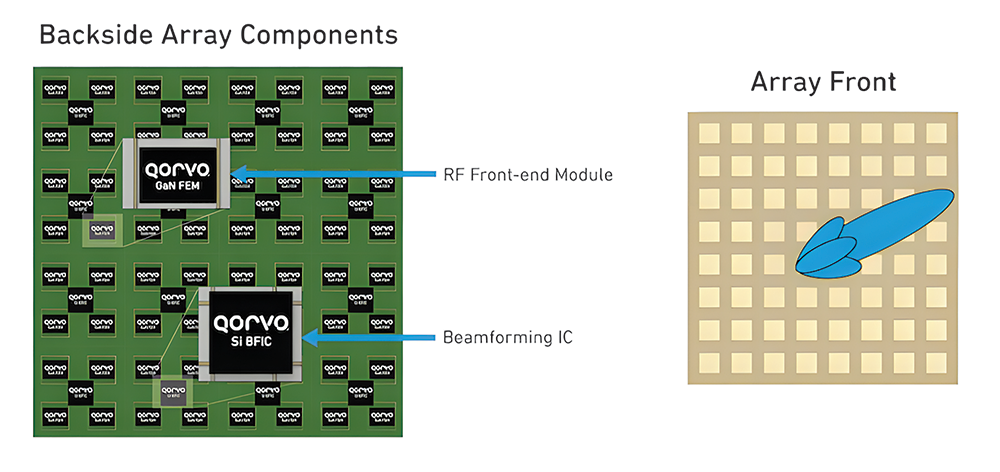
Drone detection and tracking: a new security imperative
The ability to detect, track and manage drones is becoming indispensable for defence operations. X-band radar systems are uniquely suited for this task, especially in scenarios like border security, critical infrastructure protection and mobile perimeter monitoring. These radar systems provide high-resolution detection capabilities, ensuring drones can be tracked with accuracy even in cluttered environments. The ability to differentiate drones from other small airborne objects is crucial as security demands grow around the globe. Phased array Active Electronically Scanned Array (AESA) radar systems operating at X-band offer an ideal balance of range, target resolution, and size, enabling these systems to detect and monitor obstacles from significant distances. X-band radars are lightweight and self-contained, which simplifies integration into aviation systems for comprehensive aerial surveillance and threat detection (see figure 2).
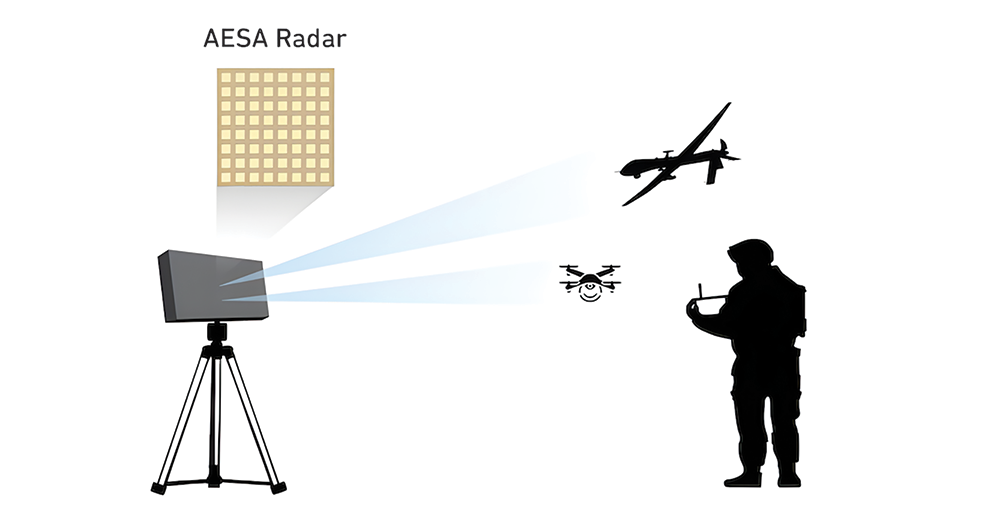
Some advantages of using AESA radar systems include:
• Accuracy – AESAs can track multiple targets with high angular accuracy, even when the airspace is very congested.
• Reliable – AESA radar systems offer superior reliability compared to legacy radar technologies, primarily due to their lack of moving parts, which reduces mechanical wear and failure points. Additionally, they feature a ‘soft failure’ capability, meaning that even if several array channels malfunction, the overall system performance experiences only minimal degradation.
• Fast – AESAs can transmit signal energy in microseconds, allowing the system to detect and track targets at a very high speed.
• Multi-functionality – AESA radar systems can operate in air-to-ground and air-to-air environments simultaneously.
• Environmentally stable – AESAs can see and map the ground from great distances in any weather conditions.
• Mobility – AESA radar systems are more mobile due to their sizes, lighter weight and use less power than previously used X-band radar system technologies.
• Low physical profile – AESA electronics can be realised in a planar (flat panel) antenna, allowing for low profile solutions. This AESA design approach enables planar arrays at frequencies above C-band and provides an overall smaller size, lighter weight and lower cost solution.
AESAs combined with advanced X-band BFICs are pushing the capabilities of compact radar systems. These systems, combined with integrated software-defined radios and beam-steering controllers, provide remote sensing coverage across a wide range of applications. Additionally, these solutions provide enhanced sensitivity and lower DC power consumption than traditional radar systems.
AESA radars also benefit significantly from X-band BFICs coupled with GaN and GaAs technologies, helping to enable long radar range, high-resolution, stable phase and amplitude control needed for rapid and precise beam steering. The combination of using these technologies – silicon for the BFIC, GaN and GaAs helps achieve SWaP-C principles. This low-profile, high-performance technology allows developers to create radar systems with optimised cascade performance, achieving lower RF power emissions, reduced false detections and increased dynamic range – attributes that open new avenues in aviation radar applications, while ensuring effective, energy-efficient drone tracking and threat management.
The accuracy and importance of BFICs in phased array antennas
A core component of X-band radar performance is precise phase control for each antenna element in the phased array. High-resolution phase and amplitude control enable fast, accurate beam steering, which is essential for tracking multiple objects simultaneously. Qorvo’s beamformer ICs facilitate this capability by providing independent phase shift and attenuation control, enhancing the radar’s ability to operate in complex environments with multiple moving targets.
At the core of X-band phased array radars, beamforming ICs allow precise control over each antenna element’s phase and amplitude, enabling rapid, accurate beam steering. This control is especially critical in scenarios where radar systems must distinguish between multiple, fast-moving targets in congested airspace or complex urban environments. Qorvo’s
| Tel: | +27 21 555 8400 |
| Email: | [email protected] |
| www: | www.rfdesign.co.za |
| Articles: | More information and articles about RF Design |






© Technews Publishing (Pty) Ltd | All Rights Reserved
 printer friendly version