


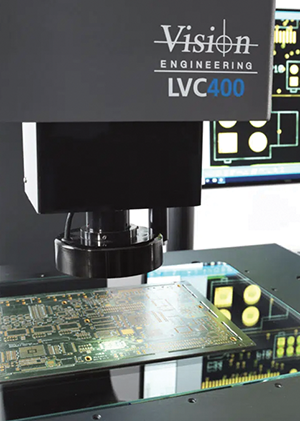
Printed circuit boards are central to today’s electronics, and PCB measurement is essential for ensuring quality, reliability, and compliance. Accurate inspection of dimensions, hole placement, and track layout plays a vital role in meeting product standards across consumer, telecom, aerospace, and medical devices.
Accurate measurements ensure:
• Product reliability: A well-designed and precisely manufactured PCB reduces the risk of failures and malfunctions, helping prevent defects and extend the lifespan of electronic products.
• Compliance with industry standards: Standards such as IPC-6012 and ISO 9001 set specific dimensional and quality requirements. Accurate measurement ensures compliance with these standards.
• Fewer defects and less waste: Detecting and correcting errors early in the production process avoids costly rework and material waste.
• Improved production efficiency: Ongoing PCB measurement and inspection help optimise processes and reduce defects.
Manufacturers rely on various inspection and quality control technologies to achieve precise measurements, including automated optical inspection (AOI), X-ray inspection (AXI), in-circuit testing (ICT), coordinate measuring machines (CMMs), and high-precision optical measurement systems.
Advanced optical measurement systems for PCB inspection
Optical measurement systems offer a contact-free, high-precision alternative for inspecting PCB dimensions. These systems use high-resolution cameras and innovative optical technology to help users detect micro-defects and dimensional variations without physical strain, thanks to ergonomic design.
These systems are ideal for miniaturised PCBs and complex layouts. They deliver fast, accurate measurements in three axes. User-friendly interfaces and real-time analysis reduce human error and improve inspection workflows. Measurements remain consistent and repeatable across different operators, supported by easy-to-use software. Certified measurement systems can also generate inspection reports that help assess non-conformities or irregularities.
Optical measurement technologies are key to ensuring high-precision PCB manufacturing throughout the production and inspection process:
• Conductive track inspection: Optical systems check the continuity and quality of conductive paths, identifying breaks, defects or dimensional variations that could influence PCB circuit performance and reliability.
• Silkscreen and drilling inspection: Optical measurements help operators check accurate hole placement for electrical connectivity and inspect silkscreen clarity for correct labelling during assembly and maintenance.
• Solder and component placement inspection: 3-axis optical measurement allows operators to check solder joint height and component alignment, reducing assembly defects and improving product reliability.
• Coating thickness control: Optical systems measure the thickness and uniformity of protective coatings applied to PCBs. These coatings are essential for protecting the PCB from environmental factors and improving electrical insulation.
Switching from traditional methods to optical measurement systems offers four key advantages:
• Higher precision and repeatability: Optical systems provide high resolution, reducing the margin of error compared to mechanical gauges or conventional microscopes.
• Faster inspection: Automation and the ability to quickly analyse a broad range of parameters reduce inspection time and increase throughput.
• Non-contact inspection: Fragile boards and sensitive components are protected from damage thanks to non-invasive inspection.
• Advanced analysis and traceability: Measurement data can be saved, analysed, and compared over time, enabling detailed and reliable quality documentation.
Conclusion
PCB measurement is a critical part of quality control and product success. By investing in advanced optical measurement systems for PCB inspection – such as those from Vision Engineering – and structured quality control strategies, manufacturers can ensure compliance, reduce costs, and improve product reliability. Accurate PCB measurement systems and inspection processes are essential for any electronics manufacturer aiming to meet modern quality and compliance demands.
| Tel: | +27 11 609 1244 |
| Email: | zetech@zetech.co.za |
| www: | www.zetech.co.za |
| Articles: | More information and articles about ZETECH ONE |






© Technews Publishing (Pty) Ltd | All Rights Reserved
 printer friendly version