


When two university friends set out in 2008 to start their own company, their vision was simple: help customers build better IoT products. Nearly two decades later, that vision has carried Grinn Global from its beginnings as a small electronic design house into the spotlight as a system-on-module innovator working alongside technology giants like MediaTek.
“We started because we wanted to help customers make their products better,” recalls CEO Robert Otręba. “That was the DNA of the company then, and it is still our DNA today. We have always seen ourselves as a partner to our customers, not just a supplier.”

A turning point
For years, Grinn built its reputation by designing electronics for others, developing a wide range of IoT solutions, and gaining familiarity with countless microprocessors and microcontrollers from manufacturers such as NXP, Microchip, and Nordic, among others, but the defining moment came about two years ago, when Grinn made a bold shift.
Rather than remain solely a design house, the company has added manufacturing its own products to its repertoire. The decision was not taken lightly. “It was a big change,” Robert admits, “but moving into system-on-modules allowed us to apply all that experience in a way that gave customers more powerful, ready-to-use solutions.”
Why MediaTek?
The company’s decision to align its SoM development with MediaTek stands out.
Over the years, Grinn had worked with many semiconductor technologies. What swayed them toward MediaTek was not just raw performance, but strategy. “The MediaTek Genio family fits perfectly into the type of applications we wanted to target,” says Robert. “They combine multiple ARM cores with advanced AI capabilities and low power consumption. That is a very powerful combination.”
There was also the promise of longevity. Traditionally seen as a consumer product focused chipmaker, MediaTek has been making moves into the industrial space, offering long-term support for its processors. “That 10-year lifecycle was very important for us and our customers,” Robert explains. “If someone builds a product today, they need to know it can still be produced years from now.”
When it comes to device connectivity, Grinn does not play favourites. Whether it is LoRaWAN, BLE, Wi-Fi, LTE, 5G, or the emerging NTN satellite links, the company sees each technology as a tool rather than a standard.
“Our approach is to choose the right technology to solve the problem,” Robert says. “There is a market and a use case for all of them. It is about giving customers the best fit for their product.”
This problem-solving mindset extends to how Grinn supports its customers. Beyond the modules themselves, the company provides evaluation kits and single-board computers, ensuring clients can hit the ground running with new designs.
The world’s smallest SoM
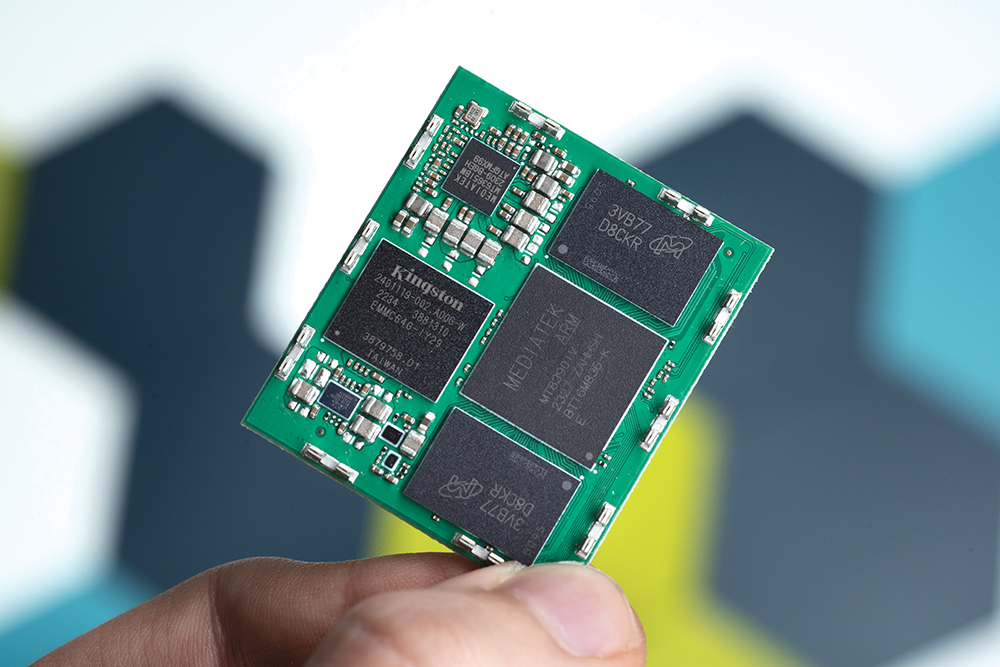
The first fruit of the partnership with MediaTek is the creation of a family of systems-on-module (SoMs) based on the MediaTek Genio 700 and Genio 510 application processors. The new Grinn GenioSOM-700 and GenioSOM-510, the world’s smallest SOMs based on the MediaTek Genio platform, support a combination of demanding compute workloads, real-time AI operations, and high-quality video, display and audio applications.
The partnership with MediaTek also helps Grinn to develop innovative and effective custom embedded computing solutions for its customers, enabling it to draw directly on advanced technical support from MediaTek, early access to MediaTek product roadmaps, and privileged supply-chain support.
The Grinn GenioSOM-700 is a high-performance SoM for smart home devices, industrial automation equipment, and computer vision systems, which require high-throughput vision processing capability and advanced AI acceleration. The industry’s smallest SoM based on the Genio 700 processor, it is supplied in an LGA-312 format, which has a footprint of just 37,0 x 42,6 mm.
The Grinn GenioSOM-700’s processor features dual 2,2 GHz Arm Cortex-A78 cores for intensive compute workloads, six 2,0 GHz Cortex-A55 cores for efficient multi-tasking, and an Arm Mali-G57 GPU for sophisticated graphics and smooth image rendering. The MT8390 supports real-time AI operation thanks to an on-chip 4 TOPS NPU.
The Grinn GenioSOM-700, which supports demanding compute and AI workloads in machine vision and audio applications, offers a combination of high-speed interfaces, image signal processing and video codecs.
The Grinn GenioSOM-510 is based on the MediaTek Genio 510 processor. It features dual 2,2 GHz Arm Cortex-A78 cores and four Cortex-A55 cores and incorporates an NPU.
For Grinn, however, it is not just about making things smaller. It is about pushing boundaries, creating solutions that balance size, power, and performance in ways that open new possibilities for IoT and AI applications.
Expanding its horizons
Though headquartered in Europe, Grinn’s ambitions are far broader. The company has already secured customers in North America and is forging partnerships with global distributors to make its products more accessible worldwide. “We are not limiting ourselves to Europe or the US,” Robert emphasises. “Our goal is to make our products available globally. The demand for AI-enabled, compact, and efficient system-on-modules is everywhere.”
As Grinn prepares new product launches and deepens its partnership with MediaTek, its story is one of steady evolution guided by a consistent principle: act as a true partner to customers. From its early days to today’s breakthroughs in SoM technology, the company has never strayed from that vision.
For more information visit www.grinn-global.com






© Technews Publishing (Pty) Ltd | All Rights Reserved
 printer friendly version