Espressif’s ESP32-H21 is a low-power wireless SoC aimed at battery-operated IoT devices that require Thread, Zigbee, Matter-over-Thread and Bluetooth Low Energy connectivity in a compact, cost-effective platform. As an evolution of the ESP32-H2 platform, ESP32-H21 integrates an on-chip DC-DC converter to further reduce active power consumption, helping extend battery life in always-connected sensor and control applications.
By combining IEEE 802.15.4 and Bluetooth LE in a single device, ESP32-H21 supports modern mesh networking approaches for smart-home and building-automation deployments, while also enabling low-power point-to-point communication for simpler endpoints.
Key features of the ESP32-H1 include:
• Ultra-low-power wireless SoC designed for Thread, Zigbee, Matter and Bluetooth Low Energy endpoints.
• Integrated IEEE 802.15.4 + Bluetooth LE radios in a single SoC.
• Thread and Zigbee mesh networking support for scalable multi-node deployments.
• Bluetooth and Bluetooth Mesh support for BLE-based networking.
• Low-power point-to-point communication support for simple links and peripherals.
• On-chip DC-DC converter to reduce active power consumption and improve receive (RX) efficiency for always-listening nodes.
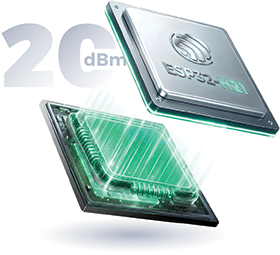
• Up to 20 dBm transmit power for extended range and stronger link budgets.
• 32-bit RISC-V microcontroller core for efficient protocol handling and system integration.
• Comprehensive peripheral set for sensors, actuators and user-interface components.
• Supported by ESP-IDF, including ESP-Matter SDK plus BLE roles, advertising and ESP-BLE-MESH in a unified framework.
Power efficiency for always-connected devices
For battery-powered nodes, receive-mode energy can dominate total consumption because many devices spend long periods listening for network traffic or wake-up events. ESP32-H21’s integrated DC-DC converter is intended to improve power efficiency during RX operation, helping extend operational life for sensors and control devices that must remain responsive.
ESP32-H21 supports transmit power up to 20 dBm, enabling improved range and link robustness in dense or interference-prone environments. This capability can reduce the need for additional routers or repeaters in distributed sensor networks, while maintaining power efficiency.
The device is ideally suited for use in smart-home sensors, building automation nodes, wearables, and other power-sensitive products.
RF filters explained RFiber Solutions
Telecoms, Datacoms, Wireless, IoT
As RF environments become increasingly crowded, RF filters play a critical role in maintaining signal quality, improving system performance, and ensuring reliable operation.
Read more...Industrial connectivity without compromise
Telecoms, Datacoms, Wireless, IoT
The IR315 combines 4G LTE, Wi-Fi, Ethernet, and VPN technologies into a rugged, industrial-grade platform that enables seamless connectivity across a wide range of applications.
Read more...Module provides 4G LTE Cat 1 bis connectivity Dizzy Enterprises
Telecoms, Datacoms, Wireless, IoT
Mikroe adds 4G LTE Cat 1 bis connectivity where reliable data transmission and low power consumption are critical with the GC02S1-EU2 module.
Read more...Enabling next-generation FPGA and SDR innovation RFiber Solutions
Telecoms, Datacoms, Wireless, IoT
Puzhi Electronic Technology has established itself as a dynamic provider of advanced ARM and FPGA-based solutions, delivering a comprehensive ecosystem of products designed for modern embedded and high-performance computing applications.
Read more...Magnetic mount antenna takes the hassle out of 4G installations iCorp Technologies
Telecoms, Datacoms, Wireless, IoT
Designed for fast, tool-free installation, the YECN022CA 4G magnetic mount whip monopole antenna gives wireless devices a dependable cellular link in the field, where installation time and signal reliability both matters.
Read more...Powering smart sensor networks CST Electronics
Telecoms, Datacoms, Wireless, IoT
NeoCortec’s NeoMesh wireless mesh networking protocol and software stack is ideally suited for powering smart sensor networks where each device is required to send and receive small packets of data infrequently, but with high reliability.
While every effort has been made to ensure the accuracy of the information contained herein, the publisher and its agents cannot be held responsible for any errors contained, or any loss incurred as a result. Articles published do not necessarily reflect the views of the publishers. The editor reserves the right to alter or cut copy. Articles submitted are deemed to have been cleared for publication. Advertisements and company contact details are published as provided by the advertiser. Technews Publishing (Pty) Ltd cannot be held responsible for the accuracy or veracity of supplied material.









 printer friendly version