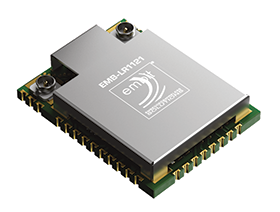
NeoCortec’s NeoMesh wireless mesh networking protocol and software stack is ideally suited for powering smart sensor networks where each device is required to send and receive small packets of data infrequently, but with high reliability. NeoMesh is optimised for ultra-low power operation, focusing on networks with many nodes, each of which is battery powered. In such applications, NeoMesh enables the network to operate on small batteries for several years.
NeoCortec has partnered with Endrich Bauelemente Vertriebs GmbH for powering their e-IoT platform with its low power and highly scalable NeoMesh wireless mesh networking protocol and software stack. Endrich’s e-IoT platform supports customers in the digitalisation of their industrial processes and includes IoT nodes, smart sensors, gateway devices as well as Cloud services.
Unlike most other mesh network technologies, NeoMesh is dynamic and scalable to thousands of nodes, with very few limits to network size or depth. It is also ‘self-healing’ since if a node fails, the system automatically re-routes the signal.
The NeoMesh is truly plug-and-play: attach an antenna, power on the small node and the protocol stack automatically forms an agile network without the need of a network manager to supervise the process. By replacing the Network Manager with autonomous intelligent nodes allows all network nodes to link to each other forming one single network that simply works, no matter how large it becomes. The protocol stack allows for up to
65 000 nodes in a single network.
The patented routing mechanism routes data seamlessly through the network and eliminates any concern in performance created by obstacles in the RF path, nodes being blocked or simply moving around within the network. Weak spots in a real life network can easily be fixed by just adding another node. Given it has the right network ID, it automatically becomes a part of the network.
Security and resilience is also built into the network; FHSS is used to spread the transmission evenly through the frequency band with all transmission encrypted using AES128.
NeoMesh is a self-forming, self-healing wireless mesh networking system that enables thousands of battery-powered devices to communicate reliably across large IoT networks without the need for dedicated routers or central network management.
RF filters explained RFiber Solutions
Telecoms, Datacoms, Wireless, IoT
As RF environments become increasingly crowded, RF filters play a critical role in maintaining signal quality, improving system performance, and ensuring reliable operation.
Read more...Industrial connectivity without compromise
Telecoms, Datacoms, Wireless, IoT
The IR315 combines 4G LTE, Wi-Fi, Ethernet, and VPN technologies into a rugged, industrial-grade platform that enables seamless connectivity across a wide range of applications.
Read more...Module provides 4G LTE Cat 1 bis connectivity Dizzy Enterprises
Telecoms, Datacoms, Wireless, IoT
Mikroe adds 4G LTE Cat 1 bis connectivity where reliable data transmission and low power consumption are critical with the GC02S1-EU2 module.
Read more...Enabling next-generation FPGA and SDR innovation RFiber Solutions
Telecoms, Datacoms, Wireless, IoT
Puzhi Electronic Technology has established itself as a dynamic provider of advanced ARM and FPGA-based solutions, delivering a comprehensive ecosystem of products designed for modern embedded and high-performance computing applications.
Read more...Magnetic mount antenna takes the hassle out of 4G installations iCorp Technologies
Telecoms, Datacoms, Wireless, IoT
Designed for fast, tool-free installation, the YECN022CA 4G magnetic mount whip monopole antenna gives wireless devices a dependable cellular link in the field, where installation time and signal reliability both matters.
Read more...Lessons in long-distance telemetry Omniflex Remote Monitoring Specialists
Telecoms, Datacoms, Wireless, IoT
Ian Loudon, international sales and marketing manager at Omniflex, reflects on some of the key engineering lessons learned from decades of deploying wireless telemetry systems in demanding industrial applications.
Read more...PEAK’s first automotive Ethernet solution Industrial Data Xchange (IDX)
Editor's Choice Telecoms, Datacoms, Wireless, IoT
The PAE-Media Converter is a robust and compact device designed to connect Automotive Ethernet (100BASE-T1 or 1000BASE-T1) with standard Ethernet (100BASE-TX or 1000BASE-T) networks.
While every effort has been made to ensure the accuracy of the information contained herein, the publisher and its agents cannot be held responsible for any errors contained, or any loss incurred as a result. Articles published do not necessarily reflect the views of the publishers. The editor reserves the right to alter or cut copy. Articles submitted are deemed to have been cleared for publication. Advertisements and company contact details are published as provided by the advertiser. Technews Publishing (Pty) Ltd cannot be held responsible for the accuracy or veracity of supplied material.









 printer friendly version