


Microtronix South Africa cements its commitment to local manufacturing with ongoing investments in production capacity, skills development, and job creation. As global markets become increasingly unpredictable and supply chains face continuing pressure, the ability to manufacture high-quality electronic products locally has become a strategic advantage for both industry and the country as a whole. Against this backdrop, Microtronix South Africa has made a significant investment in expanding its electronics manufacturing capability.
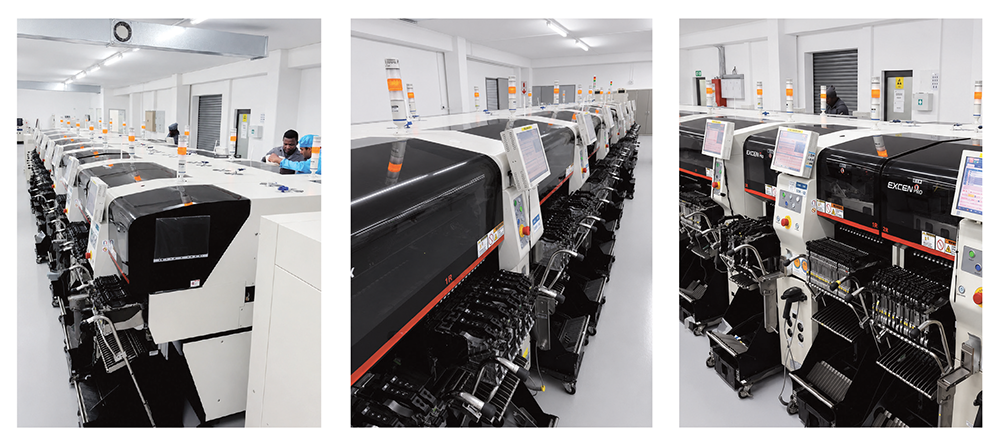
Microtronix South Africa has just completed the commissioning of a 7-module Hanwha (Samsung) SMT line with the assistance of Zetech. The line was acquired from the recently closed Samsung TV factory in KwaZulu-Natal. This investment further strengthens South Africa’s local electronics manufacturing capability and demonstrates Microtronix South Africa’s continued commitment to building advanced manufacturing capacity within the country. The line is ideally suited to fast-changeover, high-mix production, with over 50 feeder trolleys and exceeding 1000 feeders.
The company plans to use this line for fast prototyping and rapid changeovers on smaller PCB production runs. With such a large number of feeder trolleys and feeder slots available, jobs can be set up well in advance. After completing a small production run, the trolleys can simply be swapped out and the next job started within minutes, avoiding the lengthy feeder setup times normally associated with short-run manufacturing.
The 7-module, dual-lane line is also capable of high-speed, high-volume assembly, making it an excellent addition to the current Microtronix manufacturing fleet. The increased capacity and flexibility will enable the company to respond more rapidly to customer requirements, while remaining competitive in both local and international markets.
A large portion of Microtronix’s work this year has come from the energy sector and renewable energy products. The company has continued to manufacture smart meters for the Eskom rollout, despite erratic demand that often appears to reflect a lack of planning and understanding of the manufacturing process, including the time required to procure materials and produce the meters.
We trust that Eskom will continue to uphold its local content policies and strictly police the importation of fully assembled meters. So far this year, smart meter production has sustained approximately 40 full-time jobs, with an additional 30 workers employed on a part-time basis.
We believe it is extremely important for government-owned companies to support government policies and ensure that local content, job creation, and economic development remain top priorities.
The events of recent years have demonstrated the risks associated with over-reliance on imported products and global supply chains. Disruptions caused by pandemics, geopolitical tensions, shipping delays, currency fluctuations, and international trade disputes have highlighted the importance of maintaining strategic local manufacturing capability.
For Microtronix, local manufacturing is about creating sustainable employment, developing technical skills, and retaining engineering talent. It is also about contributing to the country’s long-term economic growth.
The new line has also arrived just in time to support the rollout of approximately 10 000 solar home systems (SHS) to rural areas where grid power remains unavailable or unreliable.
Each system consists of a 50 Ah lithium battery, a 150 W solar panel, a charge controller, and eight LED lights. Microtronix has won this contract for the third consecutive year and will begin producing the system components in August.
We are extremely proud to be manufacturing approximately 90% of the system locally, including 100% of the LED lights.
The Department of Electricity and Energy (DEE) has been highly proactive in enforcing local content policies, demonstrating that when government actively enforces its own policies, meaningful local manufacturing, skills development, and job creation can be achieved.
Global supply chains face uncertainty, and countries are working to protect and expand their domestic manufacturing sectors. South Africa cannot rely solely on imports to create sustainable employment, develop technical skills, and build long-term economic resilience.
The new SMT line at Microtronix South Africa shows that world-class electronics manufacturing can be successfully undertaken in South Africa. Every product manufactured locally supports jobs, develops local expertise, and contributes to a broader industrial ecosystem that benefits suppliers, service providers, and communities.
For Microtronix South Africa, manufacturing locally is a commitment to South Africa’s industrial future. By investing in modern equipment, developing local skills, and maximising local content, Microtronix South Africa continues to support economic growth, technological advancement, and job creation within the country.
| Tel: | +27 11 792 5322/3 |
| Email: | info@microtronix.co.za |
| www: | www.microtronix.co.za |
| Articles: | More information and articles about Microtronix Manufacturing |






© Technews Publishing (Pty) Ltd | All Rights Reserved
 printer friendly version