


For much of the last decade, the industrial IoT (IIoT) industry has been driven by a relatively simple assumption:if a little data is useful, more data must be better. That thinking shaped countless deployments.
Sensors became cheaper. Connectivity became more accessible. Cloud storage became effectively limitless. As a result, engineers gained the ability to instrument almost everything. Pumps, pipelines, transformers, water meters, refrigeration systems, logistics assets, bridges and buildings could all generate continuous streams of telemetry.
The technical challenge appeared solved: collect the data, store the data, analyse the data.
Yet despite significant advances in sensing, networking and analytics, many organisations continue to discover operational failures long after they occur. Water leaks remain undetected for days. Infrastructure faults develop unnoticed. Cold chain failures are often identified only after stock has been compromised. High-value assets still disappear despite sophisticated tracking systems.
This raises an uncomfortable question. If organisations have access to more operational data than ever before, why do operational blind spots persist?
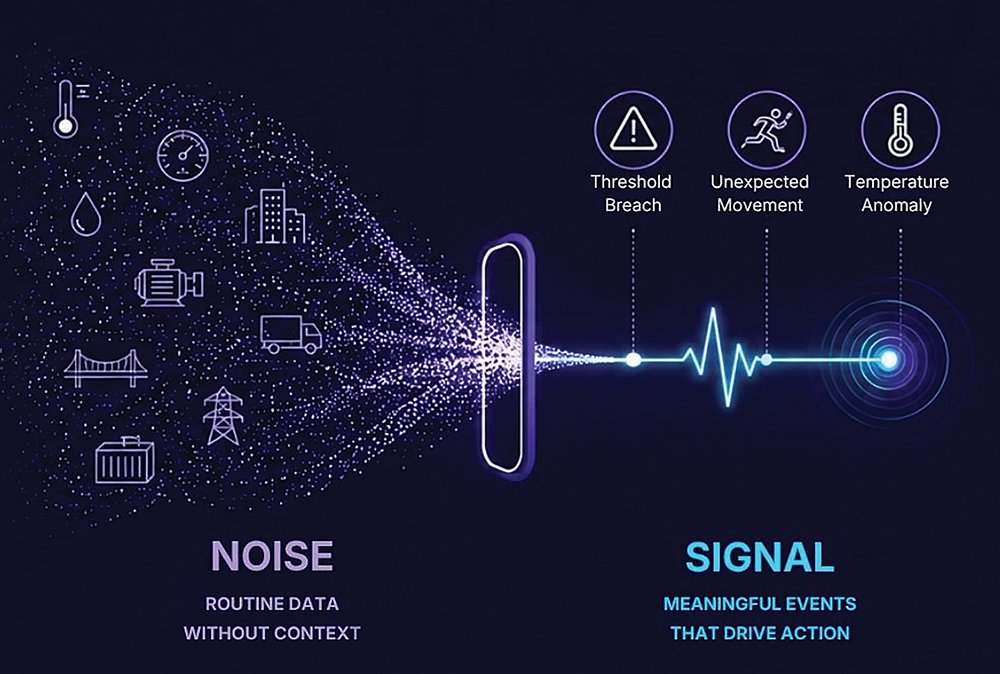
The answer may lie in a distinction that is rarely discussed in industrial monitoring circles: the difference between data and signal. From an engineering perspective, not all telemetry carries equal value.
A pressure sensor transmitting the same reading every fifteen minutes may generate thousands of messages every month. A temperature sensor operating within normal parameters may produce an even larger dataset. Yet neither necessarily provides meaningful operational intelligence.
The value often lies not in the steady-state condition, but in the exception:
• The sudden pressure drop.
• The unexpected temperature rise.
• The unauthorised movement.
• The structural deformation.
• The abnormal consumption pattern.
These are signals. They represent changes in state that require attention, intervention or investigation. Unfortunately, many telemetry architectures continue to be designed around periodic reporting rather than event significance.
Historically, this approach made sense. Communication networks were designed around availability rather than efficiency, and storage costs were falling rapidly enough that collecting everything appeared to be a sensible strategy.
However, the growth of IIoT is beginning to expose the limitations of that model. As deployments scale from hundreds of devices to tens of thousands, engineers are increasingly confronted by a simple reality: every transmitted message carries a cost.
Radio transmissions use energy, network traffic takes up capacity, backend systems require processing power, and analytics platforms utilise resources. Most importantly, engineers consume time attempting to determine which information actually matters.
A growing signal-to-noise problem
Many industrial environments are now generating more operational information than engineering teams can realistically interpret. Ironically, the pursuit of complete visibility can sometimes reduce visibility by burying important events inside large volumes of routine telemetry.
This is one of the reasons why event-driven telemetry architectures are attracting increasing attention across utilities, logistics, infrastructure monitoring and industrial automation. Instead of transmitting continuously, event-driven systems are designed to communicate only when operationally significant conditions occur.
The concept is deceptively simple. If nothing has changed, there may be little value in transmitting; if something has changed, immediate communication becomes critical.
Reducing unnecessary transmissions can dramatically improve battery life. Devices designed around event-based reporting often achieve operational lifespans measured in years rather than months. Maintenance cycles become less frequent. Infrastructure requirements become simpler. Network scalability improves significantly.
Reduced noise, improved operations
Perhaps more importantly, operational intelligence improves. The system no longer asks engineers to interpret thousands of routine status messages in search of an anomaly. Instead, it highlights the anomaly itself.
This philosophy can be observed across a growing number of industrial applications. Utility operators are increasingly interested in abnormal consumption patterns rather than routine readings. Infrastructure monitoring systems focus on movement, strain or deformation events rather than continuous reporting. Cold chain solutions prioritise threshold breaches over normal operating conditions. Security systems increasingly transmit only when tampering or intrusion occurs. Similar approaches are being used globally across logistics, infrastructure, utilities and industrial monitoring deployments.
AI makes the distinction even more important
Much of the current discussion surrounding AI assumes that more data naturally produces better outcomes. In practice, AI systems remain entirely dependent on the quality of the information they receive. Poor operational signals simply produce more sophisticated interpretations of incomplete reality.
The effectiveness of future industrial intelligence systems may therefore depend less on the sophistication of the analytics layer and more on the quality of the telemetry architecture beneath it.
For engineers, this represents an important shift in thinking. The challenge is no longer determining how much data can be collected, but which information deserves to be communicated in the first place.
As industrial systems continue to scale, the most successful telemetry architectures may not be the ones that generate the largest datasets. They may be the ones that understand the difference between information and insight.
The objective is not to collect the maximum amount of data possible. The objective is to collect the right data, at the right time, and for the right reason.
| Tel: | +27 10 497 5432 |
| Email: | sales@sigfoxsa.co.za |
| www: | www.sigfoxsa.co.za |
| Articles: | More information and articles about Sigfox South Africa |






© Technews Publishing (Pty) Ltd | All Rights Reserved
 printer friendly version