


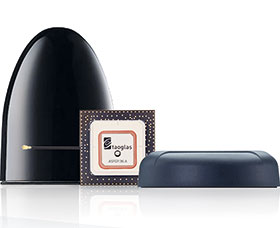
Taoglas launched a range of multiband high-performance GNSS antennas specifically designed to power the next generation of applications that require highly accurate location capabilities, including navigation, unmanned aerial vehicles (UAVs), precision heavy equipment, surveying, agriculture, and paving the way for the rise of autonomous vehicles.
To deliver the best accuracy, centimetre-level positioning and precise location capabilities required for applications like the connected car and autonomous driving, the use of multiple RF bands is required. Taoglas’ new range includes systems and antennas that utilise not only the additional functions of Galileo, GLONASS and BeiDou satellite systems, but also the GPS L1 and L2 or L1 and L5 bands to deliver the highest levels of accuracy and performance required.
The new antenna range includes the GRS.10, a ‘smart’ antenna that includes a high-performance GNSS (GPS, GLONASS, Galileo, BeiDou) ceramic antenna integrated with a u-blox NEO-M8U module. The integrated antenna removes additional loss brought on by the coaxial cables of external antennas, which results in better signal quality and acquisition times. This allows for longer cable runs during installation without degrading signal performance. The GRS.10 is an ideal product for installations in which a standard antenna cannot get a good view of the sky without a long cable run.
The Torpedo series GNSS quadrifilar helical antennas, extremely high-performance wideband satellite antennas for applications where position information is critical. The wide gain and axial ratio beam width provide excellent reception and signal fidelity across the sky. The form factor is suited for base stations, telecommunications equipment, and other use cases such as remote monitoring. These are available in passive (QHA) or active (AQHA) versions.
The BOLT A.90.A.10451111, a new GNSS timing antenna that includes lightning-induced surge protection and is an ideal solution for the base station market. The advantage over existing timing antennas is the addition of GLONASS and BeiDou. It exhibits excellent out-of-GNSS-band rejection while maintaining a low noise figure, and comes in a through-hole mount IP69 and IP67 format.
The complete range of precision GNSS antennas also includes the ASFGP.36A.07.0100C, a ceramic GPS L1/L2 low-profile, low-axial-ratio, embedded stacked active patch antenna. The additional capability to also utilise L2 signals with a compatible receiver can greatly improve the reliability of a GPS fix in urban areas, and also delivers better signal reception with more satellites acquired, and a quicker time to first fix. By stacking the antennas in an innovative wedding cake style, the form factor is compact for vehicles and UAVs, yet provides the best performance for GNSS by optimising axial ratio.
The MAT.12A a GPS/GLONASS/BeIDou duelling-loop chip antenna evaluation board delivers the advantages of a circularly polarised patch antenna, with two miniaturised low-profile chip antennas on a smaller PCB footprint, at one-fifth the weight. Two linearly polarised chip antennas are used, and instead of relying on the geometry of the antenna to deliver circular polarisation, it is enforced through the use of a hybrid coupler, which ensures that the power delivered to both antennas is always the same in magnitude and always 90 degrees separated in phase.
Taoglas also launched a range of small-form-factor ultra-wideband (UWB) antennas specifically designed to work with Decawave chipset and module solutions for applications including asset tracking, follow-me drones, healthcare monitoring, smart home services, and other applications that demand high-performance indoor localisation capabilities.
For more information contact Andrew Hutton, RF Design, +27 (0)21 555 8400, [email protected], www.rfdesign.co.za
| Tel: | +27 21 555 8400 |
| Email: | [email protected] |
| www: | www.rfdesign.co.za |
| Articles: | More information and articles about RF Design |






© Technews Publishing (Pty) Ltd | All Rights Reserved
 printer friendly version