Bluetooth 5.0 Low Energy module
25 March 2020
Telecoms, Datacoms, Wireless, IoT
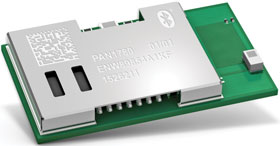
An output power of up to +8 dBm and the high sensitivity of the nRF52840, in combination with the LE coded PHY, make the module very attractive for applications that require a long range.
The Bluetooth 5.0 features enable a higher symbol rate of 2 Mbps using the high-speed LE 2M PHY. Furthermore, the new LE advertising extensions allow for much larger amounts of data to be broadcasted in connectionless scenarios. Besides BLE5.0 with the qualified Bluetooth mesh profile stack, it supports 802.15.4 and NFC-A.
With its Cortex M4F processor, 256 KB RAM and the built-in 1 MB Flash memory, it can easily be used in standalone mode, thereby eliminating the need for an external processor, saving complexity, space and cost. Complementarily available is the PAN1780AT, a variant with additional AT command set.
At only 15,6 x 8,7 x 2,0 mm, the compact module features an ARM TrustZone Cryptocell 310 security core that supports a secure boot process. A temperature sensor is also integrated in the PAN1780 module. The operating temperature range is -40°C up to 85°C and the supply voltage ranges from 1,7 V up to 5,5 V.
Especially IIoT (Industrial Internet of Things) applications like devices for smart city infrastructure, industrial mesh networks or robotics within Industry 4.0 environments can benefit from the comprehensive features of the PAN1780 module. Smart health and secure medical peripherals or building automation applications like smart locks or intelligent lighting are also suitable areas of use. Thanks to its high performance and the built-in Cryptocell of the PAN1780 Bluetooth module it is also a fitting solution for edge computing purposes.
Further reading:
Macom targets broadband radar with time delay MMIC
RFiber Solutions
Telecoms, Datacoms, Wireless, IoT
Macom’s MADU FR1012 is a GaAs MMIC 1-bit true time delay device covering 4 GHz to 12 GHz, designed for broadband microwave systems where beam accuracy and signal integrity are critical.
Read more...
Compact analogue phase shifter
RF Design
Telecoms, Datacoms, Wireless, IoT
The Mini-Circuits JSPHS-150+ is a compact analogue voltage-controlled phase shifter designed for narrowband RF applications between 100 and 150 MHz.
Read more...
Wireless connectivity expanded
iCorp Technologies
Telecoms, Datacoms, Wireless, IoT
Espressif Systems has introduced two new members of its ESP32 wireless SoC family: the ESP32-E22, the company’s first Wi-Fi 6E connectivity chip, and the ESP32-H21, an ultra-low-power Bluetooth LE microcontroller aimed at coin-cell and battery-powered devices.
Read more...
Integrated X-band radar front-end module
RF Design
Telecoms, Datacoms, Wireless, IoT
Qorvo has introduced an X-band radar front-end solution that enables defence system designers to achieve higher performance without increasing size, weight or prime power.
Read more...
Introducing Aurata
CST Electronics
Telecoms, Datacoms, Wireless, IoT
Antenova has launched Aurata SR4L112: a compact, high efficiency embedded 4G/LTE antenna engineered for long, narrow PCB designs.
Read more...
Multi-constellation GNSS module in a legacy-compatible footprint
Altron Arrow
Telecoms, Datacoms, Wireless, IoT
Telit Cinterion has announced the SE869eK2L, a single-frequency L1 GNSS module designed to help device manufacturers upgrade legacy positioning designs with improved performance and cost efficiency, while preserving design continuity.
Read more...
Quectel expands 5G portfolio
iCorp Technologies
Telecoms, Datacoms, Wireless, IoT
Quectel expands 5G portfolio with new Qualcomm- and UNISOC-based modules.
Read more...
Compact RTK design: More than just the receiver
iCorp Technologies
Editor's Choice Telecoms, Datacoms, Wireless, IoT
In practice, engineers building compact RTK products keep discovering the same thing: the hardest component in the system is no longer the receiver. It is the antenna.
Read more...
Microchip advances Space-Grade timing performance
ASIC Design Services
Telecoms, Datacoms, Wireless, IoT
Microchip Technology has expanded its atomic clock portfolio with the radiation-tolerant Space CSAC-SA65, a Chip Scale Atomic Clock designed to deliver precise timing for space systems.
Read more...
Channel emulator for 6 G and Wi-Fi 7/8
Concilium Technologies
Telecoms, Datacoms, Wireless, IoT
With 400 MHz instantaneous bandwidth and support for carrier frequencies up to 23,6 GHz, Vertex 6.0 is the industry’s first channel emulator designed for next generation 6 G and Wi-Fi 7/8 testing.
Read more...









 printer friendly version