


A month ago I was lucky enough to attend the Gitex 2017 Technology Week at the Dubai World Trade Centre. I found myself sitting in a massive hall surrounded by energetic and engaging technical conversations about cutting edge innovative technologies related to global smart cities, Internet of Things (IoT), virtual reality, artificial intelligence (AI) and more.
I remained mesmerised while waiting for one of the many informative ‘Tech Talks’ panel discussions to begin. This particular topic was ‘IoT Connected Devices and Networks’ with an expert panel including the senior director of technology for Qualcomm, VP of Internet of Things for Etisalat and principal for Roland Berger.
After the very first question posed to the panellists, I was surprised to hear their expectations of how big an impact IoT and AI will have on the world, calling it the ‘next industrial revolution’, which will have a significantly larger impact than that which was caused by the Internet. This alone took me aback, considering how much the internet has already influenced our daily lives.
The expectation is that IoT and AI will change the way all businesses, governments and consumers interact with the physical world, with Qualcomm’s strategy aligned to three main sectors – smart cities, smart homes and wearables. In each IoT and AI technology sector and applications within, there are subtle differences between the data acquisition methods, cloud storage and computing requirements, and the user control and accessibility.
When taking an holistic view of the IoT and AI ecosystem, clear distinction can be made between these two components as represented in Figure 1. In order to realise the expected revolutionary applications, IoT and AI must work in conjunction with each other, with IoT focusing on the physical sensing and controlling functions, while AI focuses on the data analytics and processing functions.
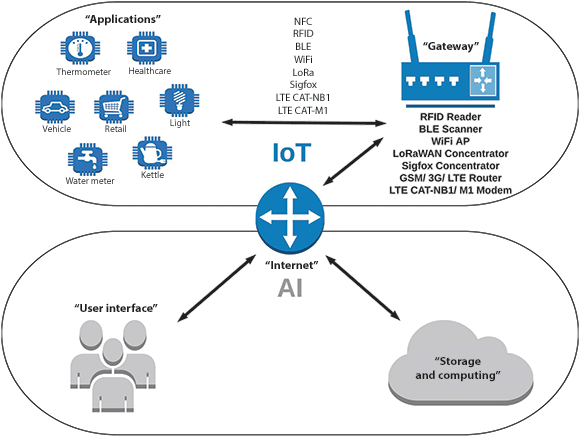
A more in-depth look at an IoT system reveals that the basic flow of information goes from sensor to microprocessor to gateway. Introducing wireless technologies to enhance the IoT system can typically influence the information flow to become sensor to microprocessor to wireless module to wireless gateway. The emergence of numerous wireless technologies, many specifically designed for IoT, raises the question of “Which wireless IoT technology should I use for my application?”
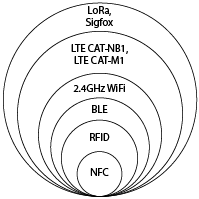
There are three main factors to consider when deploying a wireless IoT sensor or controller: power, range (network coverage) and speed. The chart in Figure 2 maps out the various IoT wireless technologies transmission ranges from shortest to longest.
NFC applications typically utilise a transmission range of roughly 5 cm and as a result are commonly used in secure access control systems. Passive RFID tags can transmit from roughly 5 cm to 20 m away depending on the RF output power used by the RFID reader. NFC and RFID are dependent on the power of the signal transmitted by the RFID reader as they do not have their own power source, but rather utilise the energy contained in the reader signal to transmit their own unique signal. Some single-channel RFID reader modules can read up to 400 times per second and use up to 3,25 W, with industrial readers using up to 60 W.
BLE transceiver modules, unlike NFC and RFID, require their own power source for operation and are being adopted in many applications as a beacon for transmitting a short signal over a preconfigured time interval, such that a BLE scanner can be used to track the beacon, specifically indoors where GPS signal may not be available. A BLE beacon can transmit at a distance of up to 75 m and, depending on the configured time interval, can run on a standard 225 mAh coin cell for up to seven years, using less than 1 mW per transmission.
Wi-Fi mini-PCIe cards traditionally used in laptops and PCs exhibit a power consumption up to 15 W with a transmission range of 15 m to 150 m and speed up to 300 Mbps depending on the environment, such speed specifically being negatively impacted by obstructions between the Wi-Fi client and access point. Newer Wi-Fi modules intended for IoT applications exhibit a similar range performance with an improved power consumption of less than 300 mW, usually at the expense of the network speed. Due to the popularity and increased coverage of Wi-Fi networks, these modules, much like other IoT wireless modules, are particularly suited to smart cities and smart home applications requiring small data packet transfers.
Over the past few years we have seen a rise of new mobile network service providers in the form of IoT network service providers. There have been two main IoT network technologies deployed around South Africa, those being LoRa and Sigfox. The latest IoT technologies to be entering into the LPWAN network category with LoRa and Sigfox are LTE CAT-NB1 and LTE CAT-M1.
These technologies are planned to be deployed by the mobile network service providers onto parts of their existing network in order to cater for IoT applications. We have been told that Vodacom has successfully tested and deployed LTE CAT-NB1 and their plan is to roll this out to cover all major cities in South Africa by year end. MTN has been evaluating both technologies and recently announced the successful test of LTE CAT-M1 in collaboration with Ericsson and Qualcomm.
The LTE CAT-NB1 and LTE CAT-M1 modules have an average power consumption of less than 1 W with pulses up to 2,5 W, in comparison to an average power consumption of less than 2 W with pulses up to 8 W for GSM. The higher-speed LTE technology CAT-M1 exhibits up to 375 Kbps in comparison to 66 Kbps on CAT-NB1, and is capable of tower handover which is crucial for certain tracking applications that require active connections whilst moving locations.
LoRa and Sigfox modules consume less than 1 W and already have LPWAN networks deployed in all major cities in South Africa. Sigfox has a global network of service providers and as such offers a unique network covering most major cities around the world for IoT applications to run on. Sigfox modules can transmit at a data rate of 12 Bps and receive up to 8 Bps. LoRa point to point modules can transmit up to 10 km line of site or up to 130 Bps while adhering to a 10% on-air duty cycle within the 868 MHz frequency band.
The countless number of wireless IoT applications are matched by a vast range of data transport options. Applications that utilise asset counting or tracking within a close proximity are well suited to the capabilities of NFC, RFID and BLE. Applications which require either a faster network speed or greater network coverage are better suited to the features offered by Wi-Fi. Those applications which require low power consumption nodes connecting onto a network with broad coverage are perfect for the LPWAN networks in the form of LoRa, Sigfox, LTE CAT-NB1 and LTE CAT-M1.
Ultimately the choice in technology comes down to the level of services which need to be offered to the end customer. Gone are the days when the only service offered was ‘Internet connectivity’, and instead what we are seeing is an assumption, or premise, that Internet connectivity must be present, in order to act as a backbone for the next layer of communication. This next layer is the basis of the IoT, essentially moving basic connectivity from the Internet access point to the device level, and the type of device, and the services which need to be offered based on the type of device, is what is driving wireless technology choice.
Otto Wireless Solutions remains committed to offering a diverse product offering, as well as the technical support, to grow and enable this market, and the company stands ready to advise on which tag, module, reader, scanner, concentrator, access point, modem or gateway is best suited to any IoT application.
| Tel: | +27 11 791 1033 |
| Email: | wireless@otto.co.za |
| www: | www.otto.co.za |
| Articles: | More information and articles about Otto Wireless Solutions |






© Technews Publishing (Pty) Ltd | All Rights Reserved
 printer friendly version