

Power Electronics / Power Management


Solar-powered bakery developed at UJ

26 June 2019 Power Electronics / Power Management Editor's Choice

Despite being ranked as the eighth most developed country in Africa in the United Nations Development Programme’s annual report in 2018, several challenges still plague South Africa.

The need for employment, access to energy, economic activity, community development and access to affordable essential foods is still very prominent in both rural and urban areas.

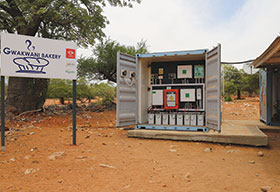
While working on a project to empower a remote village in the northern part of South Africa through locally available renewable energy sources, Profs Johan Meyer and Sune von Solms of the University of Johannesburg’s (UJ) School of Electrical and Electronic Engineering Sciences conceptualised the Solar Bread Box – a first for commercial sized photovoltaic solar bakeries.

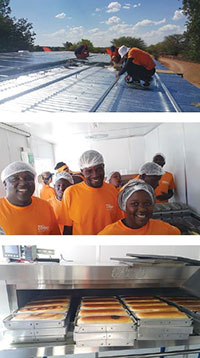
Boasting the same equipment and baking cycle as a standard grid tied commercial bakery, the Solar Bread Box eliminates the dependence, purchase and monthly bills associated with grid tied electricity. Not only that, but the bakery is also an instantaneous employment and skills development opportunity for youths, a tool for economic stimuli and an avenue for an essential product.
Low income households in rural and urban communities where there is no grid connection; communities where the residents cannot afford electricity; or communities where there are underlying social issues regarding the access and distribution of electrical power consider bread an everyday staple. The affordability and access of wholesome, fresh bread is essential in such areas.

Prof Meyer clarifies that the Solar Bread Box should not be confused with other solar solutions such as concentrated solar power or solar thermal technologies that are used for heating and cooling. He explains that this solution uses a photovoltaic system, which converts solar energy into electrical power used for the baking process.

Prof von Solms says that the idea is for the bakery to function on the conversion of solar energy as much as possible – minimising the cost of solar energy storage solutions. This means that baking will be seasonally dependent, and bakers will have to adjust their baking times in accordance with the sun to harness maximum power during baking cycles.

The UJ School of Electrical Engineering, in collaboration with Bakery and Food Technology Incubator of South Africa (BICSA), offers training on how to bake, how to run a bakery as a business and how to maintain a solar PV system, enabling communities to thrive independently.

So far, the Solar Bread Box has sparked economic activity, created jobs for eight individuals, created an enterprise that now serves neighbouring villages, enabled access to wholesome foods and the production of at least 100 loaves of bread a day, and boosted skills development in Gwakwani – a small, remote village in Limpopo that initially had no grid connection.

When used as a tool for community development, the Solar Bread Box becomes a self-sustaining, economy stimulating, job creating and skills development platform – creating communities that have access to healthy, wholesome baked goods, are self-dependent and economically active.

For more information contact Cornay Keefer, University of Johannesburg, [email protected]


Share this article:
Share via emailShare via LinkedInPrint this page

Further reading:

Powering the IoT
Uniross Batteries Power Electronics / Power Management
Choosing the right battery is not simply a technical detail, but a defining factor in the longevity and cost-effectiveness of any IoT deployment.

Read more...
The move to DC infrastructure
IOT Electronics Power Electronics / Power Management
The shift toward direct current infrastructure in data centres is accelerating as operators pursue higher efficiency, improved reliability, and stronger alignment with renewable energy goals.

Read more...
Power inductor for automotive applications
Würth Elektronik eiSos Power Electronics / Power Management
The WE-MXGA inductor features RDC values up to 25% lower and a saturation current up to 47% higher compared to other components currently available on the market.

Read more...
High-performance DC-DC converter
Conical Technologies Power Electronics / Power Management
With a wide 9 - 40 V DC input range, the Claf Power DWHB400-F24xxN series is a high-performance DC-DC converter family ideally suited for 12 V and 24 V battery-based systems including vehicles, off-grid installations, and distributed power architectures.

Read more...
DC-DC converters for next-generation IoT
iCorp Technologies Power Electronics / Power Management
AIPUPOWER’s K78XXJT-500R3 and K78XXJT-500R3-LB give designers a compact, high-efficiency power option for battery-powered and space-constrained systems, combining up to 96% efficiency with no-load input current as low as 0,2 mA.

Read more...
240 W in compact form factor
Brabek Power Electronics / Power Management
The cost-effective and reliable RECOM RACPRO1-S240E DIN-rail mount AC-DC series is only 125 x 139 mm and 39 mm wide, yet provides 240 W output.

Read more...
You cannot manage what you cannot measure
Power Electronics / Power Management
South African sites are generating solar energy. Most still have no idea what is consuming it… or when, or why. Intelligent load management hardware is changing that.

Read more...
Scalable and intelligent power solution
Power Electronics / Power Management
Designed for Africa’s rapidly evolving energy landscape, Bluetti’s ES125 offers a scalable, intelligent power solution that delivers reliable and cost-efficient electricity for uninterrupted operations.

Read more...
Simulating grid abnormalities
Conical Technologies Power Electronics / Power Management
Simulating grid abnormalities has become an essential part of validating systems such as inverters, UPS units, photovoltaic inverters, and EV charging infrastructure.

Read more...
Evaluation board for STPMIC25 PMIC
Power Electronics / Power Management
The STEVAL-PMIC25V1 is a power management IC evaluation board for the highly integrated STPMIC25, which is designed to manage the power requirements of the core, memory, and interfaces of the STM32MP2x series MPU.

Read more...


While every effort has been made to ensure the accuracy of the information contained herein, the publisher and its agents cannot be held responsible for any errors contained, or any loss incurred as a result. Articles published do not necessarily reflect the views of the publishers. The editor reserves the right to alter or cut copy. Articles submitted are deemed to have been cleared for publication. Advertisements and company contact details are published as provided by the advertiser. Technews Publishing (Pty) Ltd cannot be held responsible for the accuracy or veracity of supplied material.


© Technews Publishing (Pty) Ltd | All Rights Reserved

