Drying and storage cabinets use 'active desiccant'
15 November 2006Manufacturing / Production Technology, Hardware & Services
If moisture is absorbed from the environment by surface-mounted components, and then the components are exposed to high temperatures, as in solder reflow ovens (by convection, infrared, IR/convection, vapour phase, hot air rework tools, etc), then the absorbed moisture will expand rapidly, causing internal device stress. The resulting stress can cause internal or external cracking, delamination, and internal corrosion in the components.
Mekko offers a range of drying cabinets that are equipped with active desiccant rotor drying units, which continuously regenerate the desiccant. This means that only the cabinet and electricity is required, eliminating the requirement for any extra consumables or services to operate the unit.
All models are equipped with a desiccant rotor drying unit. This unit is installed inside the cabinet to keep the internal humidity at less than 5%RH. The operator can select continuous operation, or automatic control by an RH meter. Valuable components are protected from micro-cracking and delamination by using active desiccant, rather than baking.
Principle of operation
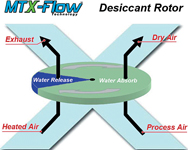
The drying unit is built into the base of the cabinet. The powerful absorbing desiccant rotor system incorporating Mekko's 'MTX-flow' technology, whereby the desiccant rotor rotates in two separate streams of air. One sector has air flowing through it within the cabinet (moisture absorb), while a smaller sector uses an external heated air flow to regenerate the desiccant (moisture release). As the disk rotates, fresh, dry desiccant is always presented to the process air flow.
Much research was done on the air flow. This unique air flow system optimises the drying and regenerating ability with minimal air leakage into the cabinet.
Cabinets
The cabinets are free-standing and self-controlled, and do not require nitrogen or compressed air. They comply with IPC/JEDEC J-STD-033, which details recommendations for handling, packing, shipping and use of moisture/reflow sensitive surface mount devices. The RH meter and digital thermo-meter are included in the cabinet, viewable through door. Mains electrical supply is 230 V a.c., 1 kW max. (ave. power is approx. 100 W). They are electrostatic safe and conform to ESD standard EN 61340-5-1.
Weller limited Black Edition soldering station Testerion
Manufacturing / Production Technology, Hardware & Services
Weller’s WE1010 Black Edition Soldering Station is a premium limited-edition soldering station.
Read more...Quick and easy shielding Würth Electronics South Africa
Electronics Technology Manufacturing / Production Technology, Hardware & Services
Würth Elektronik expands its EMC product portfolio with nanocrystalline WE-FNCS sheets.
Read more...Smarter local buying could reboot South Africa’s manufacturing sector
Manufacturing / Production Technology, Hardware & Services
With smarter localisation, clearer procurement rules and a more deliberate industrial strategy, public spending could again become a powerful engine for rebuilding factories, expanding supply chains and restoring confidence in South Africa as a place that makes things.
Read more...The effect of seasonal changes on ESD performance in South Africa Actum
Editor's Choice Circuit & System Protection Manufacturing / Production Technology, Hardware & Services
Electrostatic discharge performance is influenced by several environmental factors, with relative humidity being one of the most important. This is particularly relevant in South Africa, where seasonal changes can result in significant differences in humidity levels.
Read more...High precision in-line conformal coating inspection system MyKay Tronics
Manufacturing / Production Technology, Hardware & Services
Conformal coating is widely used to protect electronics from moisture or other environmental hazards. It is critical to know if coatings are properly applied; covering what is meant to be covered and not covering what should be exposed.
Read more...Soldering day highlights
Manufacturing / Production Technology, Hardware & Services
JAPAN UNIX has published a new event report and highlight video from their UNIX SOLDERING DAY 2026 in Hungary. This event reflects on their commitment to supporting manufacturers not only through soldering automation systems, but also through technical education, live demonstrations, hands-on training, and practical engineering know-how.
Read more...Clearing the Static: Electrostatic Discharge Actum
Manufacturing / Production Technology, Hardware & Services
A cordless ESD (Electrostatic Discharge) wrist strap does not work by grounding the person in the same way as a traditional wired wrist strap. Instead, it works by reducing or balancing the static charge on your body so that you are less likely to discharge electricity into sensitive electronic components.
Read more...Engineering trust in South Africa’s SMT sector ZETECH ONE
Manufacturing / Production Technology, Hardware & Services
From a small Johannesburg start-up to a trusted SMT technology partner, Zetech One has spent four decades helping South African electronics manufacturers improve production quality, efficiency and reliability.
Read more...The new reality of PCB material supply Jemstech
Editor's Choice Manufacturing / Production Technology, Hardware & Services
How resilient manufacturing strategies are helping OEMs navigate a changing global supply chain.
Read more...Streamlining Device Programming with the AutoBee-D1 Vepac Electronics
Manufacturing / Production Technology, Hardware & Services
The AutoBee-D1 desktop automated programmer is designed to simplify the programming of devices, while delivering consistent accuracy, high throughput and reduced manual intervention.
While every effort has been made to ensure the accuracy of the information contained herein, the publisher and its agents cannot be held responsible for any errors contained, or any loss incurred as a result. Articles published do not necessarily reflect the views of the publishers. The editor reserves the right to alter or cut copy. Articles submitted are deemed to have been cleared for publication. Advertisements and company contact details are published as provided by the advertiser. Technews Publishing (Pty) Ltd cannot be held responsible for the accuracy or veracity of supplied material.









 printer friendly version