


To build an advanced wireless system, most developers will end up choosing between two industrial, scientific and medical (ISM) radio band options – 2,4 GHz or sub-GHz frequencies.
Pairing one or the other with the system’s highest priorities will provide the best combination of wireless performance and economy. These priorities can include range, power consumption, data rates, antenna size, interoperability (standards) and worldwide deployment.
Wi-Fi, Bluetooth and ZigBee technologies are heavily marketed 2,4 GHz protocols used extensively in today’s markets. However, for low-data-rate applications, such as home security/automation and smart metering, sub-GHz wireless systems offer several advantages, including longer range, reduced power consumption and lower deployment and operating costs.
Sub-GHz radios
Sub-GHz radios can offer relatively simple wireless solutions that can operate uninterrupted on battery power alone for up to 20 years. Notable advantages over 2,4 GHz radios include the following:
Range – The narrowband operation of a sub-GHz radio enables transmission ranges of more than a kilometre. This allows sub-GHz nodes to communicate directly with a distant hub without hopping from node to node, as is often required using a much shorter-range 2,4 GHz solution. There are three primary reasons for sub-GHz superior range performance over 2,4 GHz applications:
* As radio waves pass through walls and other obstacles, the signal weakens. Attenuation rates increase at higher frequencies, therefore the 2,4 GHz signal weakens faster than a sub-GHz signal.
* 2,4 GHz radio waves also fade more quickly than sub-GHz waves as they reflect off dense surfaces. In highly congested environments, the 2,4 GHz transmission can weaken rapidly, which adversely affects signal quality.
* Even though radio waves travel in a straight line, they do bend when they hit a solid edge (like the corner of a building). As frequencies decrease, the angle of diffraction increases, allowing sub-GHz signals to bend farther around an obstacle, reducing the blocking effect.
The Friis Equation demonstrates the superior propagation characteristics of a sub-GHz radio, showing that path loss at 2,4 GHz is 8,5 dB higher than at 900 MHz:
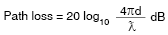
where d = distance and λ = wavelength
This translates into 2,67 times longer range for a 900 MHz radio since range approximately doubles with every 6 dB increase in power. To match the range of a 900 MHz radio, a 2,4 GHz solution would need greater than 8,5 dB additional power.
Low interference – The airways are crowded with colliding 2,4 GHz signals from various sources, such as home and office Wi-Fi hubs, Bluetooth-enabled computer and cellphone peripherals and microwave ovens. This traffic jam of 2,4 GHz signals creates a lot of interference. Sub-GHz ISM bands are mostly used for proprietary low-duty-cycle links and are not as likely to interfere with each other. The quieter spectrum means easier transmissions and fewer retries, which is more efficient and saves battery power.
Low power – Both power efficiency and system range are functions of the receiver sensitivity plus the transmission frequency. The sensitivity is inversely proportional to channel bandwidth, so a narrower bandwidth creates higher receiver sensitivity and allows efficient operation at lower transmission rates.
For example, at 300 MHz, if the transmitter and receiver crystal errors (XTAL inaccuracies) are both 10 ppm (parts per million), the error is 3 kHz for each. For the application to efficiently transmit and receive, the minimum channel bandwidth is two times the error rate, or 6 kHz, which is ideal for narrowband applications. The same scenario at 2,4 GHz requires a minimum channel bandwidth of 48 kHz, which wastes bandwidth for narrowband applications and requires substantially more operating power.
In general, all radio circuits running at higher frequencies, including low-noise amplifier, power amplifier, mixer and synthesiser, need more current to achieve the same performance as lower frequencies.
Range, low interference and low power consumption are basic advantages of sub-GHz applications over 2,4 GHz apps. One of the disadvantages often cited is that the antennas are larger than those used in 2,4 GHz networks. The optimal antenna size for 433 MHz applications, for instance, can be up to 18 cm. However, antenna size and frequency are inversely proportional. If node size is an important design consideration, developers can raise the frequency (up to 950 MHz) in order to employ a smaller antenna.
2,4 GHz vs. sub-GHz application trends
Both 2,4 GHz and sub-GHz technologies are expanding in the consumer, industrial and automotive marketplaces. The 2008 2,4 GHz TAM (total available market) was 172 million units while the sub-GHz TAM was almost three times that number at 492 million. Figure 1 illustrates how sub-GHz and 2,4 GHz applications have dominated in specific applications. Remote keyless entry (RKE) is a common sub-GHz application, where low-data-rate transmission at a fairly long range (100+ metres) and very long battery life are high priorities. The same is true for remote garage door openers (GDO) and tyre pressure monitoring systems (TPMS).
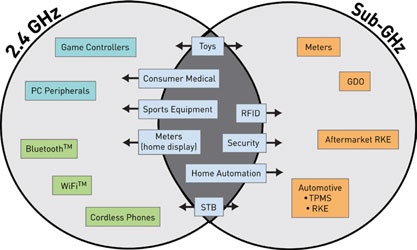
There are several markets, such as toys, medical equipment, security systems and building automation, where both wireless options are used in the same system. For example, in building security, 2,4 GHz radios are needed to serve high-data-rate video cameras while proximity, pressure and acceleration sensors are networked using a sub-GHz protocol.
Range, power consumption, antenna size and data rate are not the only design considerations for wireless applications. Worldwide deployment and software stack size and cost also have to be addressed.
Worldwide deployment
Global compliance is an important design consideration for a number of wireless applications. For instance, video game manufacturers who market their products worldwide can use 2,4 GHz radios for all their consoles because it is a global ISM allocation. Similarly, wireless applications using the 433 MHz band share a global sub-GHz ISM allocation, with Japan being the sole major market exception. In addition, 915 MHz is used extensively in North America and Australia, 868 MHz is deployed across all of Europe and 315 MHz is available in North America, Asia and Japan.
Standard vs. proprietary solutions
A number of standard solutions for the radio PHY, MAC and stack layers are available for 2,4 GHz and sub-GHz applications. 802.15.4 (PHY/MAC), ZigBee, Bluetooth, 6LoWPAN, Wi-Fi and RF4CE are widely used 2,4 GHz solutions. Sub-GHz standards-based solutions include ZigBee (currently the only protocol offering both 2,4 GHz and sub-GHz versions in the 868 MHz and 900 MHz bands), EnOcean, io-homecontrol, ONE-NET, INSTEON and Z-Wave.
While standard solutions offer the advantage of vendor-independent interoperable nodes, they normally will increase each node’s cost and footprint. For example, a 2,4 GHz ZigBee radio node’s software stack will require about 128 KB of embedded memory. Conversely, proprietary sub-GHz nodes generally target low-cost systems, with each node costing approximately 30–40% less and requiring 4 KB memory for the stack).
With specialised functions and small software stacks, proprietary solutions can achieve smaller die sizes and reduced memory footprints. What is more, less complex stacks simplify deployments and lower maintenance costs. Therefore, proprietary sub-GHz solutions can offer among the least expensive point-to-point localised networks, such as a garage door opener or home automation system.
The opportunities for more extensive long-range sub-GHz mesh networks, proprietary or standards-based, are growing by leaps and bounds with the emergence of smart grid technology.
Sub-GHz application for smart grid technology
Smart grid technology is 21st century electronics enhancing the functionality of the 20th century energy grid infrastructure, enabling two-way communication between homes and businesses and their utility companies. Sub-GHz communication offers distinct advantages in a number of smart grid applications. For instance, its longer range allows more homes and businesses to communicate with fewer hubs, which saves deployment and maintenance costs for the utilities provider. In addition, battery-powered gas and water meters can operate for years without changing batteries.
There are major standardisation efforts underway for smart energy applications around the world (802.15.4G, Wireless MBUS, etc) with sub-GHz being the dominant frequency band for long-range communication links from the meter to the utility.
Automated metering system – Automated electronic meters offer utilities providers the benefits of improved reliability and accuracy, ease of calibration, improved security and advanced billing features. The full system can take advantage of long-range, low-cost wireless communication for the effective data exchange the smart grid requires.
In Figure 2, the automated metering system supports four kinds of smart meters:
* The electricity meter supports multirate metering by measuring the kilowatt hours consumed and the power factor of the load and by recording the time the electricity was used.
* The gas and water meters use positive displacement flow meters that measure the number of times a unit volume of fluid or gas moves through the meter. Low operating power is critical as these meters are usually battery powered.
* Heat meters enable utilities to bill customers by the number of BTUs or kilowatts used, which are calculated by measuring the flow of hot water through the system and recording its input and exit temperatures. These meters are primarily used by industrial customers.
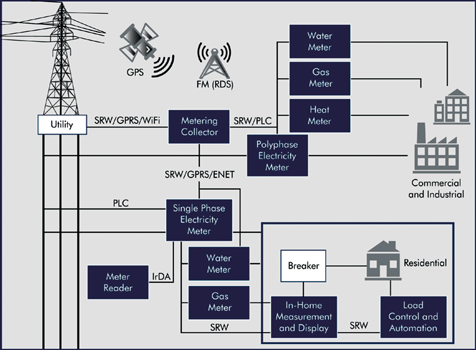
Each of these meters, equipped with a sub-GHz radio, can quickly and inexpensively transmit data to a metering aggregator (or hub) that acts as a gateway to the utility company. The aggregator, in turn, can communicate from the utility provider back to individual meters through the same sub-GHz network. This enables more efficient use of available water and energy and provides more accurate billing services for the customer.
Conclusion
Sub-GHz wireless networks can provide an extremely cost-effective solution in any low-data-rate system, from simple point-to-point connections to much larger mesh networks, where long range, robust radio links and extended battery life are leading priorities. Higher regulatory output power, reduced absorption, less spectral pollution and narrowband operation increase transmission range. Better circuit efficiency, improved signal propagation and a smaller memory footprint reduce overall power consumption, which can result in years of battery-powered operation.
For more information contact Gary de Klerk, NuVision Electronics, +27 (0)11 894 8214, [email protected], www.nuvisionelec.co.za
| Tel: | +27 11 608 0144 |
| Email: | [email protected] |
| www: | www.nuvisionelec.com |
| Articles: | More information and articles about NuVision Electronics |






© Technews Publishing (Pty) Ltd | All Rights Reserved
 printer friendly version