


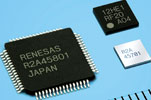
Renesas Electronics has developed a near field communication (NFC) wireless charging system to eliminate the power cable for charging and to increase the efficiency of these systems.
Renesas supplies the essential components needed to build a system: the NFC microcontroller (MCU) RF20, the R2A45801 power transmitter and the R2A45701 power receiver. The company also provides a kit including peripheral general-purpose devices (eg, power semiconductor devices) as a system solution.
Wireless charging is starting to become popular in products such as smartphones. It eases battery charging of portable devices and makes cables and connectors redundant. Today’s existing wireless charging systems typically couple two antennas, one for receiving and one for transmitting power.
The gap between and the combination of the two antennas highly influence the efficiency of the charging power. Such existing wireless charging systems limit the effective charging area significantly. In consequence the alignment of the transmitting and receiving antennas greatly reduces the freedom of product design.
The Renesas NFC wireless charging technology widens the charging area to about 10 cm. It incorporates the technology of the existing NFC MCU and utilises the NFC antenna to implement a wireless charging system that uses a single RX antenna for NFC communication and receiving power.
NFC Controller RF20 In addition to wireless charging applications, NFC can be used for a wide variety of other applications, including conventional ones such as payment transactions, transportation systems, and ticketing, as well as newer ones such as gaming and healthcare devices. In particular, smartphones based on the Android OS and equipped with NFC functions are proliferating rapidly. This has spurred demand for solutions for easy implementation of NFC functionality. In response, Renesas has developed the RF20 NFC MCU to be compliant with the international NFC standards and with support for smartphones based on the Android OS.
The RF20 NFC controller is supplied with the programmed firmware incorporating all the functions required by smartphones (and other devices such as those used for payment transactions, transportation systems, ticketing, gaming and healthcare) including a validation function for compatibility of the various NFC standards, with middleware for the host side.
Single Wire Protocol (SWP) is provided as a communication interface to external secure elements required for applications such as payment transactions, and can also be connected to a SIM card. In addition, I²C and UART are supported as host controller interfaces.
The R2A45801 power transmitter implements the three charging output channels required in the driver circuit of a wireless power transmitter. It also has on-chip functions for enhanced control safety, including thermal shutdown and field effect transistor (FET) temperature detection/system temperature detection functions.
The R2A45701 power receiver steps down the voltage received by the coil on the receiver side after rectification to the specified level required for charging control. It also has voltage and current monitoring functions as well as an AC adaptor input, a USB charging input and an input for external charging other than wireless charging.
Supporting these multiple charging inputs is an on-chip charging control function that enables direct charging of a single-cell lithium-ion battery.
For more information contact Marinus Rudman, Hi-Q Electronics, +27 (0)21 595 1307, [email protected], www.hi-q.co.za
| Tel: | +27 21 595 1307 |
| Email: | [email protected] |
| www: | www.hi-q.co.za |
| Articles: | More information and articles about Hi-Q Electronics |






© Technews Publishing (Pty) Ltd | All Rights Reserved
 printer friendly version