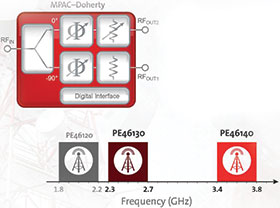
New from Peregrine Semiconductor come two UltraCMOS MPAC–Doherty products, the PE46130 and PE46140. These monolithic phase and amplitude controllers (MPAC) join the PE46120 in offering maximum phase-tuning flexibility for Doherty power amplifier (PA) optimisation. Designed for the LTE and LTE-A wireless infrastructure transceiver market, this product family now extends from 1,8 to 3,8 GHz with three separate, pin-compatible parts.
Because the devices are based on UltraCMOS technology, Peregrine claims they deliver intelligent integration benefits – reliability, flexibility, smaller footprint, configurability and greater system capability – that cannot be matched by gallium arsenide (GaAs) solutions. Each product eliminates the need for discrete components and integrates a 90-degree RF splitter, 5-bit digital phase shifters, a 4-bit digital step attenuator and a digital serial peripheral (SPI) interface on a single monolithic die.
The PE46130 and PE46140 are ideal for optimising gallium nitride (GaN)-based Doherty PAs, which are preferred at higher frequencies. Low-frequency Doherty amplifiers are typically based on laterally diffused metal oxide semiconductor (LDMOS) technology as LDMOS offers efficiency and cost advantages at frequencies less than 2,0 GHz. However, at higher frequencies, this efficiency breaks down and GaN-based Doherty PAs are used for their ability to maintain performance and meet high power density requirements. The UltraCMOS PE46130 covers a frequency range of 2,3 to 2,7 GHz and PE46140 extends from 3,4 to 3,8 GHz.
Aside from supporting different cellular frequency bands, the two chips are similar in their features and performance advantages. The controllers cover a phase range of 87,2 degrees in 2,8 degree steps and an attenuation range of 7,5 dB in 0,5 dB steps. They deliver high linearity of greater than 60 dBm IIP3 and low power consumption of 0,35 mA, while providing high power handling of 35 dBm P0.1dB and high port-to-port isolation of 30 dB.
High performance RF signal conditioning RFiber Solutions
Telecoms, Datacoms, Wireless, IoT
The AM3269 from Mercury Systems is a high-performance RF preselector module designed to improve receiver sensitivity and signal integrity in demanding electronic warfare, signals intelligence, test, and communications applications.
Read more...Nordic expands nRF Cloud with firmware vulnerability scanning RF Design
Computer/Embedded Technology
nRF Cloud identifies vulnerabilities in firmware and shows exactly which deployed devices are affected, empowering device manufacturers to address EU Cyber Resilience Act requirements.
Read more...RF filters explained RFiber Solutions
Telecoms, Datacoms, Wireless, IoT
As RF environments become increasingly crowded, RF filters play a critical role in maintaining signal quality, improving system performance, and ensuring reliable operation.
Read more...Industrial connectivity without compromise
Telecoms, Datacoms, Wireless, IoT
The IR315 combines 4G LTE, Wi-Fi, Ethernet, and VPN technologies into a rugged, industrial-grade platform that enables seamless connectivity across a wide range of applications.
Read more...Module provides 4G LTE Cat 1 bis connectivity Dizzy Enterprises
Telecoms, Datacoms, Wireless, IoT
Mikroe adds 4G LTE Cat 1 bis connectivity where reliable data transmission and low power consumption are critical with the GC02S1-EU2 module.
Read more...Enabling next-generation FPGA and SDR innovation RFiber Solutions
Telecoms, Datacoms, Wireless, IoT
Puzhi Electronic Technology has established itself as a dynamic provider of advanced ARM and FPGA-based solutions, delivering a comprehensive ecosystem of products designed for modern embedded and high-performance computing applications.
Read more...Magnetic mount antenna takes the hassle out of 4G installations iCorp Technologies
Telecoms, Datacoms, Wireless, IoT
Designed for fast, tool-free installation, the YECN022CA 4G magnetic mount whip monopole antenna gives wireless devices a dependable cellular link in the field, where installation time and signal reliability both matters.
While every effort has been made to ensure the accuracy of the information contained herein, the publisher and its agents cannot be held responsible for any errors contained, or any loss incurred as a result. Articles published do not necessarily reflect the views of the publishers. The editor reserves the right to alter or cut copy. Articles submitted are deemed to have been cleared for publication. Advertisements and company contact details are published as provided by the advertiser. Technews Publishing (Pty) Ltd cannot be held responsible for the accuracy or veracity of supplied material.









 printer friendly version