Supercomputing students bring home third prize
18 July 2018
Editor's Choice
News
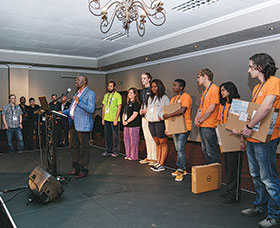
The South African supercomputing team that participated in the International Student Cluster Competition in Frankfurt, Germany, took third place behind China’s Tsinghua University and Nanyang Technological University of Singapore.
The team of six, made up of undergraduate computer science and engineering students from the Universities of the Witwatersrand and Limpopo, was one of 12 teams from around the world that participated in the prestigious challenge from 25 to 27 June 2018.
The students showcased computing systems of their own design, adhering to strict power constraints and seeking to achieve the highest performance across a series of standard high-performance computing benchmarks and applications. South Africa has been participating in the international competition since 2013 and won it in 2013, 2014 and 2016, coming second in 2015 and 2017. It is one of the few teams that consists entirely of undergraduate students, and that sends different students each year.
Before participating, the members of the team received extensive training from the Centre for High Performance Computing (CHPC), an initiative of the Department of Science and Technology and the Council for Scientific and Industrial Research (CSIR).
The CHPC’s Director, Dr Happy Sithole, said that the placing was “a significant achievement for South Africa,” and that the CHPC hopes to increase the number of students who received exposure of this kind in the field of high-performance computing. “In the past six years we have had 36 students performing well on the world stage,” he said.
The South African team was chosen from 10 participating teams at a national student cluster supercomputing competition held in December last year. Team selection for the national competition takes place at the CHPC’s Winter School, which is designed to impart critical knowledge for building a cluster. This includes using Linux systems, the basic software stack of a cluster, and considerations that should be taken into account when choosing hardware. Team selection concludes with an assignment that requires each team to build a prototype cluster in the cloud.
After all their hard work, this year’s team – Meir Rosendorff, Joshua Bruton, Kimessha Paupamah, Katleho Mokoena, Nathan Michlo and Njabulo Sithole – said that they planned to hire bicycles and cycle around Frankfurt “doing touristy things”.
For more information contact Nox Moyake, CHPC, nmoyake@csir.co.za
Further reading:
Women and the future of engineering in South Africa
Editor's Choice
With women making up just 16% of registered engineering professionals in South Africa, AvenirHoldings CEO, Tshidi Mndzebele, is calling on women engineers and graduates to pursue formal professional registration as a key step to unlocking career growth and industry leadership.
Read more...
The effect of seasonal changes on ESD performance in South Africa
Actum
Editor's Choice Circuit & System Protection Manufacturing / Production Technology, Hardware & Services
Electrostatic discharge performance is influenced by several environmental factors, with relative humidity being one of the most important. This is particularly relevant in South Africa, where seasonal changes can result in significant differences in humidity levels.
Read more...
Compact RTK design: More than just the receiver
iCorp Technologies
Editor's Choice Telecoms, Datacoms, Wireless, IoT
In practice, engineers building compact RTK products keep discovering the same thing: the hardest component in the system is no longer the receiver. It is the antenna.
Read more...
The signal-to-noise challenge in large-scale IIoT
Sigfox South Africa
Editor's Choice Telecoms, Datacoms, Wireless, IoT
For much of the last decade, the industrial IoT industry has been driven by a relatively simple assumption: if a little data is useful, more data must be better. That thinking shaped countless deployments.
Read more...
Women building South Africa’s power infrastructure
Editor's Choice
As South Africa celebrates Women’s Month in August, women are increasingly taking their place on the factory floor, in technical workshops and across engineering environments, helping manufacture the infrastructure that keeps the country’s electricity network running.
Read more...
More efficient production with optimised procurement
Editor's Choice
The smallest part on the BOM is usually the one that holds it up. Interconnect, passive and electromechanical components rarely get attention until they are missing. That is starting to change, and it is reshaping how procurement teams think about risk.
Read more...
Locate underground cable faults faster with the Fluke AF2082 A-Frame
Comtest
Editor's Choice Test & Measurement
Underground cable faults can lead to costly downtime, service disruptions, and extensive excavation if the fault location is uncertain. The AF2082 simplifies this process by guiding operators directly to the fault point.
Read more...
Here is what we learnt from three supply chain crises
Seven Labs Technology
Editor's Choice
Component crises are not random events. They follow a pattern. After fifteen years and three major disruptions, Seven Labs knows exactly what that pattern demands, and what it takes to keep production lines moving.
Read more...
The new reality of PCB material supply
Jemstech
Editor's Choice Manufacturing / Production Technology, Hardware & Services
How resilient manufacturing strategies are helping OEMs navigate a changing global supply chain.
Read more...
Strengthening local electronics manufacturing through investment and innovation
Microtronix Manufacturing
Editor's Choice Manufacturing / Production Technology, Hardware & Services
Microtronix South Africa cements its commitment to local manufacturing with ongoing investments in production capacity, skills development, and job creation.
Read more...









 printer friendly version