There are many consumer, enterprise and industrial devices today that have a USB Type-C port as the only input power option. While USB-C technology can offer high power and high data rate, it limits the range of the installation to a maximum of 3 metres from an AC outlet. As Power over Ethernet (PoE) becomes more prevalent and a more convenient solution to provide power over a standard Ethernet cable, it is the most practical solution to provide both power and data connections up to 100 metres long.
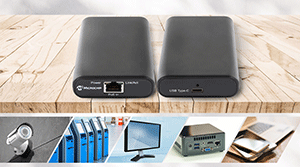
While most adaptors on the market provide only power, they provide only limited power up to 25 W. Microchip Technology has announced a PoE to USB-C adaptor with the highest power capability that converts both power and data while offering up to 60 W USB output power via an Ethernet cable supported by PoE infrastructure.
The adaptor (part number PD-USB-DP60) can accept up to 90 W of PoE and convert it to 60 W output over USB-C that will power most cameras, laptops, tablets and other devices using USB-C for input power. This adaptor simplifies installation by reducing dependence on AC infrastructure. Without the dependence on an AC outlet, there is no longer a range limitation of 3 metres and power can be delivered over 100 metres.
This adaptor also enhances the remote power management capabilities of the USB-C power device. The remote power reset capability, provided by the PoE source, allows power cycling via web interface or Simple Network Management Protocol (SNMP) to reset the device, rather than having to manually unplug and restart at the location of the equipment.
Microchip’s PoE to USB-C adaptor can connect to a variety of PoE sources with various standards deployed. It supports newer IEEE 802.3af/at/bt standards as well as legacy PoE standards. Having a versatile adaptor is crucial due to the many different implementations of PoE already installed.
High-precision current transducer
Power Electronics / Power Management
Danisense announces its new high-precision DP12IP current transducer designed for isolated DC and AC current measurement in demanding PCB-mounted power electronics applications.
Read more...Secure holder for protected 18650 batteries
Power Electronics / Power Management
Designed for protected 18650 batteries up to 70 mm long, the holder offers secure retention for portable, industrial, and embedded applications.
Read more...More room to scale Altron Arrow
Power Electronics / Power Management
With the latest STM32H5 lines from STMicroelectronics, you can now scale within the same platform, from a compact 1 Mbyte device to higher-memory MCUs for graphics-rich and feature-heavy designs.
Read more...Multi-constellation GNSS module in a legacy-compatible footprint Altron Arrow
Telecoms, Datacoms, Wireless, IoT
Telit Cinterion has announced the SE869eK2L, a single-frequency L1 GNSS module designed to help device manufacturers upgrade legacy positioning designs with improved performance and cost efficiency, while preserving design continuity.
Read more...Compact SSI family for industrial automation Altron Arrow
Passive Components
Infineon Technologies has introduced the ISSI20BxxF Solid State Isolator (SSI) family, bringing solid-state isolation technology into high-volume applications traditionally served by photovoltaic isolators (PVIs), photovoltaic relays (PVRs), and electromechanical relays (EMRs).
Read more...Rev 2.0 PolarFire FPGA ethernet sensor bridge Altron Arrow
Computer/Embedded Technology
Smaller, multi-camera platform enables scalable Ethernet architectures for NVIDIA Edge AI systems, while lowering power, cost and integration complexity.
Read more...Surface mount power amplifier for high-power applications RF Design
Power Electronics / Power Management
The GNA-63-5W+, from Mini-Circuits, is a GaN MMIC Power Amplifier (PA) designed for demanding RF applications requiring high efficiency, excellent linearity, and a compact footprint.
Read more...1200 V QSiC modules
Power Electronics / Power Management
SemiQ Inc has launched the QSiC Dual3, a family of 1200 V half-bridge MOSFET modules for motor drives in data centre cooling systems, grid converters in energy storage systems, and industrial drivers.
Read more...Universal IR receiver module Altron Arrow
Telecoms, Datacoms, Wireless, IoT
Vishay Intertechnology has introduced a new series of infrared (IR) receiver modules for IR remote control applications, which feature a wide modulation frequency acceptance from 30 kHz to 68 kHz.
While every effort has been made to ensure the accuracy of the information contained herein, the publisher and its agents cannot be held responsible for any errors contained, or any loss incurred as a result. Articles published do not necessarily reflect the views of the publishers. The editor reserves the right to alter or cut copy. Articles submitted are deemed to have been cleared for publication. Advertisements and company contact details are published as provided by the advertiser. Technews Publishing (Pty) Ltd cannot be held responsible for the accuracy or veracity of supplied material.









 printer friendly version