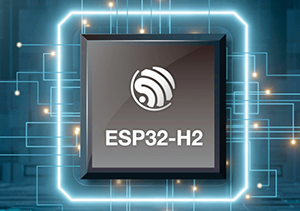
Espressif Systems announced the upcoming release of the ESP32-H2 SoC (system-on-chip) with IEEE 802.15.4 and Bluetooth 5.2 (LE) connectivity, operable in the 2,4 GHz band. It enhances Espressif’s SoC portfolio further beyond Wi-Fi and Bluetooth connectivity by adding IEEE 802.15.4 connectivity as well. This SoC comes with an integrated DC-DC converter that enables ultra-low-power, energy-efficient operation.
The device combines two important connectivity technologies. IEEE 802.15.4 radio connectivity is important to support a mesh architecture with low power consumption. The availability of Thread and Zigbee protocols addresses a variety of application use cases. Bluetooth LE supports point-to-point, broadcast and mesh communication topologies, while it also enables direct communication between a smartphone and the device.
Additionally, the ESP32-H2 takes advantage of Bluetooth 5.2 technology and supports its new features. Bluetooth 5.2 provides LE isochronous channel support that enables building devices for LE Audio, the next generation of Bluetooth Audio. Not only will LE Audio enhance Bluetooth audio performance, but it will also add support for broadcasting audio and enabling audio sharing. The LE power control and enhanced attribute protocol of Bluetooth 5.2 also improve device efficiency even further. The ESP32-H2 also provides full support for the Bluetooth mesh protocol and will support the upcoming Bluetooth mesh 1.1.
The combined availability of IEEE 802.15.4 and Bluetooth LE connectivity enables the building of devices for the upcoming Matter protocol that intends to bring interoperability for smart home devices. With ESP32-H2 and other SoCs in its portfolio, Espressif can offer the full spectrum of Matter protocol solutions for endpoints with Wi-Fi or Thread connectivity, as well as for border router implementations using a combination of SoCs.
The ESP32-H2 has a single-core, 32-bit RISC-V microcontroller that can be clocked up to 96 MHz, a 256 KB SRAM and works with external flash. It has 26 programmable GPIOs with support for ADC, SPI, UART, I2C, I2S, RMT, GDMA and PWM. Hardware security features include ECC-based secure boot, AES-128/256-XTS-based Flash encryption, digital signature and an HMAC peripheral for identity protection, as well as cryptographic accelerators for improved performance.
The ESP32-H2 will support Thread version 1.x and Zigbee 3.x.
Quectel’s single-board computers put industrial edge computing on one PCB iCorp Technologies
Computer/Embedded Technology
Quectel Pi series of single-board computers (SBCs), designed for a broad range of industrial applications, include three compact development platforms – the Quectel Pi M1, L1, and H1 boards.
Read more...Simplifying system design iCorp Technologies
Telecoms, Datacoms, Wireless, IoT
The FGMC63N tri-band MCU Wi-Fi 6E module from Quectel addresses offers integrated connectivity across 2,4 GHz, 5 GHz, and 6 GHz bands in a compact, highly optimised design.
Read more...Dragino’s connectivity catalogue Otto Wireless Solutions
Telecoms, Datacoms, Wireless, IoT
Where Wi-Fi demands frequent charging and covers tens of meters, and traditional cellular consumes too much power for battery-operated nodes, LoRaWAN threads the needle.
Read more...RF filters explained RFiber Solutions
Telecoms, Datacoms, Wireless, IoT
As RF environments become increasingly crowded, RF filters play a critical role in maintaining signal quality, improving system performance, and ensuring reliable operation.
Read more...Practical design strategies for 5G RF Design
Telecoms, Datacoms, Wireless, IoT
The Cavli CQM211 aims to provide a platform that combines strong 5G connectivity with onboard compute capability, as well as interface flexibility that suits both new designs and rapid migrations from earlier products.
Read more...Low-power memory born for edge AI iCorp Technologies
DSP, Micros & Memory
As intelligence moves from the cloud to the device, memory become one of the most important design decisions in modern electronics. Edge-AI products – from smart speakers and surveillance cameras to ADAS modules and wearables – need to move data fast, but they also need to sip power. Winbond’s low-density LPDDR4/LPDDR4X SDRAM range is built to strike that balance.
Read more...An industry-first Android 16 smart module solution RF Design
Computer/Embedded Technology Telecoms, Datacoms, Wireless, IoT
The MeiG Smart SLM580 4G Smart Module features native support for Android 16 and covers core frequency bands in major countries and regions worldwide.
Read more...Compact MCU for IoT endpoints iCorp Technologies
DSP, Micros & Memory
Quectel’s FCM266D combines single-band 2,4 GHz Wi-Fi 6 with Bluetooth LE 5.4 in an ultra-compact LCC package measuring just 20 x 18 x 2,4 mm.
While every effort has been made to ensure the accuracy of the information contained herein, the publisher and its agents cannot be held responsible for any errors contained, or any loss incurred as a result. Articles published do not necessarily reflect the views of the publishers. The editor reserves the right to alter or cut copy. Articles submitted are deemed to have been cleared for publication. Advertisements and company contact details are published as provided by the advertiser. Technews Publishing (Pty) Ltd cannot be held responsible for the accuracy or veracity of supplied material.









 printer friendly version