27 July 2022Manufacturing / Production Technology, Hardware & Services
Electrostatic discharge (ESD) can cause damage, especially to sensitive electronic components. Static charge can accumulate on surfaces of objects when there is an exchange of charge between the surfaces of two objects that touch, rub against, or are detached from each other, e.g., as is the case when foil is peeled off. One object is charged positively and the other negatively. People can carry a charge of up to 35 000 volts, depending on the environmental conditions.
Figure 1.
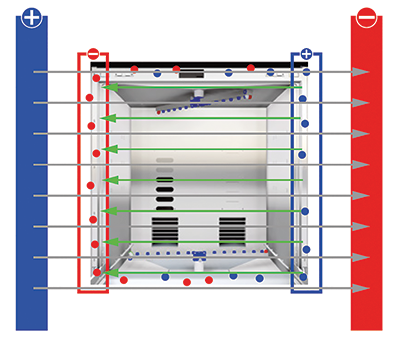
A shell of an electrical conductor (e.g., wire mesh or sheet metal) closed on all sides acts as an electrical shield against electrostatic discharges insofar as their contents do not come into contact with the shell itself (Faraday cage). If an electric field builds up between the positive pole and the negative pole, the negatively charged electrons of the shell migrate to the side of the positive pole. As a result, a charge shift occurs within the shell, which generates an electric field in the shell that acts in exactly the opposite direction to the external electric field (Figure 1).
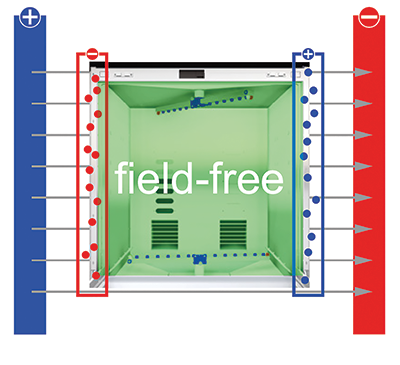
As a result, the effects of the fields in the envelope cancel each other out exactly, and the interior is shielded (Figure 2).
Permanent grounding of working personnel in ESD areas by means of grounding straps, ESD clothing, ESD gloves and antistatic safety shoes as well as further measures such as antistatic work surfaces, floor coverings or conductive covers of office furniture are basic requirements for ESD-protected production.
Figure 2.
But even in an electronics cleaning system with a closed metal chamber, static charge can still occur, especially during the drying process. Humidity control is known to be an active measure against electrostatic discharge. Once an optimum humidity level is reached – typically between 40 and 60% relative humidity – this is sufficient to discharge electrostatic build-up into the air without danger. However, as soon as the humidity drops below 40% during the drying phase while micro-particles can be introduced into the chamber by blowers, the possibility of static charging increases significantly.
Figure 3.
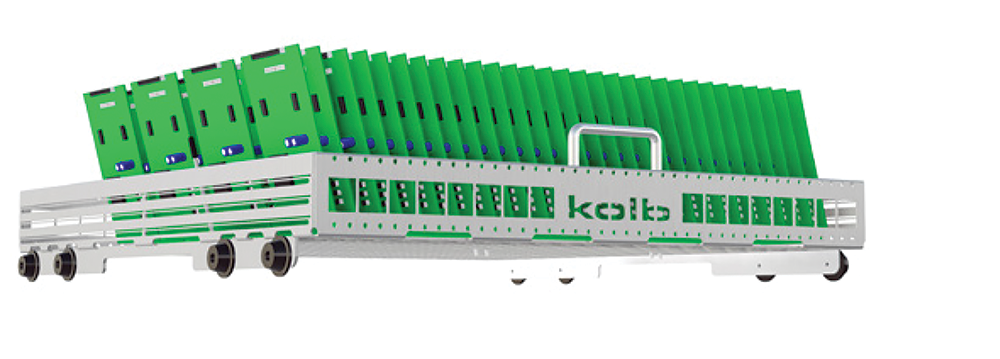
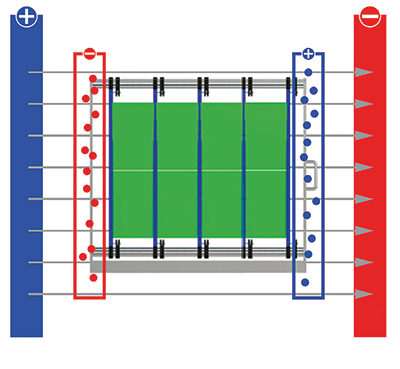
To shield against electrostatic fields within the cleaning chambers of kolb systems, ESD-sensitive electronic cleaning goods are therefore accommodated in special kolb metal washing frames (Figure 3) or kolb metal washing baskets (Figure 4). These fixtures also make use of Faraday’s principle by shielding the cleaning products from electrostatic fields as a closed unit. In addition, the fixtures are grounded via suitable materials with leakage resistances of 103 to 107 Ω. These include, for example, the black ESD casters of the washing baskets and the mounting brackets of the washing frames.
This means that in kolb cleaning systems the products are continuously ESD-protected through all process steps.
For further handling, such as manual loading and unloading of the cleaning goods, all relevant kolb systems have an ESD grounding connection box as standard.
In the standard version of the systems, the double-wall airlock door, the control panel including switching elements, lid, side panels and collecting tray are not ESD-compliant, as these do not come into contact with the cleaning goods at any time. Static charging or contact with ESD-sensitive electronic components can thus be ruled out. The airlock door (used only for heat decoupling of the process chamber against contact) is located in such a way that during loading and unloading and during the process, contact of the cleaning good with the door is not possible.
Weller limited Black Edition soldering station Testerion
Manufacturing / Production Technology, Hardware & Services
Weller’s WE1010 Black Edition Soldering Station is a premium limited-edition soldering station.
Read more...Quick and easy shielding Würth Electronics South Africa
Electronics Technology Manufacturing / Production Technology, Hardware & Services
Würth Elektronik expands its EMC product portfolio with nanocrystalline WE-FNCS sheets.
Read more...Smarter local buying could reboot South Africa’s manufacturing sector
Manufacturing / Production Technology, Hardware & Services
With smarter localisation, clearer procurement rules and a more deliberate industrial strategy, public spending could again become a powerful engine for rebuilding factories, expanding supply chains and restoring confidence in South Africa as a place that makes things.
Read more...The effect of seasonal changes on ESD performance in South Africa Actum
Editor's Choice Circuit & System Protection Manufacturing / Production Technology, Hardware & Services
Electrostatic discharge performance is influenced by several environmental factors, with relative humidity being one of the most important. This is particularly relevant in South Africa, where seasonal changes can result in significant differences in humidity levels.
Read more...High precision in-line conformal coating inspection system MyKay Tronics
Manufacturing / Production Technology, Hardware & Services
Conformal coating is widely used to protect electronics from moisture or other environmental hazards. It is critical to know if coatings are properly applied; covering what is meant to be covered and not covering what should be exposed.
Read more...Soldering day highlights
Manufacturing / Production Technology, Hardware & Services
JAPAN UNIX has published a new event report and highlight video from their UNIX SOLDERING DAY 2026 in Hungary. This event reflects on their commitment to supporting manufacturers not only through soldering automation systems, but also through technical education, live demonstrations, hands-on training, and practical engineering know-how.
Read more...Clearing the Static: Electrostatic Discharge Actum
Manufacturing / Production Technology, Hardware & Services
A cordless ESD (Electrostatic Discharge) wrist strap does not work by grounding the person in the same way as a traditional wired wrist strap. Instead, it works by reducing or balancing the static charge on your body so that you are less likely to discharge electricity into sensitive electronic components.
Read more...Engineering trust in South Africa’s SMT sector ZETECH ONE
Manufacturing / Production Technology, Hardware & Services
From a small Johannesburg start-up to a trusted SMT technology partner, Zetech One has spent four decades helping South African electronics manufacturers improve production quality, efficiency and reliability.
Read more...The new reality of PCB material supply Jemstech
Editor's Choice Manufacturing / Production Technology, Hardware & Services
How resilient manufacturing strategies are helping OEMs navigate a changing global supply chain.
Read more...Streamlining Device Programming with the AutoBee-D1 Vepac Electronics
Manufacturing / Production Technology, Hardware & Services
The AutoBee-D1 desktop automated programmer is designed to simplify the programming of devices, while delivering consistent accuracy, high throughput and reduced manual intervention.
While every effort has been made to ensure the accuracy of the information contained herein, the publisher and its agents cannot be held responsible for any errors contained, or any loss incurred as a result. Articles published do not necessarily reflect the views of the publishers. The editor reserves the right to alter or cut copy. Articles submitted are deemed to have been cleared for publication. Advertisements and company contact details are published as provided by the advertiser. Technews Publishing (Pty) Ltd cannot be held responsible for the accuracy or veracity of supplied material.









 printer friendly version