


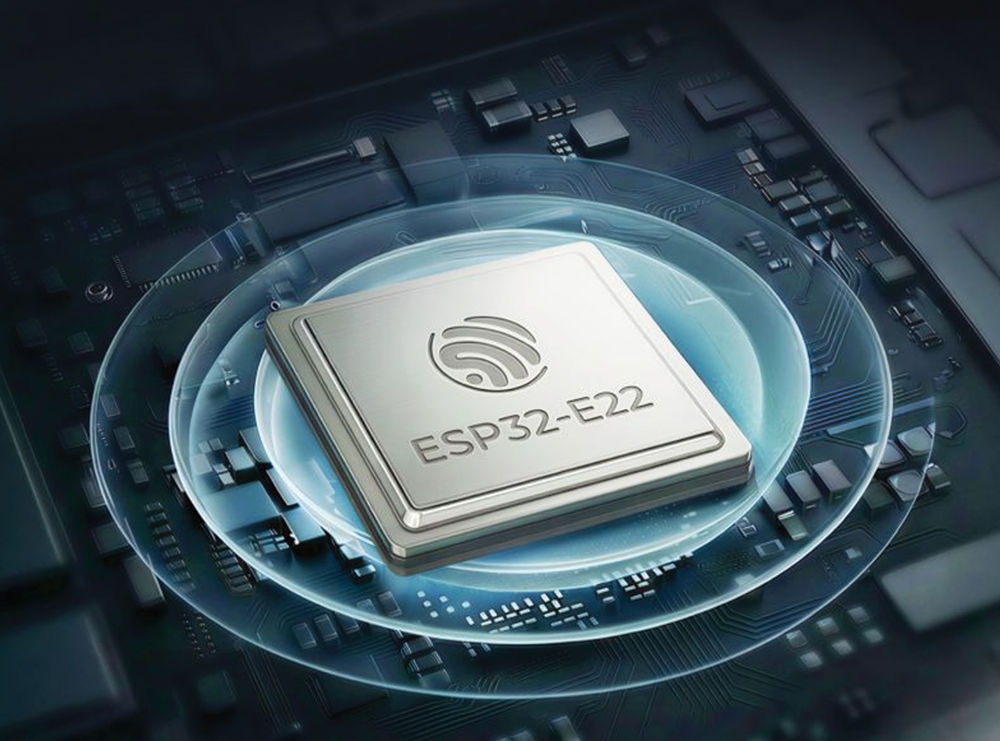
Espressif Systems has expanded its connectivity portfolio with the introduction of the ESP32-E22, the company’s first Wi-Fi 6E connectivity co-processor. Designed to meet the growing demand for higher bandwidth, lower latency, and improved spectral efficiency, the ESP32-E22 brings tri-band Wi-Fi 6E and advanced Bluetooth capabilities into a flexible architecture suited for next-generation embedded systems.
As wireless ecosystems become increasingly congested, particularly in the 2,4 GHz and 5 GHz bands, access to the newly available 6 GHz spectrum offers a significant performance advantage. The ESP32-E22 is built to leverage this opportunity.
Tri-band Wi-Fi 6E for high throughput and low latency
The ESP32-E22 supports Wi-Fi 6E across 2,4 GHz, 5 GHz, and 6 GHz bands, including 160 MHz channel bandwidth and 2x2 MU-MIMO capability. These features enable substantially higher throughput and reduced latency compared to previous Wi-Fi generations, while improving performance in dense deployment environments.
By utilising the less congested 6 GHz band, designers can achieve cleaner spectrum operation, making the device well suited for:
• High-definition video streaming.
• AR/VR accessories.
• Smart home hubs and gateways.
• Industrial IoT systems.
• Bandwidth-intensive edge devices.
The enhanced OFDMA and MU-MIMO capabilities of Wi-Fi 6E further improve network efficiency by enabling simultaneous communication with multiple devices.
In addition to Wi-Fi 6E, the ESP32-E22 integrates Bluetooth Classic and Bluetooth LE 5.4. This dual-mode capability ensures compatibility with legacy devices, while supporting modern low-power IoT and sensor-based applications.
BLE 5.4 enhancements enable improved efficiency and reliability in device-to-device communication, making the ESP32-E22 suitable for hybrid connectivity environments requiring both high data throughput and low-power operation.
Dedicated RISC-V processing architecture
At the core of the ESP32-E22 is a dual-core 500 MHz RISC-V processor that runs the complete Wi-Fi and Bluetooth protocol stacks internally. This architecture allows the device to function as a dedicated connectivity co-processor, significantly reducing processing overhead on the host MCU or application processor. This improves overall system responsiveness, simplifies software partitioning, reduces development complexity, and aids in optimising host processor utilisation for application-level tasks.
This separation of connectivity and application processing is particularly valuable in high-performance embedded Linux systems and advanced RTOS-based platforms.
The ESP32-E22 supports PCIe 2.1 and SDIO 3.0 interfaces, enabling integration with a wide range of host processors and SoCs. This flexibility allows designers to incorporate advanced Wi-Fi 6E connectivity into both existing and new architectures without major redesigns.
The demand for higher wireless throughput, ultra-low latency, and improved reliability continues to grow across multiple industries. From industrial automation and smart infrastructure to consumer electronics and immersive multimedia devices, next-generation applications require more robust wireless foundations.
By combining tri-band Wi-Fi 6E, dual-mode Bluetooth, and a high-performance RISC-V architecture, the ESP32-E22 positions itself as a powerful solution for designers building the next wave of connected products.
| Tel: | +27 11 781 2029 |
| Email: | enquiries@icorptechnologies.co.za |
| www: | www.icorptechnologies.co.za |
| Articles: | More information and articles about iCorp Technologies |






© Technews Publishing (Pty) Ltd | All Rights Reserved
 printer friendly version