Espressif’s ESP32-H21 is a low-power wireless SoC aimed at battery-operated IoT devices that require Thread, Zigbee, Matter-over-Thread and Bluetooth Low Energy connectivity in a compact, cost-effective platform. As an evolution of the ESP32-H2 platform, ESP32-H21 integrates an on-chip DC-DC converter to further reduce active power consumption, helping extend battery life in always-connected sensor and control applications.
By combining IEEE 802.15.4 and Bluetooth LE in a single device, ESP32-H21 supports modern mesh networking approaches for smart-home and building-automation deployments, while also enabling low-power point-to-point communication for simpler endpoints.
Key features of the ESP32-H1 include:
• Ultra-low-power wireless SoC designed for Thread, Zigbee, Matter and Bluetooth Low Energy endpoints.
• Integrated IEEE 802.15.4 + Bluetooth LE radios in a single SoC.
• Thread and Zigbee mesh networking support for scalable multi-node deployments.
• Bluetooth and Bluetooth Mesh support for BLE-based networking.
• Low-power point-to-point communication support for simple links and peripherals.
• On-chip DC-DC converter to reduce active power consumption and improve receive (RX) efficiency for always-listening nodes.
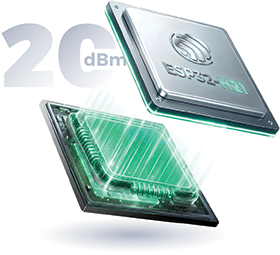
• Up to 20 dBm transmit power for extended range and stronger link budgets.
• 32-bit RISC-V microcontroller core for efficient protocol handling and system integration.
• Comprehensive peripheral set for sensors, actuators and user-interface components.
• Supported by ESP-IDF, including ESP-Matter SDK plus BLE roles, advertising and ESP-BLE-MESH in a unified framework.
Power efficiency for always-connected devices
For battery-powered nodes, receive-mode energy can dominate total consumption because many devices spend long periods listening for network traffic or wake-up events. ESP32-H21’s integrated DC-DC converter is intended to improve power efficiency during RX operation, helping extend operational life for sensors and control devices that must remain responsive.
ESP32-H21 supports transmit power up to 20 dBm, enabling improved range and link robustness in dense or interference-prone environments. This capability can reduce the need for additional routers or repeaters in distributed sensor networks, while maintaining power efficiency.
The device is ideally suited for use in smart-home sensors, building automation nodes, wearables, and other power-sensitive products.
Wireless connectivity expanded iCorp Technologies
Telecoms, Datacoms, Wireless, IoT
Espressif Systems has introduced two new members of its ESP32 wireless SoC family: the ESP32-E22, the company’s first Wi-Fi 6E connectivity chip, and the ESP32-H21, an ultra-low-power Bluetooth LE microcontroller aimed at coin-cell and battery-powered devices.
Read more...Integrated X-band radar front-end module RF Design
Telecoms, Datacoms, Wireless, IoT
Qorvo has introduced an X-band radar front-end solution that enables defence system designers to achieve higher performance without increasing size, weight or prime power.
Read more...Introducing Aurata CST Electronics
Telecoms, Datacoms, Wireless, IoT
Antenova has launched Aurata SR4L112: a compact, high efficiency embedded 4G/LTE antenna engineered for long, narrow PCB designs.
Read more...Multi-constellation GNSS module in a legacy-compatible footprint Altron Arrow
Telecoms, Datacoms, Wireless, IoT
Telit Cinterion has announced the SE869eK2L, a single-frequency L1 GNSS module designed to help device manufacturers upgrade legacy positioning designs with improved performance and cost efficiency, while preserving design continuity.
Read more...Quectel expands 5G portfolio iCorp Technologies
Telecoms, Datacoms, Wireless, IoT
Quectel expands 5G portfolio with new Qualcomm- and UNISOC-based modules.
Read more...Compact RTK design: More than just the receiver iCorp Technologies
Editor's Choice Telecoms, Datacoms, Wireless, IoT
In practice, engineers building compact RTK products keep discovering the same thing: the hardest component in the system is no longer the receiver. It is the antenna.
Read more...Microchip advances Space-Grade timing performance ASIC Design Services
Telecoms, Datacoms, Wireless, IoT
Microchip Technology has expanded its atomic clock portfolio with the radiation-tolerant Space CSAC-SA65, a Chip Scale Atomic Clock designed to deliver precise timing for space systems.
Read more...Channel emulator for 6 G and Wi-Fi 7/8 Concilium Technologies
Telecoms, Datacoms, Wireless, IoT
With 400 MHz instantaneous bandwidth and support for carrier frequencies up to 23,6 GHz, Vertex 6.0 is the industry’s first channel emulator designed for next generation 6 G and Wi-Fi 7/8 testing.
Read more...Secure, low-power Bluetooth LE SoC NuVision Electronics
Telecoms, Datacoms, Wireless, IoT
Silicon Labs unveils BG2B, its lowest-power Bluetooth LE SoC with industry-leading power efficiency, security, and integration.
While every effort has been made to ensure the accuracy of the information contained herein, the publisher and its agents cannot be held responsible for any errors contained, or any loss incurred as a result. Articles published do not necessarily reflect the views of the publishers. The editor reserves the right to alter or cut copy. Articles submitted are deemed to have been cleared for publication. Advertisements and company contact details are published as provided by the advertiser. Technews Publishing (Pty) Ltd cannot be held responsible for the accuracy or veracity of supplied material.









 printer friendly version