7 GHz RF power detector
19 November 2003
Telecoms, Datacoms, Wireless, IoT
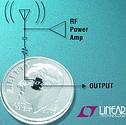
A precision RF power detector designed for monitoring and control applications in wireless communication transceivers, the LTC5532, is an integrated device that is factory trimmed to accurately measure RF signals from 300 MHz to 7 GHz. Manufactured by Linear Technology, this device is suitable for equipment including the 802.11a, b, and g WiFi systems, 5,8 GHz WAN and WLAN radios and other licensed band transceivers.
Its RF input signal range extends from -32 dBm to +8 dBm. The LTC5532 has an on-chip temperature compensated Schottky diode for RF detection. It employs a peak-detection architecture, providing a stable DC output voltage as a function of the RF input power.
The LTC5532 can be powered from a single 2,7 to 6 V supply and draws 500 µA. Besides its applicability in the 900 MHz and 1,9 GHz cellular and PCS infrastructure, its 7 GHz capability opens new uses in the 5,2 GHz to 5,8 GHz bands, including 802.11 multiband a, b, and g, WLAN and WiFi applications. Additional uses include both the 3,5 GHz and the 2,5-2,7 GHz MMDS licensed bands, as well as cable infrastructure equipment, in which RF power level control is important.
For more information contact Memec SA, 011 897 8600.
Further reading:
Macom targets broadband radar with time delay MMIC
RFiber Solutions
Telecoms, Datacoms, Wireless, IoT
Macom’s MADU FR1012 is a GaAs MMIC 1-bit true time delay device covering 4 GHz to 12 GHz, designed for broadband microwave systems where beam accuracy and signal integrity are critical.
Read more...
Compact analogue phase shifter
RF Design
Telecoms, Datacoms, Wireless, IoT
The Mini-Circuits JSPHS-150+ is a compact analogue voltage-controlled phase shifter designed for narrowband RF applications between 100 and 150 MHz.
Read more...
Wireless connectivity expanded
iCorp Technologies
Telecoms, Datacoms, Wireless, IoT
Espressif Systems has introduced two new members of its ESP32 wireless SoC family: the ESP32-E22, the company’s first Wi-Fi 6E connectivity chip, and the ESP32-H21, an ultra-low-power Bluetooth LE microcontroller aimed at coin-cell and battery-powered devices.
Read more...
Integrated X-band radar front-end module
RF Design
Telecoms, Datacoms, Wireless, IoT
Qorvo has introduced an X-band radar front-end solution that enables defence system designers to achieve higher performance without increasing size, weight or prime power.
Read more...
Introducing Aurata
CST Electronics
Telecoms, Datacoms, Wireless, IoT
Antenova has launched Aurata SR4L112: a compact, high efficiency embedded 4G/LTE antenna engineered for long, narrow PCB designs.
Read more...
Multi-constellation GNSS module in a legacy-compatible footprint
Altron Arrow
Telecoms, Datacoms, Wireless, IoT
Telit Cinterion has announced the SE869eK2L, a single-frequency L1 GNSS module designed to help device manufacturers upgrade legacy positioning designs with improved performance and cost efficiency, while preserving design continuity.
Read more...
Quectel expands 5G portfolio
iCorp Technologies
Telecoms, Datacoms, Wireless, IoT
Quectel expands 5G portfolio with new Qualcomm- and UNISOC-based modules.
Read more...
Compact RTK design: More than just the receiver
iCorp Technologies
Editor's Choice Telecoms, Datacoms, Wireless, IoT
In practice, engineers building compact RTK products keep discovering the same thing: the hardest component in the system is no longer the receiver. It is the antenna.
Read more...
Microchip advances Space-Grade timing performance
ASIC Design Services
Telecoms, Datacoms, Wireless, IoT
Microchip Technology has expanded its atomic clock portfolio with the radiation-tolerant Space CSAC-SA65, a Chip Scale Atomic Clock designed to deliver precise timing for space systems.
Read more...
Channel emulator for 6 G and Wi-Fi 7/8
Concilium Technologies
Telecoms, Datacoms, Wireless, IoT
With 400 MHz instantaneous bandwidth and support for carrier frequencies up to 23,6 GHz, Vertex 6.0 is the industry’s first channel emulator designed for next generation 6 G and Wi-Fi 7/8 testing.
Read more...









 printer friendly version